Désiré Bois del. · Frederick Warne & Co., London
Week of 22 July 2024
Zinnias
Part 4 of 6 in Flowers of the cottage garden
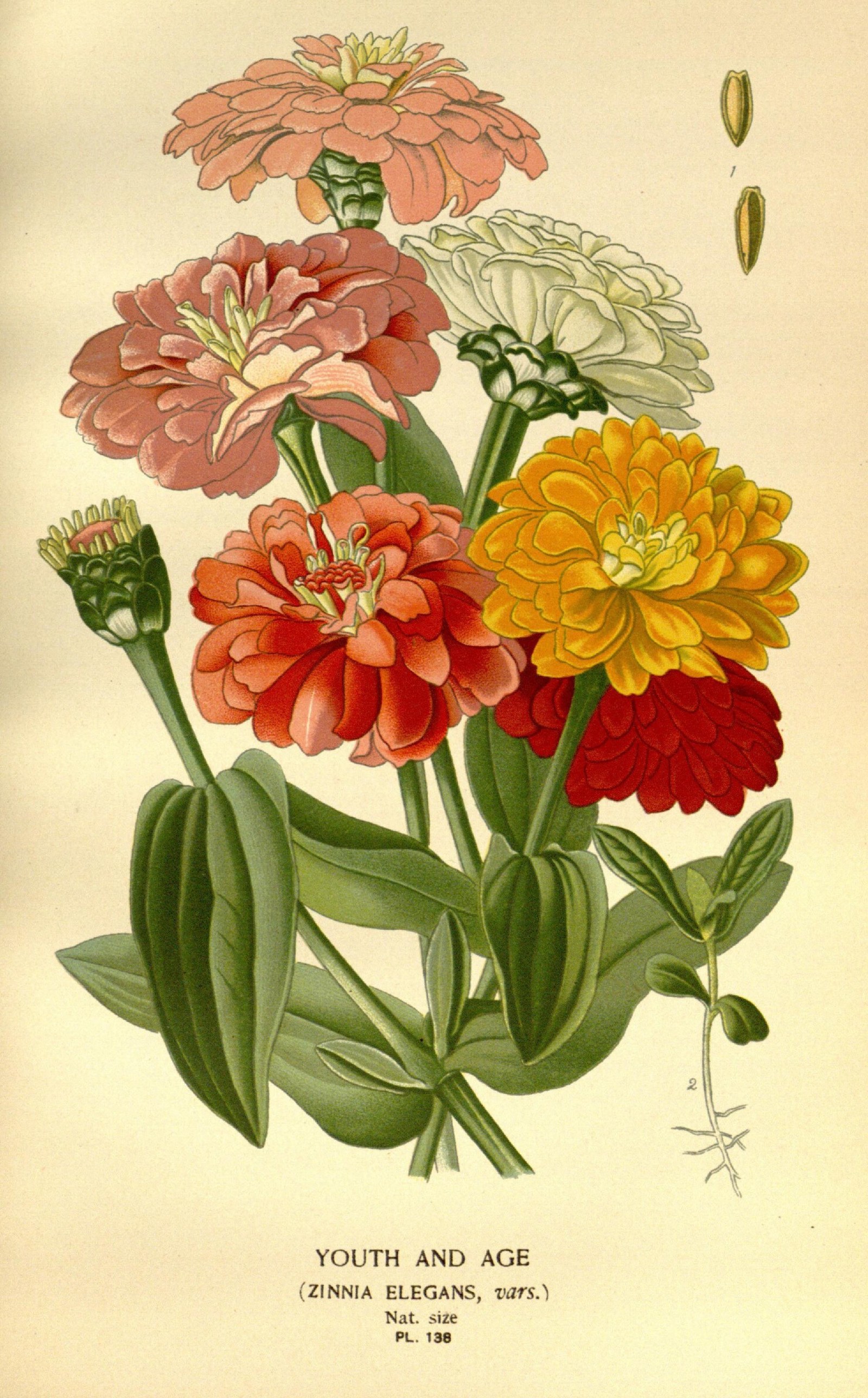
Zinnia elegans (published as Youth-and-age)
Zinnias in scarlet, rose, yellow and white, the Mexican annual the Aztecs thought ugly and the Victorians bred into the brightest flower of the summer border, drawn for Favourite Flowers.
- Published
- Plate 138, volume 2, 1896
- From
- Favourite Flowers of Garden and Greenhouse
- Drawn by
- Désiré Bois
- Technique
- Chromolithograph
- Family
- Asteraceae
- Native to
- Mexico
About the plant
The zinnia is a plant the Aztecs disliked. The wild species of the Mexican hills has small, dingy purple flowers, and the Nahuatl name meant something like an eyesore. Seed reached the botanic garden in Madrid in 1796, and Linnaeus had already named the genus for Johann Gottfried Zinn, a professor at Göttingen who had written the first full account of the anatomy of the eye, a coincidence the plant seems to have taken to heart. For fifty years it was a curiosity. Then French growers in the 1850s found doubles, and by the time Edward Step's Favourite Flowers appeared in 1896 the zinnia had become one of the brightest annuals in the garden, in scarlet, rose, orange, yellow and white, stiff-stemmed and stiff-petalled.
Its old English name, youth-and-age, describes the habit that makes it useful: the flowers last for weeks without fading, so that new ones open beside the old and the plant is never out of bloom from July to the frosts. It is also a plant for heat and drought, which suits it to the places it is grown most now. Bois drew a mixed group at natural size for the second volume, and in 2016 a zinnia became the first flower grown from seed to bloom in space.
Bought together
More in the archive