Désiré Bois del. · Frederick Warne & Co., London
Week of 29 July 2024
Ghent gladiolus
Part 5 of 6 in Flowers of the cottage garden
Gladiolus × gandavensis
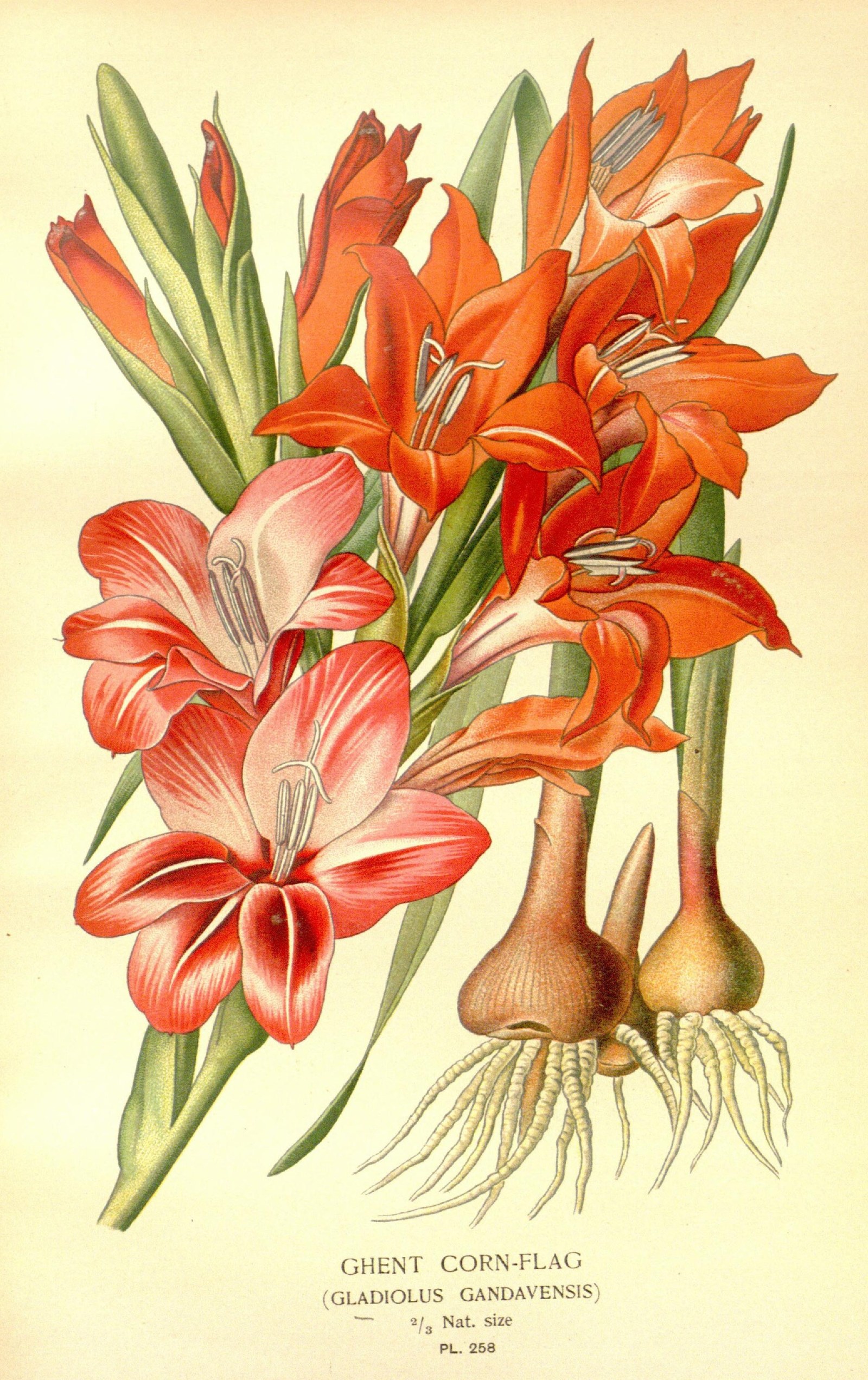
The Ghent gladiolus, the hybrid that turned a Cape wild flower into the sword lily of the Victorian border, drawn for Favourite Flowers at two-thirds natural size.
- Published
- Plate 258, volume 4, 1897
- From
- Favourite Flowers of Garden and Greenhouse
- Drawn by
- Désiré Bois
- Technique
- Chromolithograph
- Family
- Iridaceae
- Native to
- Of garden origin, raised in Belgium in 1837 from two South African species
About the plant
The wild gladioli of the Cape are small and elegant, and for a century after they reached Europe they were grown by connoisseurs in pots. The garden gladiolus, the tall sword of scarlet in the back of a Victorian border, is a made thing: in 1837 Hermann Beddinghaus, gardener to the Duc d'Arenberg at Enghien in Belgium, crossed the scarlet Gladiolus natalensis with the striped Gladiolus oppositiflorus and raised a plant that was bigger, stronger and brighter than either. Louis van Houtte of Ghent bought his stock and began selling it in 1841, and the hybrid took the Latin name of the city, gandavensis.
From it, by crossing with other Cape species, came the large-flowered gladioli of the 1890s in every colour but blue, which Edward Step's readers grew in rows in the kitchen garden for cutting, lifting the corms each autumn to store in the shed. Désiré Bois drew the Ghent gladiolus itself for the fourth volume of Favourite Flowers in 1897, a spike of scarlet flowers flushed with yellow at two-thirds natural size, the plant that started it all.