Désiré Bois del. · Frederick Warne & Co., London
Week of 5 August 2024
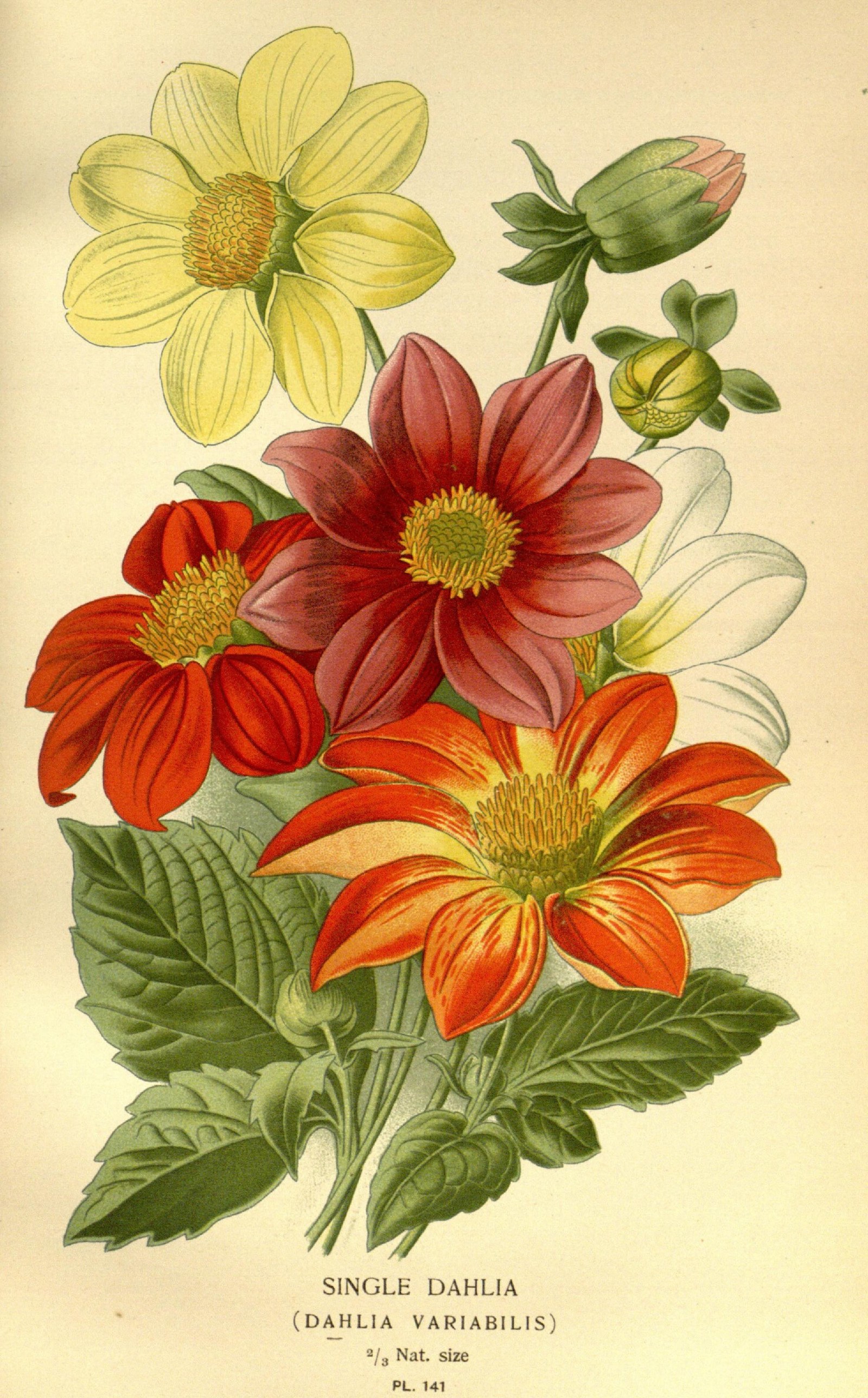
Single dahlia
Part 6 of 6 in Flowers of the cottage garden
Dahlia pinnata (published as Dahlia variabilis)
Single dahlias in scarlet, yellow and white, the Mexican mountain flower the Aztecs grew for its tubers, returned to fashion in the 1880s and drawn for Favourite Flowers.
- Published
- Plate 141, volume 2, 1896
- From
- Favourite Flowers of Garden and Greenhouse
- Drawn by
- Désiré Bois
- Technique
- Chromolithograph
- Family
- Asteraceae
- Native to
- The mountains of Mexico and Central America
About the plant
The dahlia grows wild on the mountains of Mexico, a tall plant with hollow stems and single daisy-like flowers in red or purple, and the Aztecs grew it long before the Spaniards came, as acocotli, the water-pipe plant, for its tubers and its stems. Seed reached the royal botanic garden in Madrid in 1789, and its director Antonio Cavanilles named the genus two years later for Anders Dahl, a pupil of Linnaeus. It was tried in Europe as a vegetable and found disgusting. Then the Empress Josephine grew it at Malmaison, the French and English nurserymen discovered how readily it varied from seed, and by 1830 there were dahlias by the thousand, doubled into balls and pompons and judged on the show bench with the same severity as tulips.
By the 1880s the show dahlia had become a stiff and formal thing, and gardeners who wanted flowers rather than specimens went back to the single dahlia, which the Victorians rediscovered as a cottage-garden plant and a cut flower. Edward Step's plate of 1896 shows single dahlias at two-thirds natural size, in scarlet, yellow and white, each a ring of broad rays around a disc of gold. Dahlias are tender: the tubers are lifted after the first frost blackens the leaves and stored dry until spring.
Bought together
More in the archive