Désiré Bois del. · Frederick Warne & Co., London
Week of 15 July 2024
Carnation
Part 3 of 6 in Flowers of the cottage garden
Dianthus caryophyllus
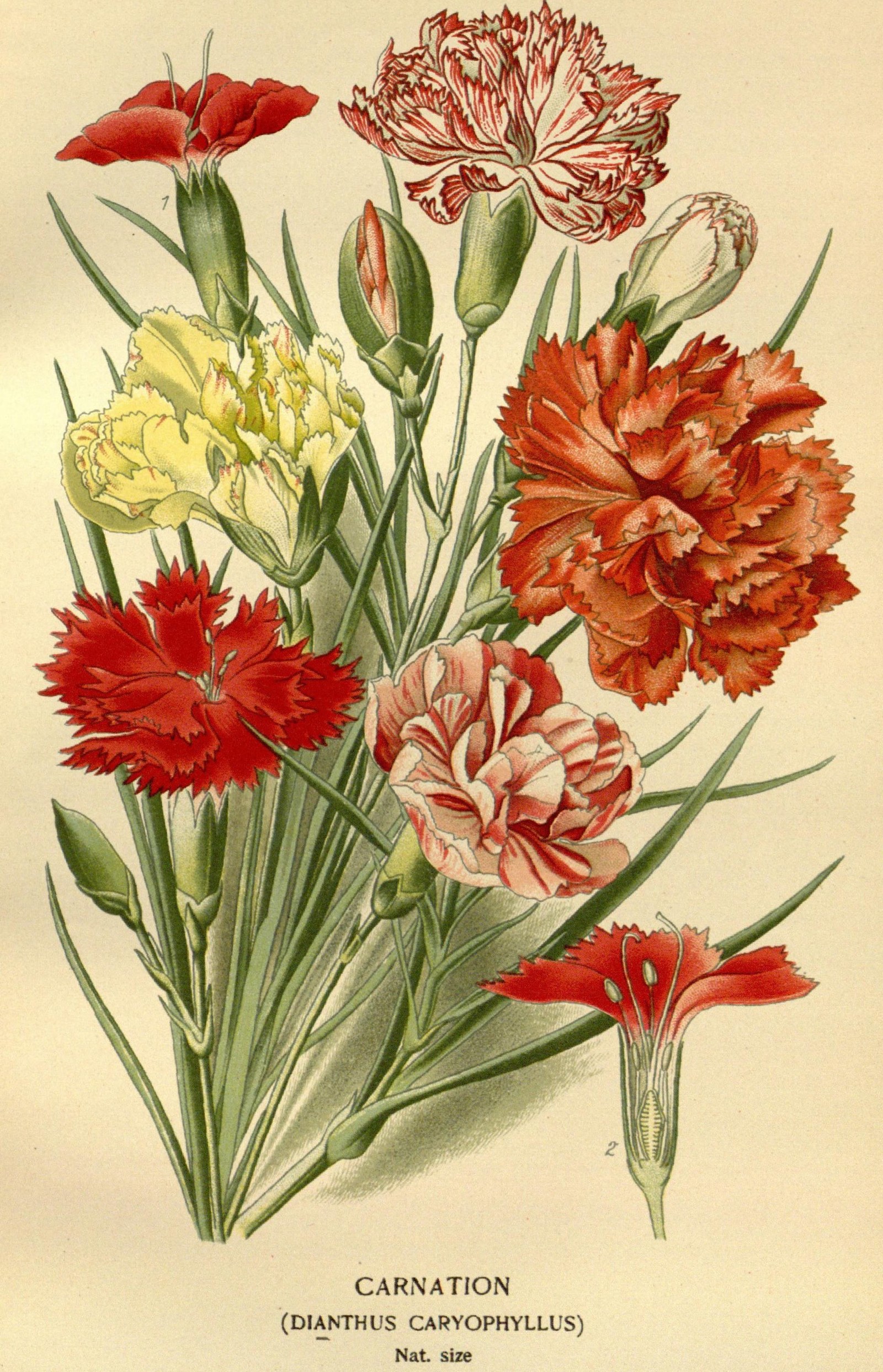
The clove-scented carnation, flower of Zeus and of the Tudor wine cup, in the red, yellow and striped border forms of the 1890s, drawn at natural size for Favourite Flowers.
- Published
- volume 1, 1896
- From
- Favourite Flowers of Garden and Greenhouse
- Drawn by
- Désiré Bois
- Technique
- Chromolithograph
- Family
- Caryophyllaceae
- Native to
- The Mediterranean; its wild home is uncertain, perhaps Greece or Sardinia
About the plant
The carnation has been in gardens so long that nobody is sure where it is wild. It is a Mediterranean plant, a single pink flower with a scent of cloves on a tuft of grey grass-like leaves, growing from rock and old walls, and the Greeks were cultivating it when Theophrastus wrote in the fourth century BC; he called it dianthos, the flower of Zeus. Caryophyllus is the clove, for the smell. In Tudor England it was the gillyflower, and its petals went into wine and ale as sops-in-wine; Perdita in The Winter's Tale refuses to grow the streaked gillyvors because their colour was man's work, not nature's.
That streaking is what the florists bred for. The weavers of Paisley raised the laced pinks of the 1790s, and the florists' societies of the nineteenth century bred the carnation into flakes, bizarres and picotees, striped and edged in two or three colours, judged on the smoothness of the petal edge and the purity of the markings. Step's plate shows the border carnations the ordinary gardener grew in 1896, a scarlet self, a yellow and a striped bizarre at natural size. The perpetual-flowering carnations of the florist's shop, bred in France and America for the cut-flower trade, were only just beginning.
Bought together
More in the archive