Désiré Bois del. · Frederick Warne & Co., London
Week of 8 July 2024
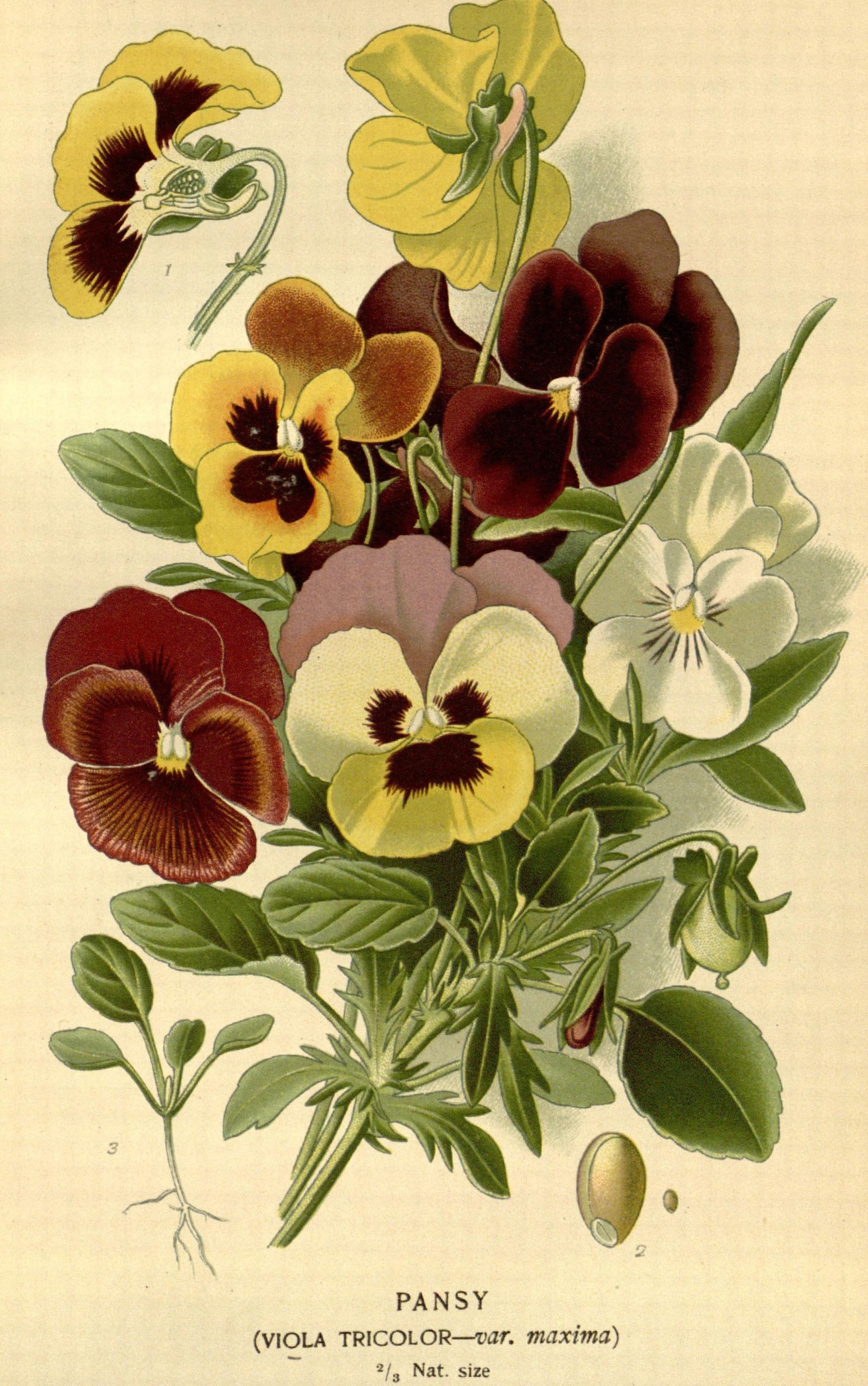
Pansy
Part 2 of 6 in Flowers of the cottage garden
Viola × wittrockiana (published as Viola tricolor var. maxima)
The show pansies of the 1890s, round, flat and blotched like faces, bred within living memory from the little wild heartsease, drawn at natural size for Favourite Flowers of Garden and Greenhouse.
- Published
- volume 1, 1896
- From
- Favourite Flowers of Garden and Greenhouse
- Drawn by
- Désiré Bois
- Technique
- Chromolithograph
- Family
- Violaceae
- Native to
- Of garden origin, bred in England from the wild heartsease in the 1810s and 1820s
About the plant
The pansy is one of the few garden flowers whose invention can be dated. The wild heartsease, Viola tricolor, is a weed of cornfields across Europe with small flowers of purple, white and yellow, pencilled with dark lines; it was Shakespeare's love-in-idleness. Around 1813 Lady Mary Bennet began collecting its forms in her garden at Walton-on-Thames, and her gardener William Richardson crossed them, while at Iver Lord Gambier's gardener William Thompson did the same with the mountain pansy and a yellow violet from the Altai. By 1830 they had flowers an inch across in solid colours. In 1839 Thompson found a seedling with a dark blotch on each petal instead of lines, and the pansy acquired its face.
From there the florists took over, the working men's societies that judged auriculas, tulips and pinks on points, and bred the show pansy to be perfectly round, flat and smooth-edged, with a blotch of exact proportions, and the fancy pansy with bigger, blotchier, more lavish flowers. Step's plate of 1896 shows both at natural size. Désiré Bois drew the 316 plates of Favourite Flowers from living plants in France for a book written in London, and they were printed in colour by chromolithography, the process that put cheap colour into every late-Victorian home.
Bought together
More in the archive