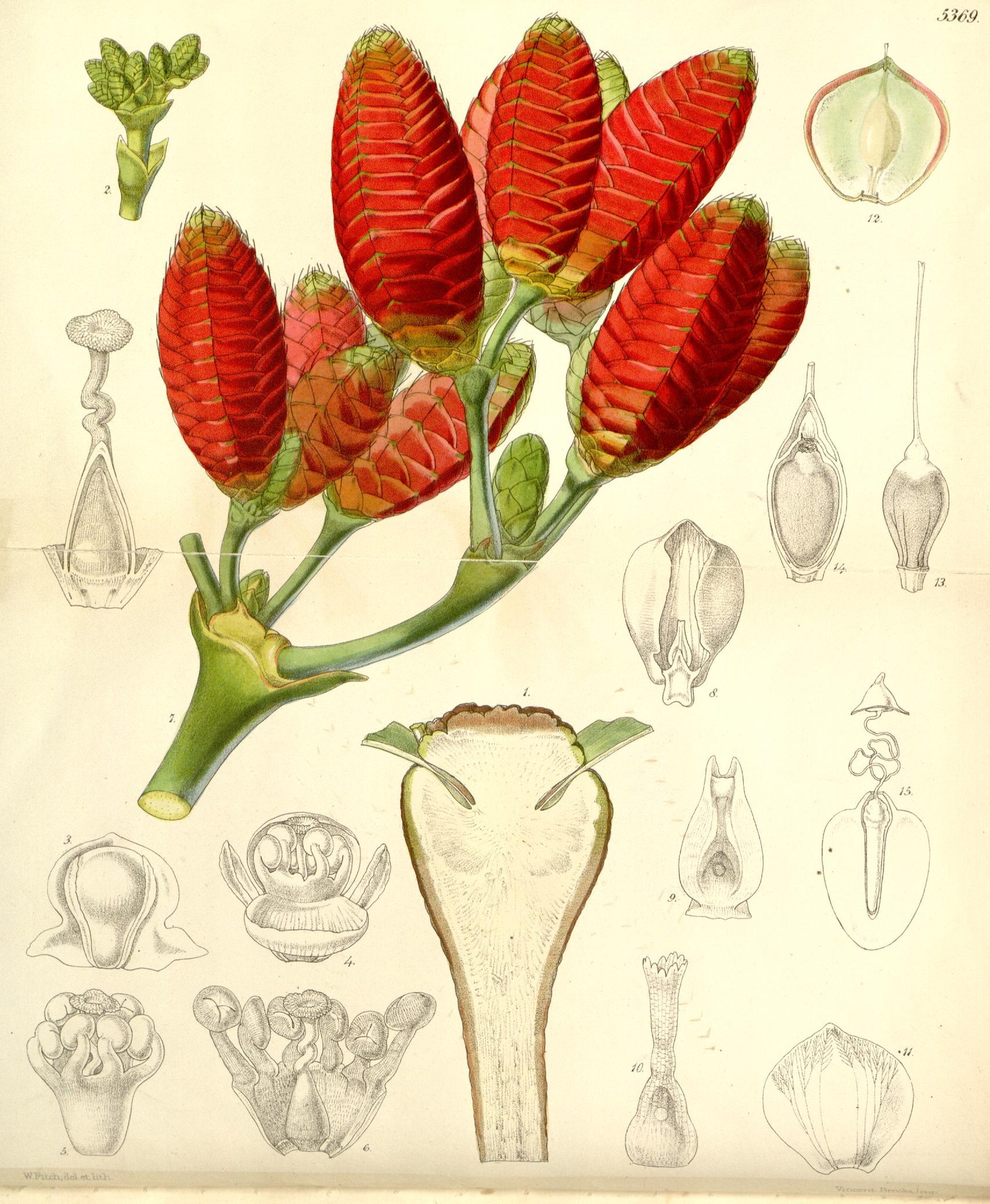
Walter Hood Fitch del. et lith. · Vincent Brooks, Day & Son · L. Reeve & Co., London
Week of 10 November 2025
Welwitschia
Part 2 of 6 in Desert plants and living fossils
Welwitschia mirabilis
The desert plant that grows only two leaves in a life that can last a thousand years, drawn by Walter Hood Fitch when it first astonished Kew in 1863.
- Published
- Plate 5369, volume 89, 1863
- From
- Curtis's Botanical Magazine
- Drawn by
- Walter Hood Fitch
- Lithograph
- Walter Hood Fitch
- Technique
- Hand-coloured lithograph
- Family
- Welwitschiaceae
- Native to
- Namib Desert, Namibia and Angola
About the plant
In September 1859 the Austrian botanist Friedrich Welwitsch, exploring the desert south of Moçâmedes in Angola, came upon something he could not place: a stump like a sawn-off tree, a metre across, with two enormous ragged leaves sprawling over the sand. He is said to have knelt and simply stared at it. Welwitschia mirabilis turned out to be one of the strangest plants on Earth: a gymnosperm, a relative of conifers and the joint-pines, that keeps the two leaves of its seedling for life and never makes another, each leaf growing from its base like a conveyor belt while the tip frays away in the wind.
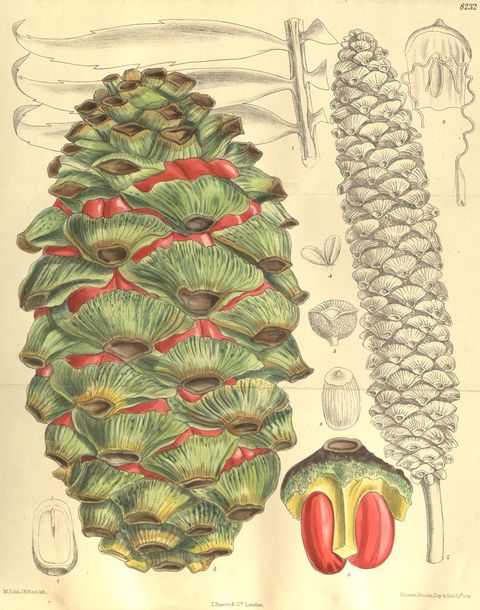
It lives only in the Namib, where rain may not fall for years and the plant depends on fog rolling in from the cold Atlantic. Carbon dating has put some individuals at well over a thousand years old. Male and female plants are separate and carry small cones, pollinated by insects drawn to the drops of 'nectar' they secrete.
Joseph Hooker described the species in 1863 and devoted a long paper and this plate to it, drawn by Walter Hood Fitch from material sent to Kew. Hooker called it, without exaggeration, the most wonderful plant ever brought to this country.
Bought together
More in the archive