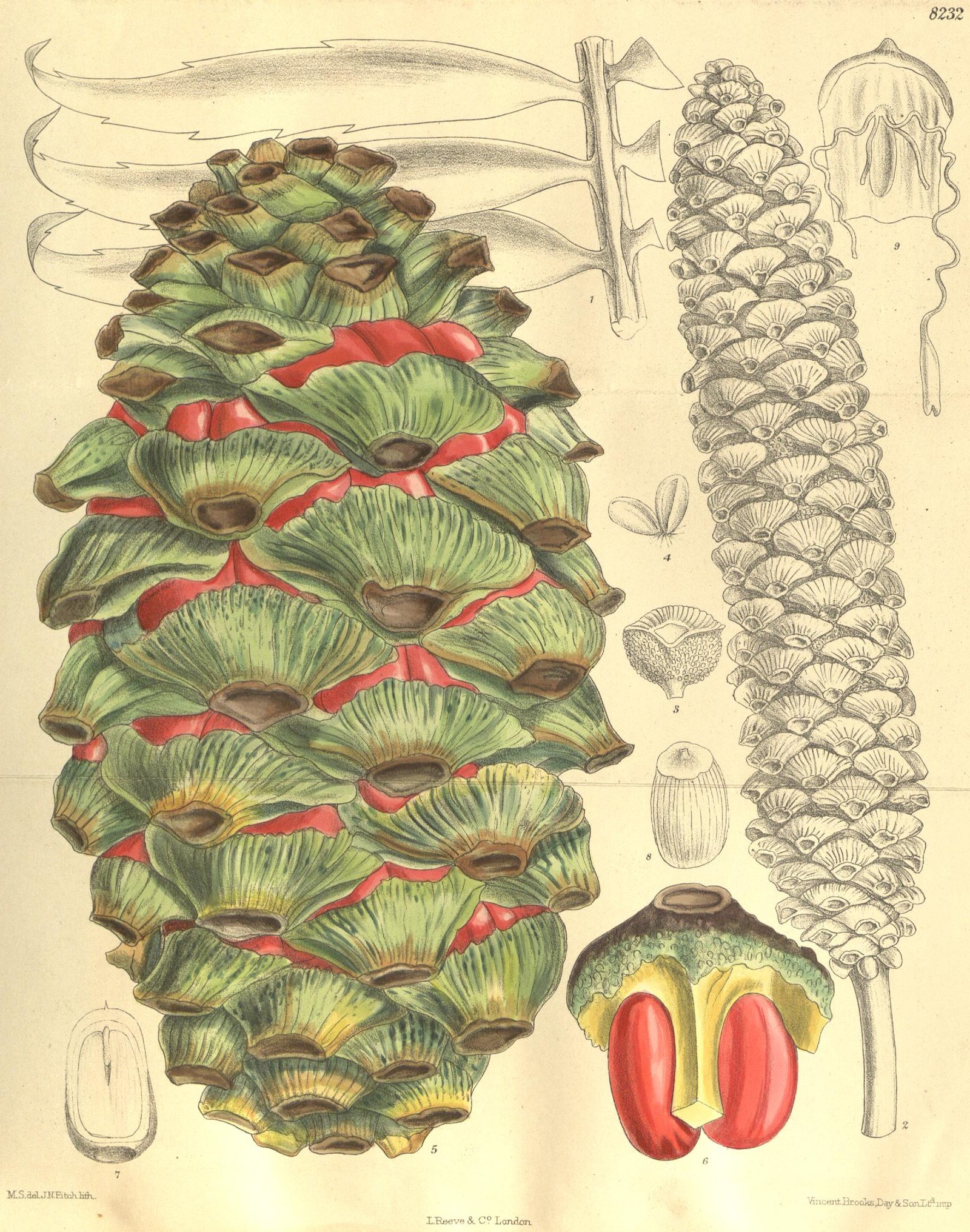
Matilda Smith del. · John Nugent Fitch lith. · Vincent Brooks, Day & Son Ltd · L. Reeve & Co., London
Week of 8 December 2025
Barter's cycad
Part 6 of 6 in Desert plants and living fossils
Encephalartos barteri
A savanna cycad from West Africa, a survivor from the age of the dinosaurs that hides its stem underground to live through grass fires.
- Published
- Plate 8232, volume 135, 1909
- From
- Curtis's Botanical Magazine
- Drawn by
- Matilda Smith
- Lithograph
- John Nugent Fitch
- Technique
- Hand-coloured lithograph
- Family
- Zamiaceae
- Native to
- West African savanna: Nigeria, Benin, Togo and Ghana
About the plant
Cycads look like palms and are nothing of the kind. They are gymnosperms, relatives of conifers that dominated the forests of the Jurassic, and the fossil record shows plants almost identical to this one being browsed by dinosaurs. Encephalartos barteri grows on the savannas of West Africa, from Nigeria to Ghana, and copes with the yearly grass fires by keeping most of its trunk underground; after a burn, a new flush of stiff, glossy, pinnate leaves comes up from the ashes.
Charles Barter, a young gardener from Kew, collected it as botanist to the Niger Expedition of 1857 led by William Baikie. He died on the river two years later, and the plant was named in his memory. The genus name means 'bread in the head': across Africa the starchy pith of cycad trunks has been eaten in famine years, but only after days of soaking to leach out toxins that otherwise cause liver damage and paralysis.
Separate male and female plants carry cones, and the female cones break up into seeds coated in red flesh that baboons and hornbills carry away. Every cycad is now protected by CITES because collectors have stripped so many wild colonies.
Bought together
More in the archive