Matilda Smith del. · John Nugent Fitch lith. · Vincent Brooks, Day & Son Ltd · L. Reeve & Co., London
Week of 1 December 2025
Mountain aloe
Part 5 of 6 in Desert plants and living fossils
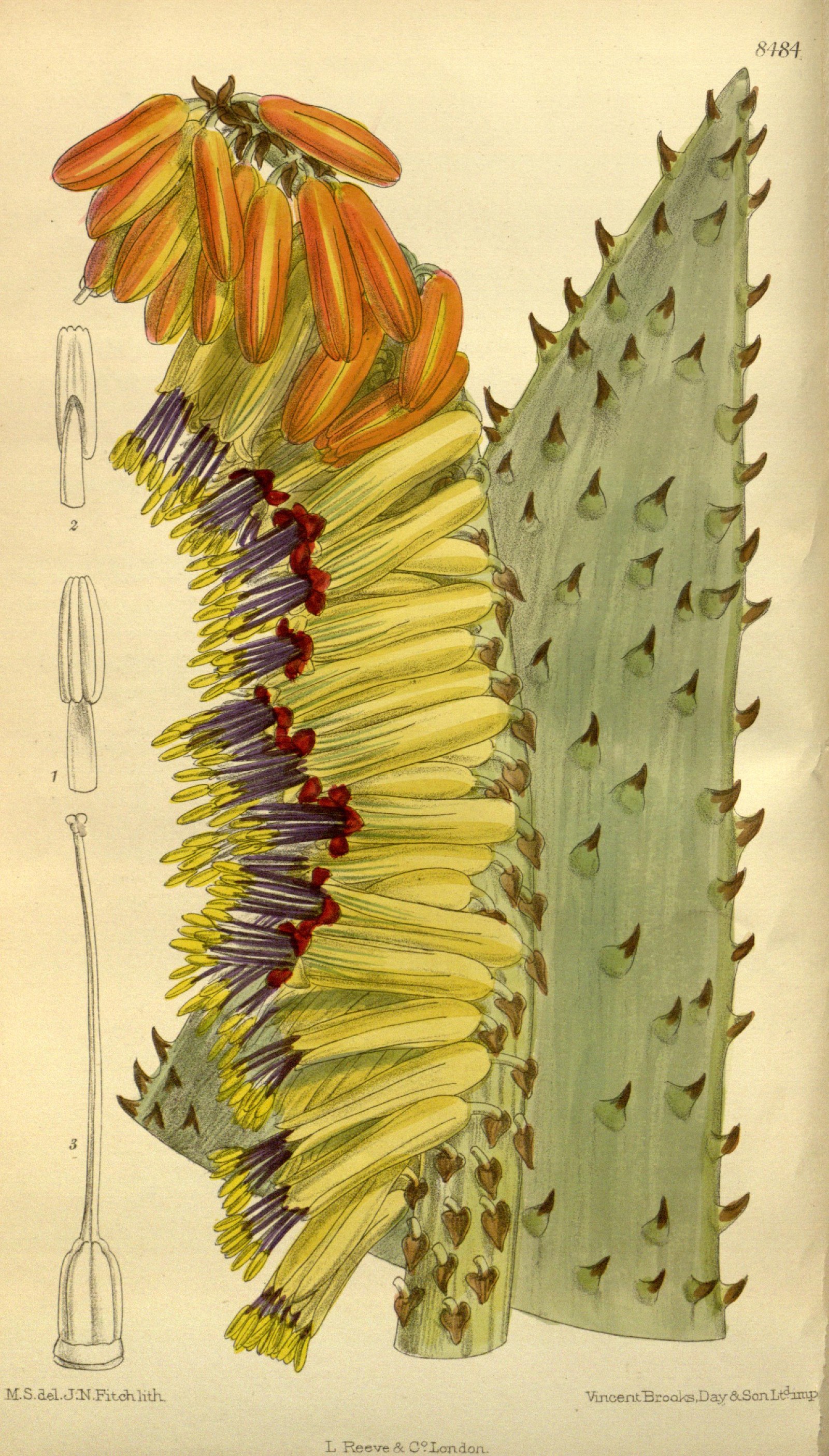
Aloe marlothii
A single-stemmed tree aloe of the southern African bushveld, armoured with spines and crowned in winter by a candelabra of orange flowers that feed the sunbirds.
- Published
- Plate 8484, volume 139, 1913
- From
- Curtis's Botanical Magazine
- Drawn by
- Matilda Smith
- Lithograph
- John Nugent Fitch
- Technique
- Hand-coloured lithograph
- Family
- Asphodelaceae
- Native to
- South Africa, Botswana, Eswatini and Mozambique
About the plant
Across the bushveld of what are now Limpopo and Mpumalanga, the mountain aloe stands on rocky hillsides like a sentry: one stout trunk wrapped in a thatch of its own dead leaves, a rosette of spine-studded blue-grey blades on top, and in the dry southern winter a great branched candelabra of orange flowers held almost horizontally. For sunbirds, bees and even monkeys it is a lifeline in the leanest months, and whole hillsides hum with them.
Rudolf Marloth, a Cape Town pharmacist who spent his weekends and holidays botanising, collected it and Alwin Berger named it for him in 1905. Marloth went on to write the six-volume Flora of South Africa. The leaves are armed on both surfaces, not just the margins, which makes this one of the least approachable of aloes and one of the best at keeping browsing animals off. Traditional healers use the leaf sap for wounds and stomach complaints.
The plate was drawn at Kew in 1913 from a plant grown under glass; in the Temperate House aloes flower in January, the mirror image of their home season.
Bought together
More in the archive