Matilda Smith del. · John Nugent Fitch lith. · Vincent Brooks, Day & Son Ltd · L. Reeve & Co., London
Week of 28 September 2026
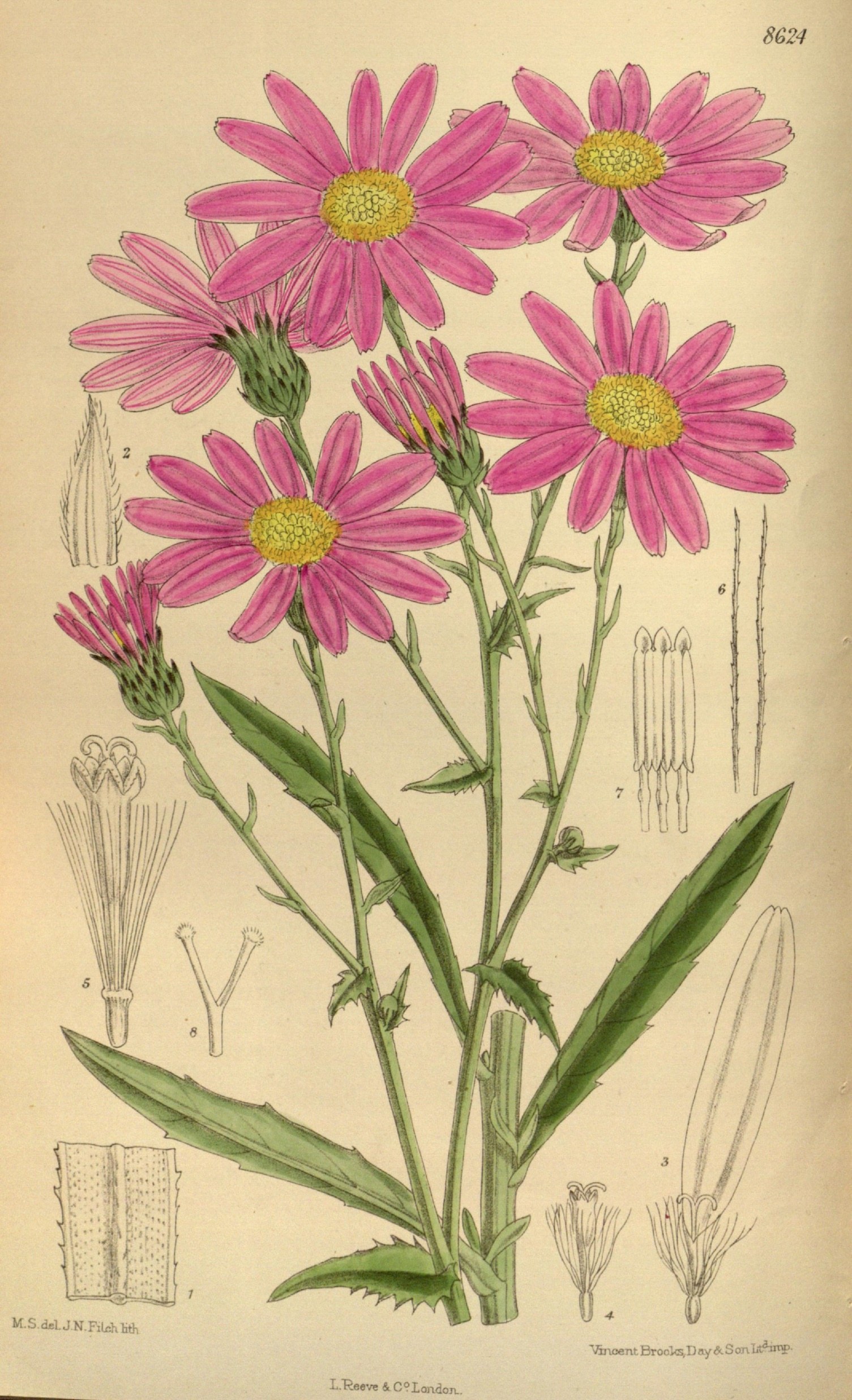
Pink ragwort
Part 5 of 6 in Daisies, primulas and the odd ones out
Senecio glastifolius
A South African daisy of startling pink, drawn at Kew in 1915, and today a familiar escapee on the Isles of Scilly.
- Published
- Plate 8624, volume 141, 1915
- From
- Curtis's Botanical Magazine
- Drawn by
- Matilda Smith
- Lithograph
- John Nugent Fitch
- Technique
- Hand-coloured lithograph
- Family
- Asteraceae
- Native to
- The Cape, South Africa
About the plant
Senecio glastifolius is a shrubby, short-lived perennial of the daisy family from the Cape of South Africa, where it grows on sandy ground and in fynbos along the southern coast. Linnaeus's son described it in 1782; glastifolius means 'woad-leaved', for the toothed, slightly clasping leaves that resemble those of the dye plant woad.
Everything about it is generous. It shoots up to a metre or more in a season and covers itself in spring and early summer with loose heads of daisies, the rays a clear mauve-pink around a yellow disc. The seed is carried on the wind, and the plant self-sows so freely that it has become naturalised far from home: most famously on the Isles of Scilly, where it is known simply as pink ragwort, and in New Zealand and Western Australia, where it is treated as an invasive weed.
In a British garden it is best thought of as a biennial for a sunny, well-drained spot, raised from seed and allowed to seed itself. Plate 8624 was published in 1915.
Bought together
More in the archive