Matilda Smith del. · John Nugent Fitch lith. · Vincent Brooks, Day & Son Ltd · L. Reeve & Co., London
Week of 31 August 2026
Miyabe's candelabra primula
Part 1 of 6 in Daisies, primulas and the odd ones out
Primula miyabeana
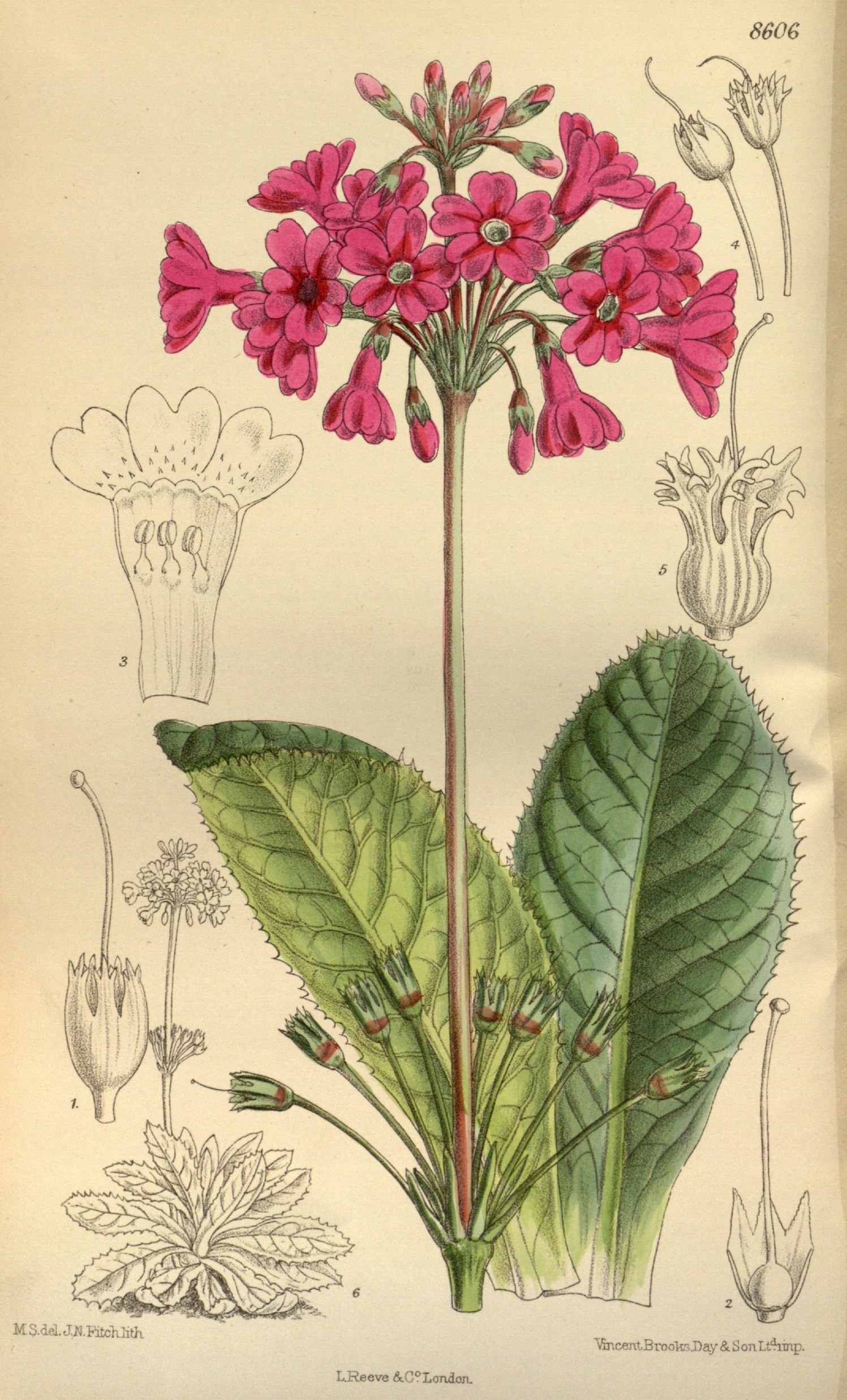
A candelabra primula from the high mountains of Taiwan, its magenta flowers stacked in tiers up a tall, leafless stem.
- Published
- Plate 8606, volume 141, 1915
- From
- Curtis's Botanical Magazine
- Drawn by
- Matilda Smith
- Lithograph
- John Nugent Fitch
- Technique
- Hand-coloured lithograph
- Family
- Primulaceae
- Native to
- Mountains of Taiwan
About the plant
Primula miyabeana is one of the candelabra primulas, the group whose flowers are arranged in several whorls, one above another, on a tall leafless stem. This one is found only on the island of Taiwan (Formosa, when the plate was made), where it grows beside streams and in wet alpine meadows high in the central mountains.
It was described in 1906 by the Japanese botanists Tokutarō Itō and Takiya Kawakami and named in honour of Kingo Miyabe, the professor of botany at Sapporo who did much to catalogue the flora of Japan's northern islands. The flowers are a deep rose-magenta with a small yellow eye, opening in early summer over a rosette of broad, finely toothed leaves.
In the garden it behaves like its better-known Chinese relatives Primula japonica and Primula pulverulenta: it wants damp, humus-rich soil and a little shade, and will seed itself about in a bog garden. Plate 8606 was published in 1915, drawn by Matilda Smith from a plant flowering at Kew.
Bought together
More in the archive