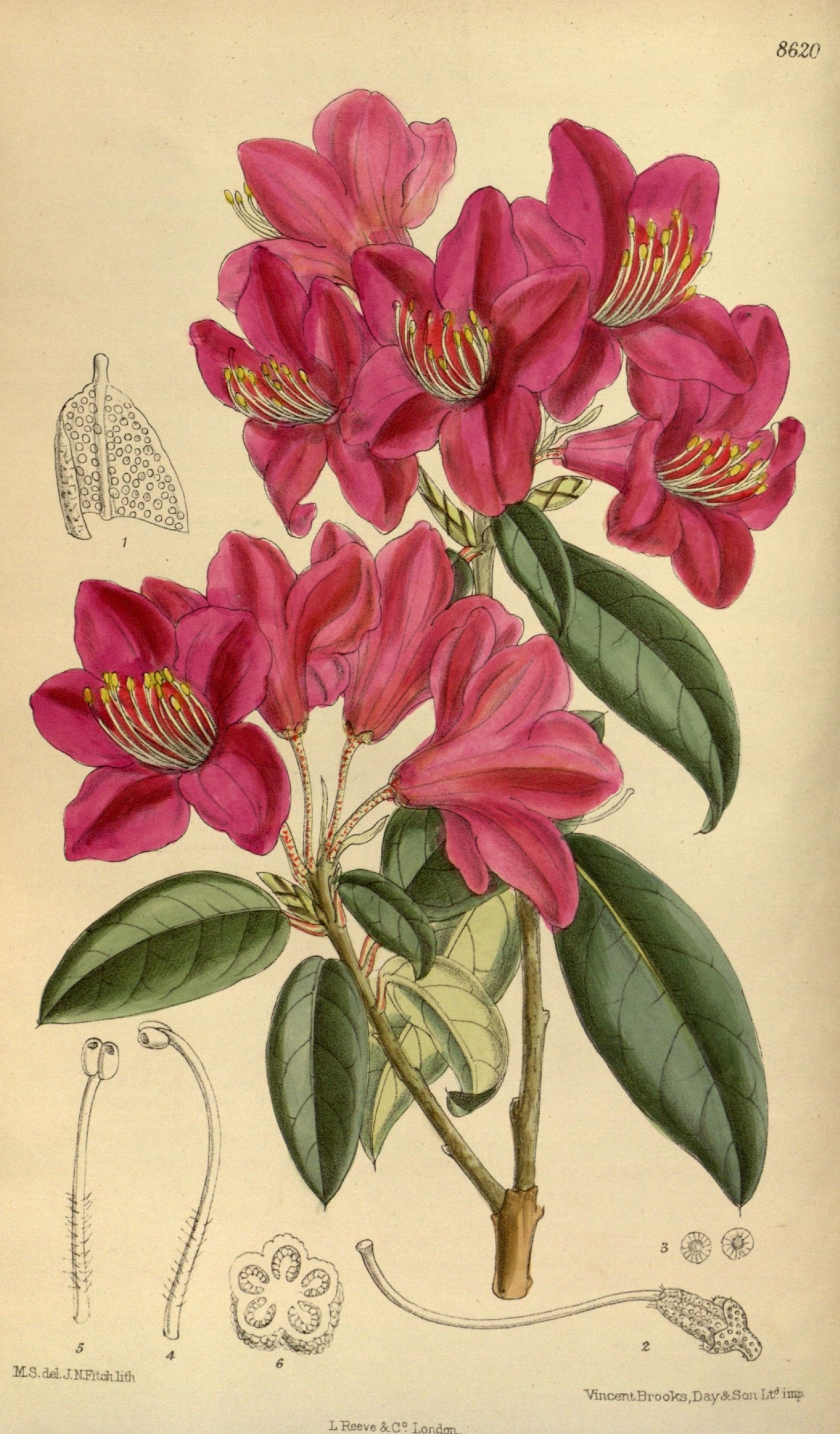
Matilda Smith del. · John Nugent Fitch lith. · Vincent Brooks, Day & Son Ltd · L. Reeve & Co., London
Week of 20 April 2026
Neat rhododendron
Part 7 of 7 in Rhododendrons and magnolias of the Himalaya
Rhododendron concinnum
A compact, scaly-leaved rhododendron from the mountains of western China, its magenta-purple trusses a legacy of the great plant hunters.
- Published
- Plate 8620, volume 141, 1915
- From
- Curtis's Botanical Magazine
- Drawn by
- Matilda Smith
- Lithograph
- John Nugent Fitch
- Technique
- Hand-coloured lithograph
- Family
- Ericaceae
- Native to
- Mountains of western China
About the plant
Rhododendron concinnum, whose name means 'neat' or 'elegant', is a compact evergreen shrub from the mountains of western China. It grows in woods and thickets in Sichuan, Hubei, Shaanxi and Yunnan at altitudes between about 2,300 and 3,800 metres, and was first described by William Botting Hemsley at Kew in 1889 from specimens collected by Augustine Henry.
It belongs to the scaly-leaved, or lepidote, rhododendrons: the undersides of the small leaves are dotted with glandular scales that give the foliage a faint aromatic scent. The funnel-shaped flowers appear in April and May, in clusters of two to five, in shades from rosy purple to the deep magenta shown here, often freckled with darker spots on the upper lobes.
Seed sent home from western Sichuan by Ernest 'Chinese' Wilson in the early 1900s brought it into cultivation, and it has proved one of the hardiest and easiest of the Chinese species in British gardens. Plate 8620 appeared in 1915.
Bought together
More in the archive