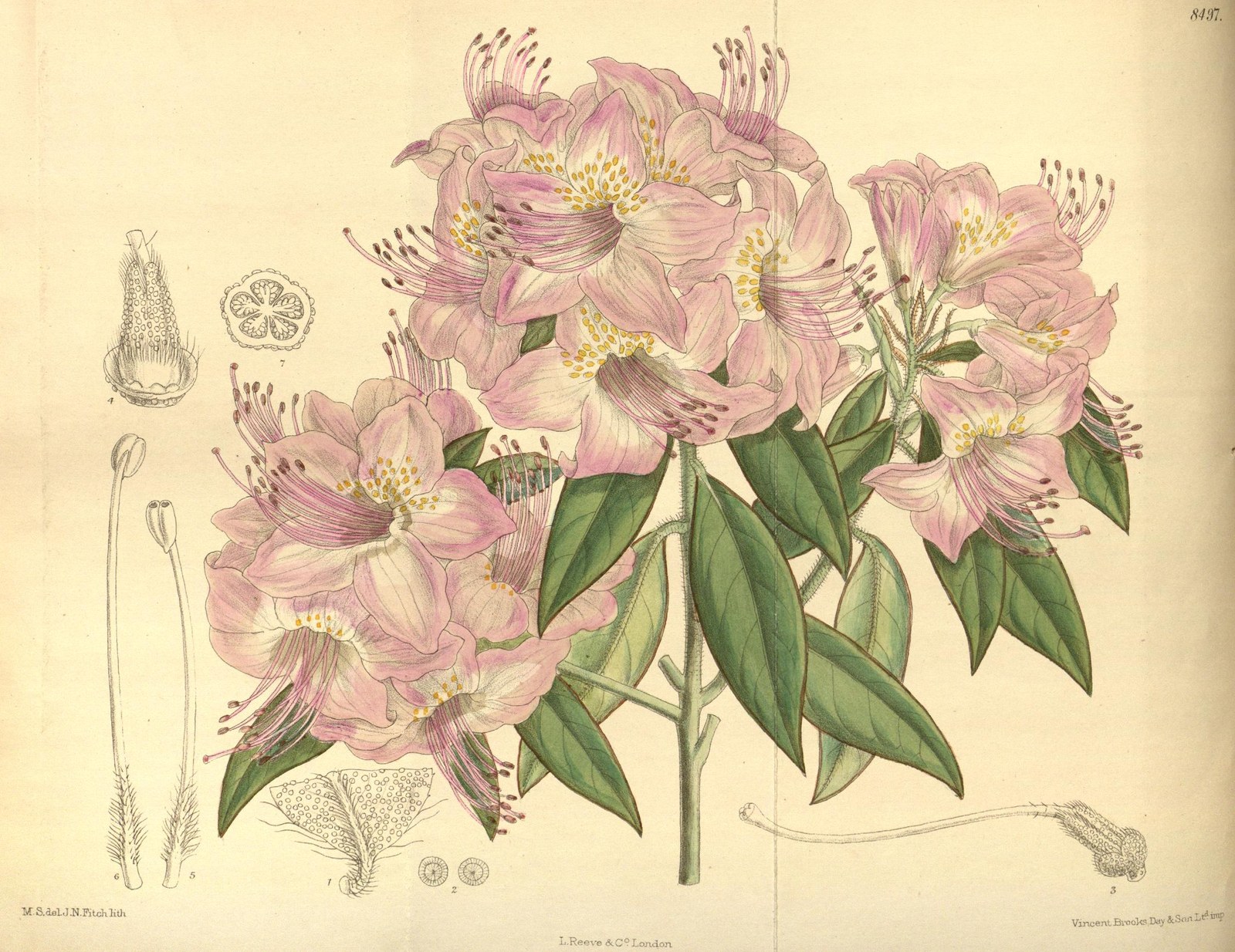
Matilda Smith del. · John Nugent Fitch lith. · Vincent Brooks, Day & Son Ltd · L. Reeve & Co., London
Week of 13 April 2026
Augustine's rhododendron
Part 6 of 7 in Rhododendrons and magnolias of the Himalaya
Rhododendron augustinii
The nearest thing to a blue rhododendron, named for the Irish customs officer Augustine Henry who found it in the hills of Hubei.
- Published
- Plate 8497, volume 139, 1913
- From
- Curtis's Botanical Magazine
- Drawn by
- Matilda Smith
- Lithograph
- John Nugent Fitch
- Technique
- Hand-coloured lithograph
- Family
- Ericaceae
- Native to
- Hubei, Sichuan and Yunnan, China
About the plant
Rhododendrons come in every colour but blue, or nearly: a handful of Chinese species flower in lavender and mauve, and the best of them, Rhododendron augustinii, in a clear sky blue that stops visitors to a spring garden in their tracks. It makes an upright, airy shrub to five metres, with narrow aromatic leaves, and in April and May every shoot ends in a cluster of wide, flat flowers freckled with green in the throat.
Augustine Henry, an Irish doctor who joined the Chinese Imperial Maritime Customs and found himself with time on his hands in the Yangtze port of Yichang, began collecting plants in the hills to pass it. He sent 158,000 specimens to Kew, including this one, and William Hemsley named it for him in 1889. Ten years later Ernest Wilson, sent to China by the Veitch nursery with Henry's advice in his pocket, brought back the seed from which the garden plant descends. Breeders crossed it with other species to make the blue hybrids of the twentieth century.
Matilda Smith drew this plate in 1913 from a plant raised from Wilson's seed and flowering at Kew.
Bought together
More in the archive