Matilda Smith del. · John Nugent Fitch lith. · Vincent Brooks, Day & Son Ltd · L. Reeve & Co., London
Week of 1 June 2026
Maltese rock-centaury
Part 6 of 6 in Flowering shrubs
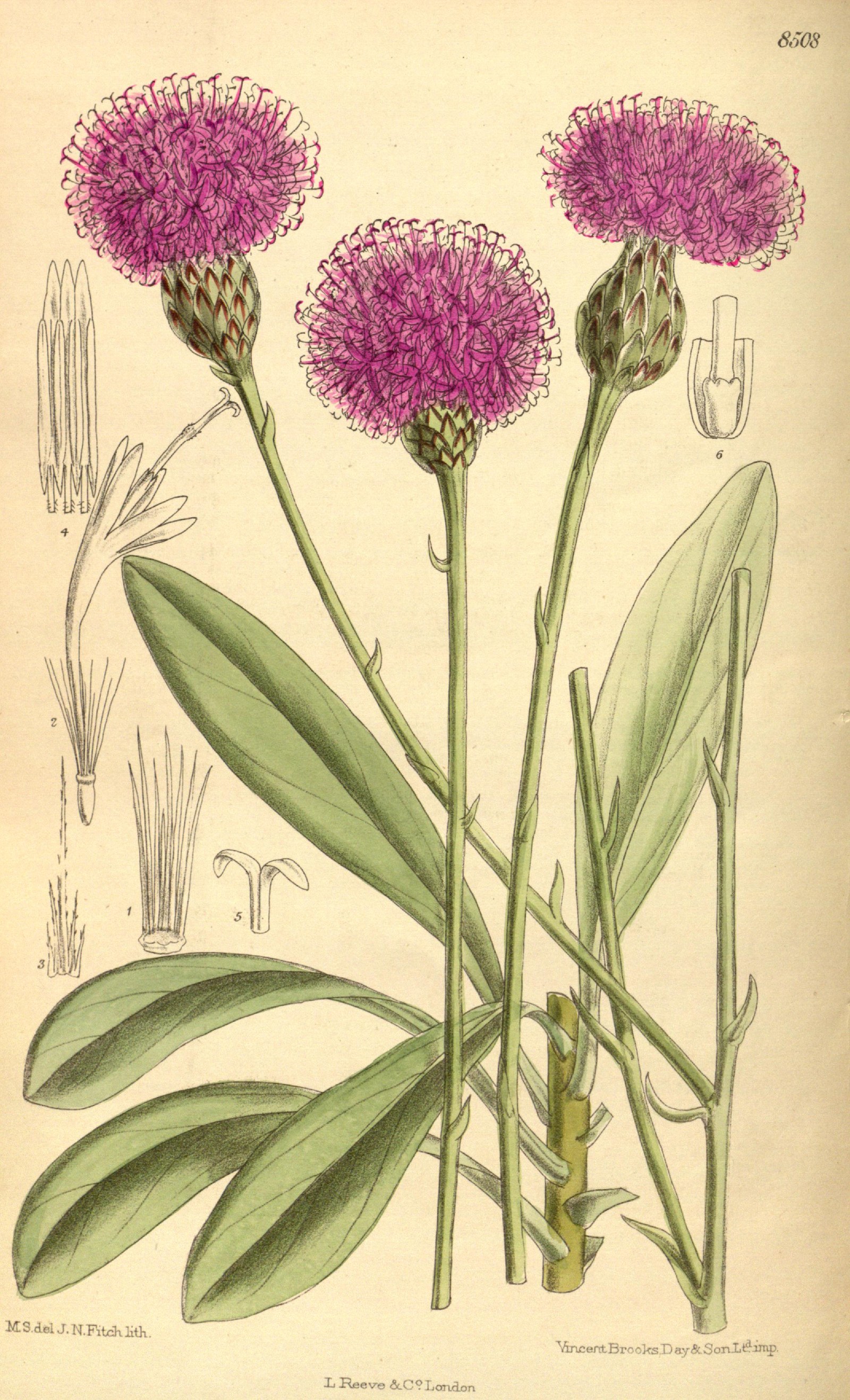
Cheirolophus crassifolius (published as Centaurea crassifolia)
The national plant of Malta, a woody knapweed with fleshy leaves that grows nowhere on Earth but the limestone sea cliffs of Malta and Gozo.
- Published
- Plate 8508, volume 139, 1913
- From
- Curtis's Botanical Magazine
- Drawn by
- Matilda Smith
- Lithograph
- John Nugent Fitch
- Technique
- Hand-coloured lithograph
- Family
- Asteraceae
- Native to
- Sea cliffs of Malta and Gozo
About the plant
On the limestone sea cliffs of Malta and Gozo, in the zone where salt spray keeps most plants away, grows a shrub that exists nowhere else: a knapweed that has turned woody, with fleshy, spoon-shaped leaves clustered at the ends of the branches and, in early summer, heads of pink-purple florets like a cornflower's. The Maltese call it widnet il-baħar, 'the ear of the sea', and it has been the islands' national plant since 1971.
It is a relic. Its closest relatives are in the Canary Islands and the mountains of Morocco, and botanists read it as a survivor of a flora that covered the Mediterranean shores before the ice ages, now stranded on a few headlands. Perhaps a few thousand plants remain, on ledges that only climbers can reach, and the species is strictly protected; the University of Malta has been raising it from seed to plant back onto the cliffs. Botanists have moved it from Centaurea into the small genus Cheirolophus.
The plate was drawn by Matilda Smith in 1913 from plants raised at Kew from Maltese seed, in the days when the islands were a British naval base and their botany was studied by naval surgeons.
Bought together
More in the archive