Matilda Smith del. · John Nugent Fitch lith. · Vincent Brooks, Day & Son Ltd · L. Reeve & Co., London
Week of 11 May 2026
Fuchsia grevillea
Part 3 of 6 in Flowering shrubs
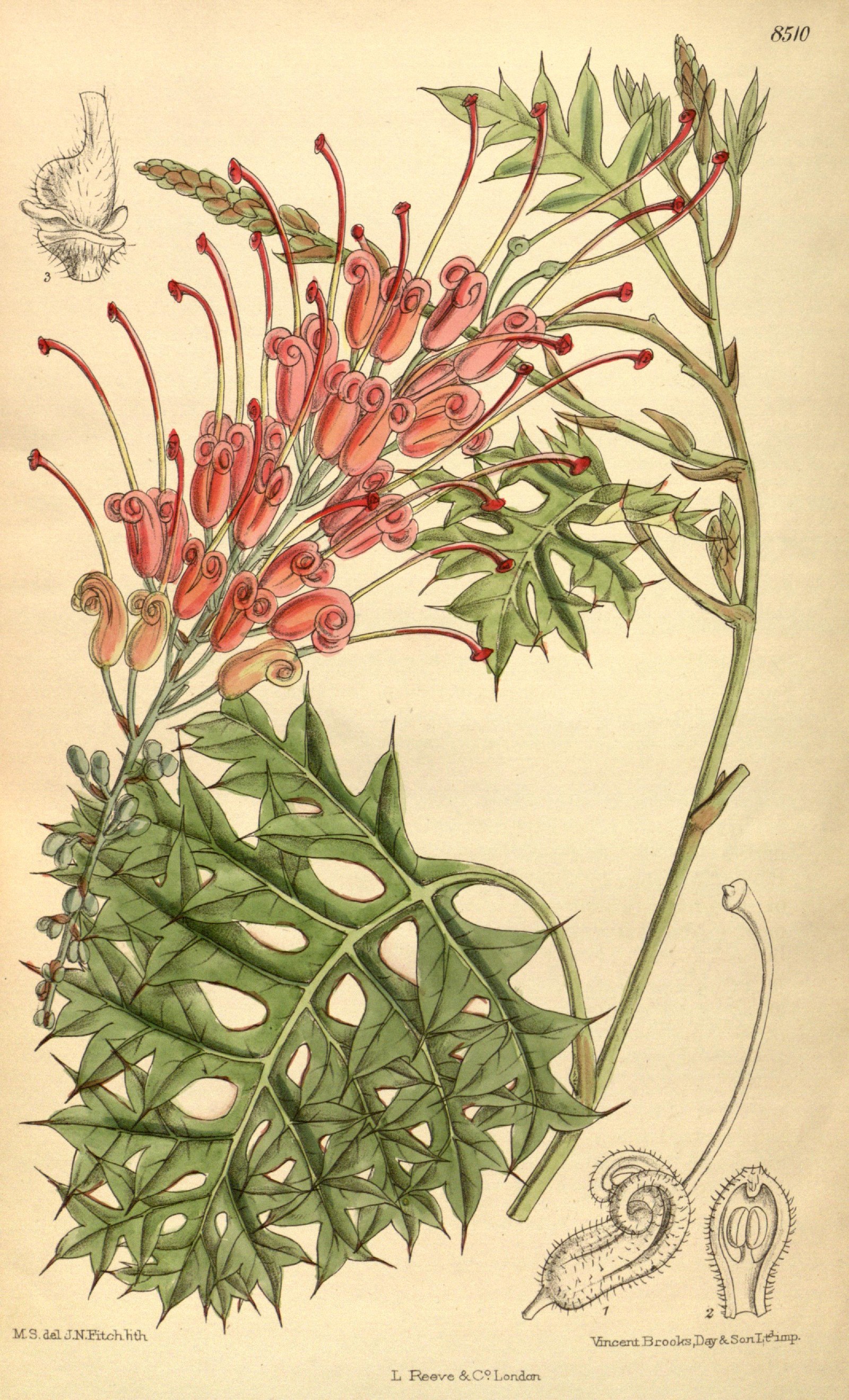
Grevillea bipinnatifida
A low Western Australian shrub with prickly, twice-divided leaves and hanging red toothbrush flowers, parent of the most-planted grevillea in the world.
- Published
- Plate 8510, volume 139, 1913
- From
- Curtis's Botanical Magazine
- Drawn by
- Matilda Smith
- Lithograph
- John Nugent Fitch
- Technique
- Hand-coloured lithograph
- Family
- Proteaceae
- Native to
- Darling Range, south-western Western Australia
About the plant
Grevilleas are the honeyeaters' plants. Across Australia their flowers, which have no petals but long styles curled like springs, are packed into brushes that drip with nectar, and the birds that feed on them carry pollen on their foreheads from bush to bush. Grevillea bipinnatifida is a low, spreading shrub of the jarrah forests east of Perth, with leaves cut twice over into prickly lobes and flowers that hang beneath them in red brushes, like a toothbrush dipped in raspberry, for much of the year.
It was named by Robert Brown, the botanist of Flinders's voyage, in 1830, and the genus honours Charles Francis Greville, a founder of what became the Royal Horticultural Society and a patron of the plant hunters of the 1800s. In the 1960s an Australian nurseryman crossed it with the Queensland Grevillea banksii and raised 'Robyn Gordon', which flowers every day of the year and is now planted by the million from Sydney to San Diego.
This plate, by Matilda Smith in 1913, was drawn from a plant in the Temperate House at Kew, where Western Australian shrubs have been grown since the colony's first collectors sent seed in the 1830s.
Bought together
More in the archive