Matilda Smith del. · John Nugent Fitch lith. · Vincent Brooks, Day & Son Ltd · L. Reeve & Co., London
Week of 6 April 2026
Delavay's magnolia
Part 5 of 7 in Rhododendrons and magnolias of the Himalaya
Magnolia delavayi
An evergreen magnolia from Yunnan with the largest leaves of any hardy evergreen in Britain and creamy bowl flowers that open at dusk and last two nights.
- Published
- Plate 8282, volume 135, 1909
- From
- Curtis's Botanical Magazine
- Drawn by
- Matilda Smith
- Lithograph
- John Nugent Fitch
- Technique
- Hand-coloured lithograph
- Family
- Magnoliaceae
- Native to
- Yunnan, Sichuan and Guizhou, China
About the plant
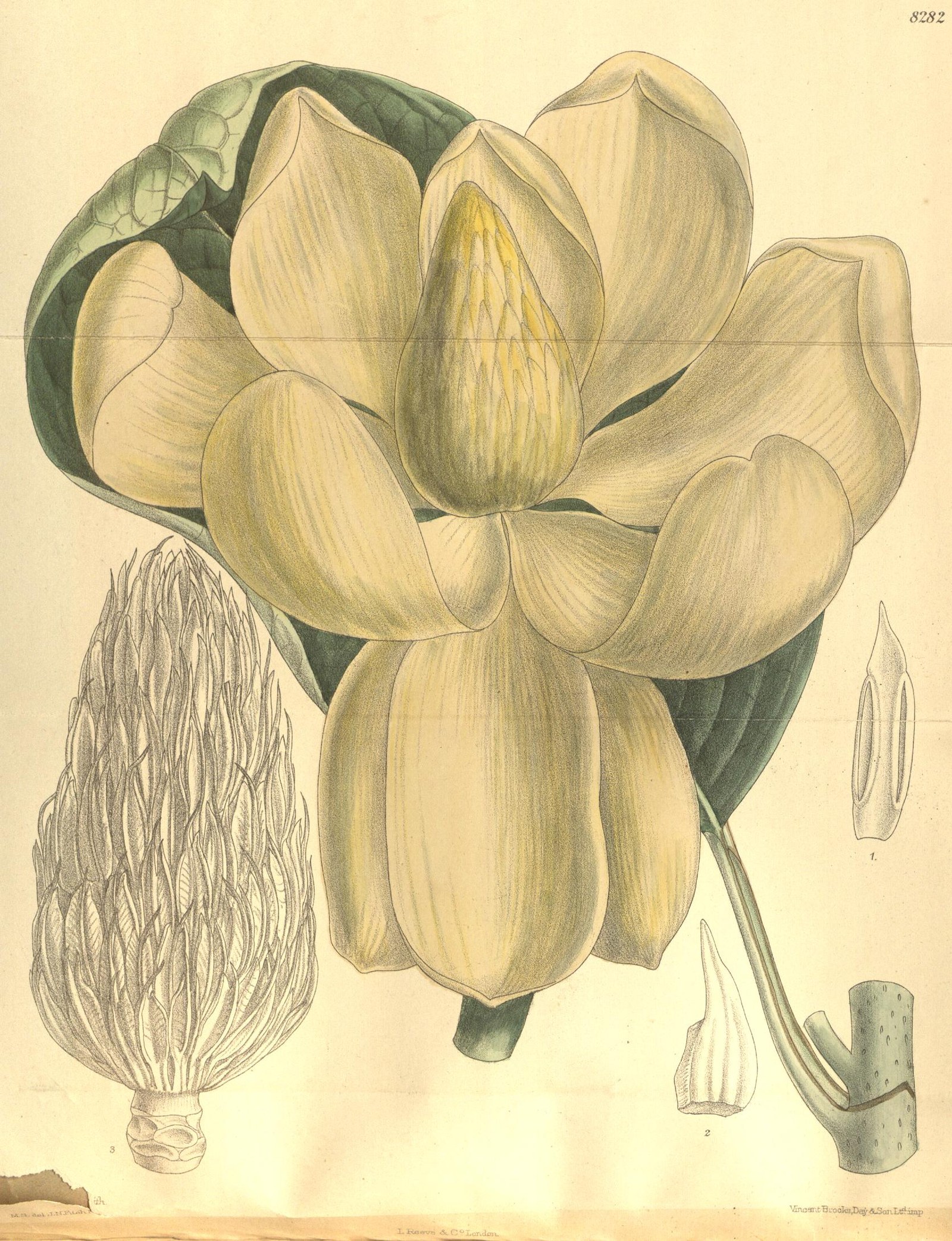
Most magnolias are deciduous and flower on bare branches in spring; the Chinese Magnolia delavayi keeps its leaves all year, and such leaves: great sea-green leathery blades up to 35 cm long, grey beneath, the largest of any evergreen tree that will stand an English winter. The flowers come in summer, creamy bowls the size of a soup plate that open at dusk, breathe out a scent of lemon through the night to attract the beetles that pollinate them, and are brown and finished within two days.
Père Jean Marie Delavay, a French Catholic missionary posted to the mountains of Yunnan in 1882, spent his spare hours walking the hills and collected some 200,000 specimens for the Paris museum, more than 1,500 of them new to science; this tree, which grows on the limestone above Dali, carries his name. Ernest Wilson sent the first seed to the Veitch nursery in 1899, and the trees raised from it flowered first at Caerhays in Cornwall, against a warm wall, where the original tree still stands.
Matilda Smith's plate of 1909 shows the flower and a leaf at a scale that barely fits the page.
Bought together
More in the archive