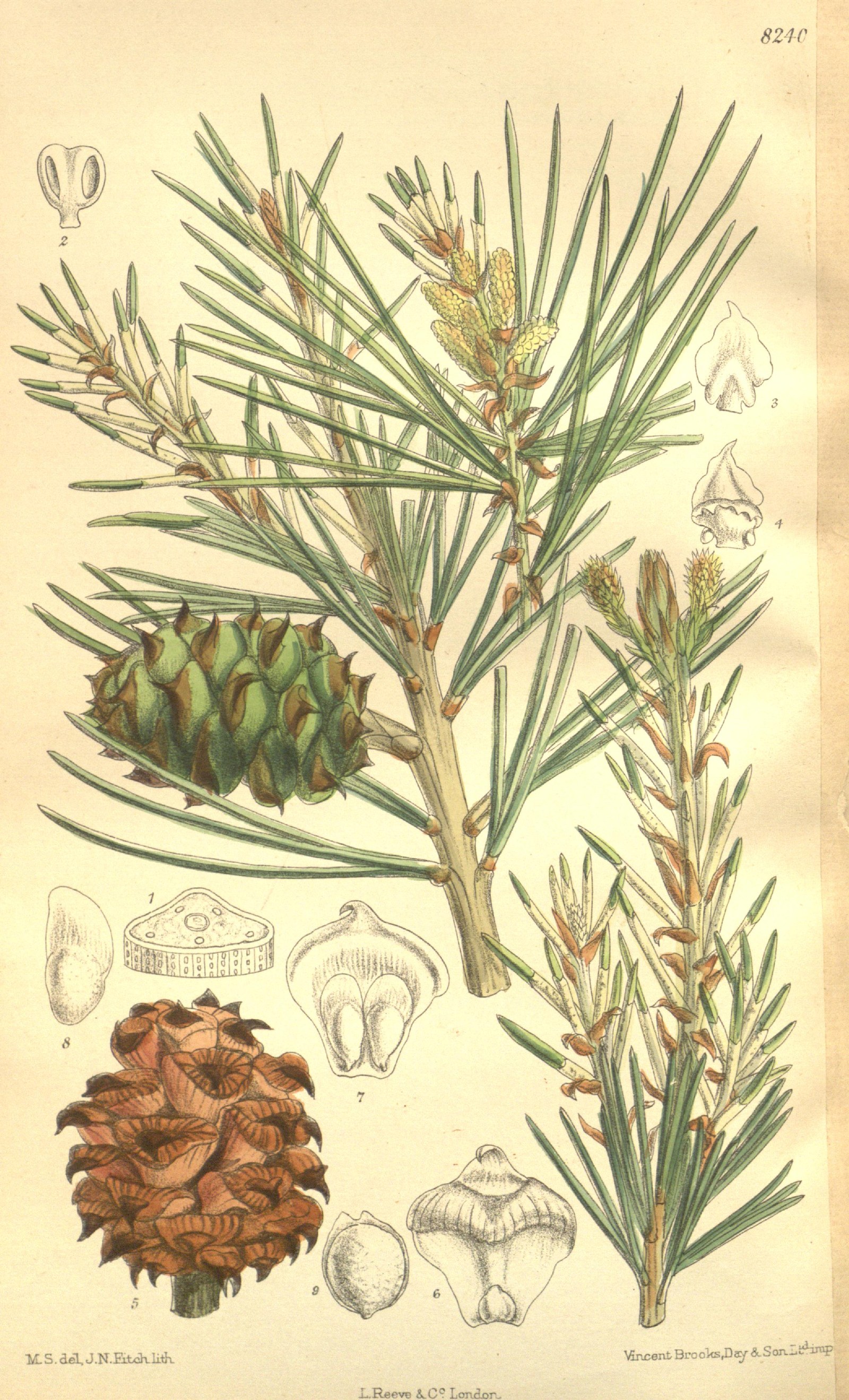
Matilda Smith del. · John Nugent Fitch lith. · Vincent Brooks, Day & Son Ltd · L. Reeve & Co., London
Week of 29 September 2025
Lacebark pine
Part 2 of 6 in Trees and conifers
Pinus bungeana
The temple pine of northern China, whose bark flakes into a patchwork of grey, green, cream and chalk-white that outshines its flowers.
- Published
- Plate 8240, volume 135, 1909
- From
- Curtis's Botanical Magazine
- Drawn by
- Matilda Smith
- Lithograph
- John Nugent Fitch
- Technique
- Hand-coloured lithograph
- Family
- Pinaceae
- Native to
- Northern and central China
About the plant
Most pines are admired for their shape; the lacebark pine is admired for its skin. As the trunk thickens, the bark falls away in irregular plates, each layer a different colour, so that an old tree is dappled grey, olive, cream and chalk-white like a camouflaged animal. In the courtyards of Beijing's temples and around the Ming tombs stand trees that have been doing this for five or six centuries, and the Chinese name, bai pi song, 'white-bark pine', describes what they become in extreme old age.
Alexander von Bunge, a Baltic German botanist travelling with a Russian mission, saw the tree near Beijing in 1831 and it was named for him. Robert Fortune, the Scottish plant hunter who smuggled tea out of China for the East India Company, sent the first seeds home in 1846. In Britain it grows slowly and often with several trunks, which only multiplies the bark on show.
The plate, drawn by Matilda Smith in 1909, shows the three-needled shoots and the small cones; the Magazine's text admitted that the bark, the tree's real glory, was impossible to do justice to on the page.
Bought together
More in the archive