Matilda Smith del. · John Nugent Fitch lith. · Vincent Brooks, Day & Son Ltd · L. Reeve & Co., London
Week of 6 October 2025
Pacific madrone
Part 3 of 6 in Trees and conifers
Arbutus menziesii
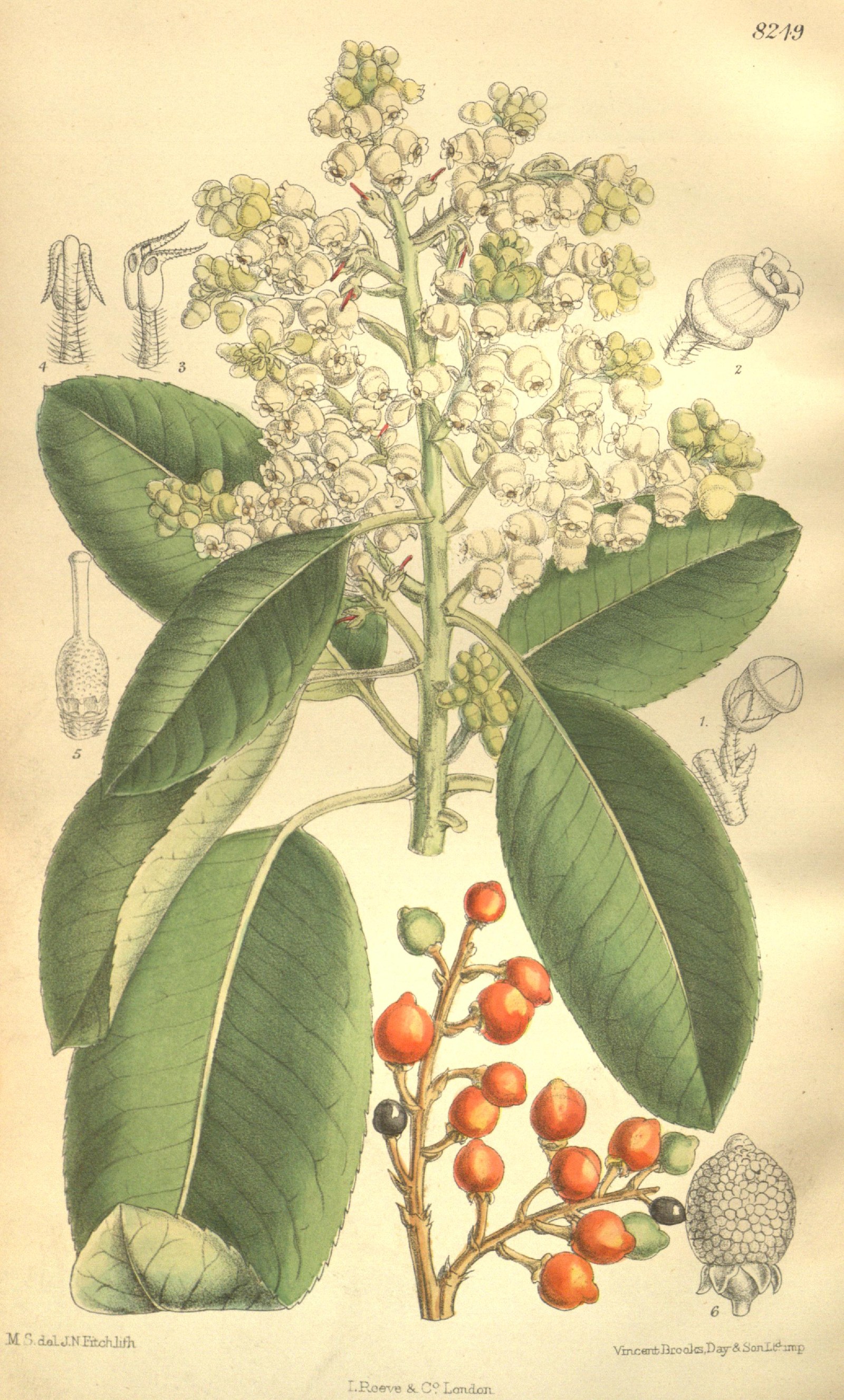
The madrone of the Pacific coast, an evergreen heather relative with cinnamon-red bark that peels to reveal smooth green beneath, white bell flowers and orange berries.
- Published
- Plate 8249, volume 135, 1909
- From
- Curtis's Botanical Magazine
- Drawn by
- Matilda Smith
- Lithograph
- John Nugent Fitch
- Technique
- Hand-coloured lithograph
- Family
- Ericaceae
- Native to
- Pacific coast of North America
About the plant
Drive the coast road from Vancouver to Big Sur and the madrone is the tree that catches your eye: a lean, twisting evergreen whose bark peels in paper curls of rust-red to expose new bark as smooth and green as a bottle. It belongs, improbably, to the heather family, and its flowers show it, hanging in creamy clusters of little urns in spring exactly like those of a blueberry. By autumn they have become orange-red berries that waxwings and band-tailed pigeons strip in a day.
Archibald Menzies, surgeon and botanist on George Vancouver's voyage, collected it in the 1790s, and Frederick Pursh named it for him in 1814. The Spanish settlers of California had already called it madroño after the Mediterranean strawberry tree, Arbutus unedo, its smaller cousin, and 'madrone' or 'madrona' stuck. It can reach 30 m in the redwood belt, the largest of all the strawberry trees.
It has always been a tree that resists the gardener: seedlings sulk if moved, and it wants sharp drainage and a dry summer. The plant Matilda Smith drew at Kew in 1909 was a rare English success.
Bought together
More in the archive