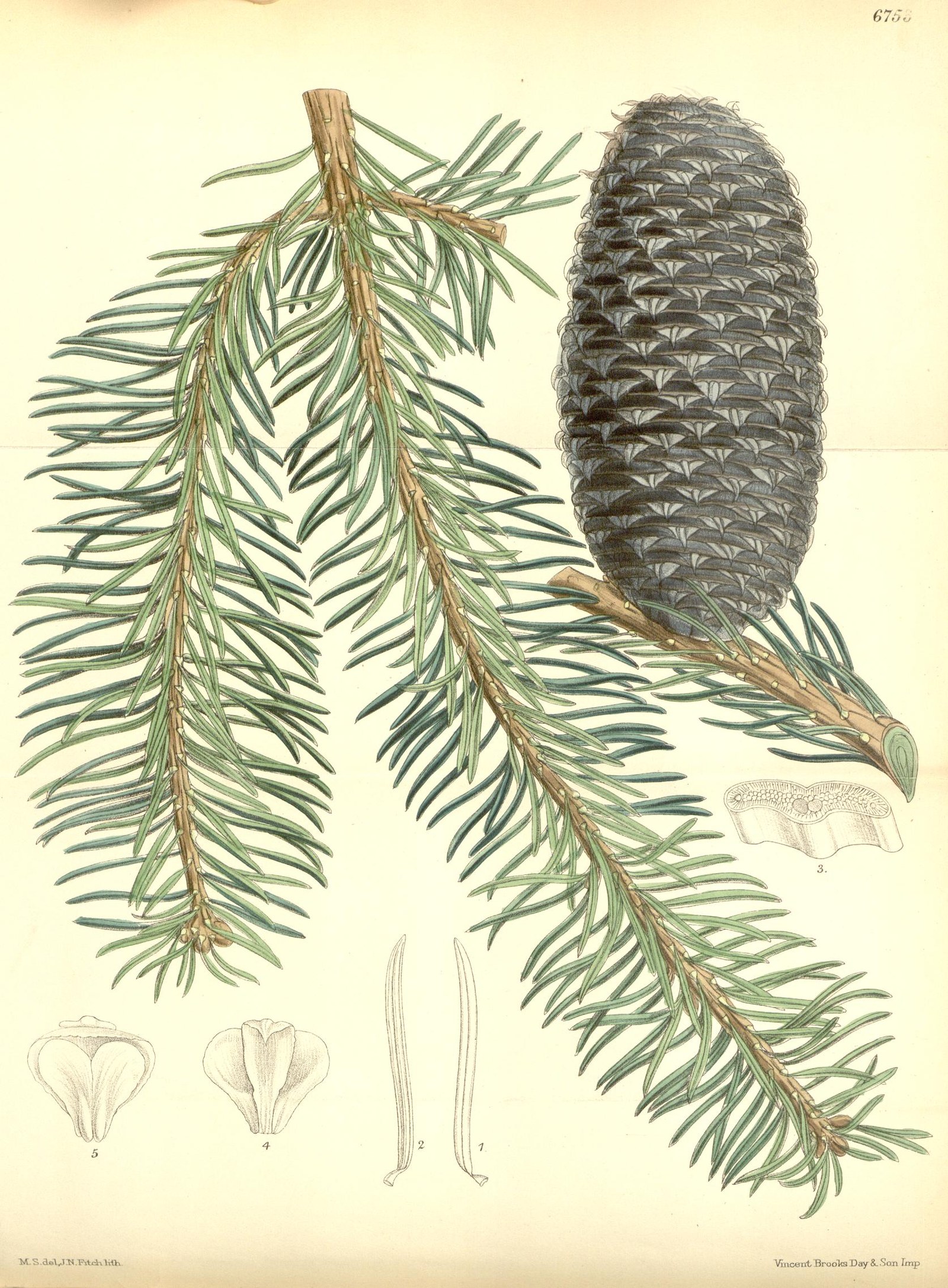
Matilda Smith del. · John Nugent Fitch lith. · Vincent Brooks, Day & Son Ltd · L. Reeve & Co., London
Week of 22 September 2025
Sacred fir
Part 1 of 6 in Trees and conifers
Abies religiosa
The oyamel fir of the Mexican highlands, cut for church festivals since colonial times and the winter roost of millions of monarch butterflies.
- Published
- Plate 6753, volume 110, 1884
- From
- Curtis's Botanical Magazine
- Drawn by
- Matilda Smith
- Lithograph
- John Nugent Fitch
- Technique
- Hand-coloured lithograph
- Family
- Pinaceae
- Native to
- Mountains of central Mexico and Guatemala
About the plant
Every November, monarch butterflies that have flown up to 4,000 km from Canada and the United States settle on the oyamel firs of a few mountain tops in Michoacán, in such numbers that branches bend and the trees turn orange. The firs' dense, cool canopy keeps the butterflies just above freezing and just below the point of using up their fat, and for five months the forest is their blanket. No other tree will do, which is why the loss of oyamel forest to logging is the monarch's greatest threat.
The Spanish named it for its use: branches cut for Corpus Christi and Christmas, the resin burned as incense, a habit that long predates the church. Humboldt and Bonpland collected it on their Mexican journey of 1803, and Kunth described it in 1817. It is a handsome, dark fir with needles silvered beneath and violet young cones, growing at 2,000 m and higher, which is why it finds English winters damp and English summers short.
This plate from 1884 is one of the early works of Matilda Smith, who had joined Kew as its artist six years before and would go on to draw more than 2,300 plates for the Magazine.
Bought together
More in the archive