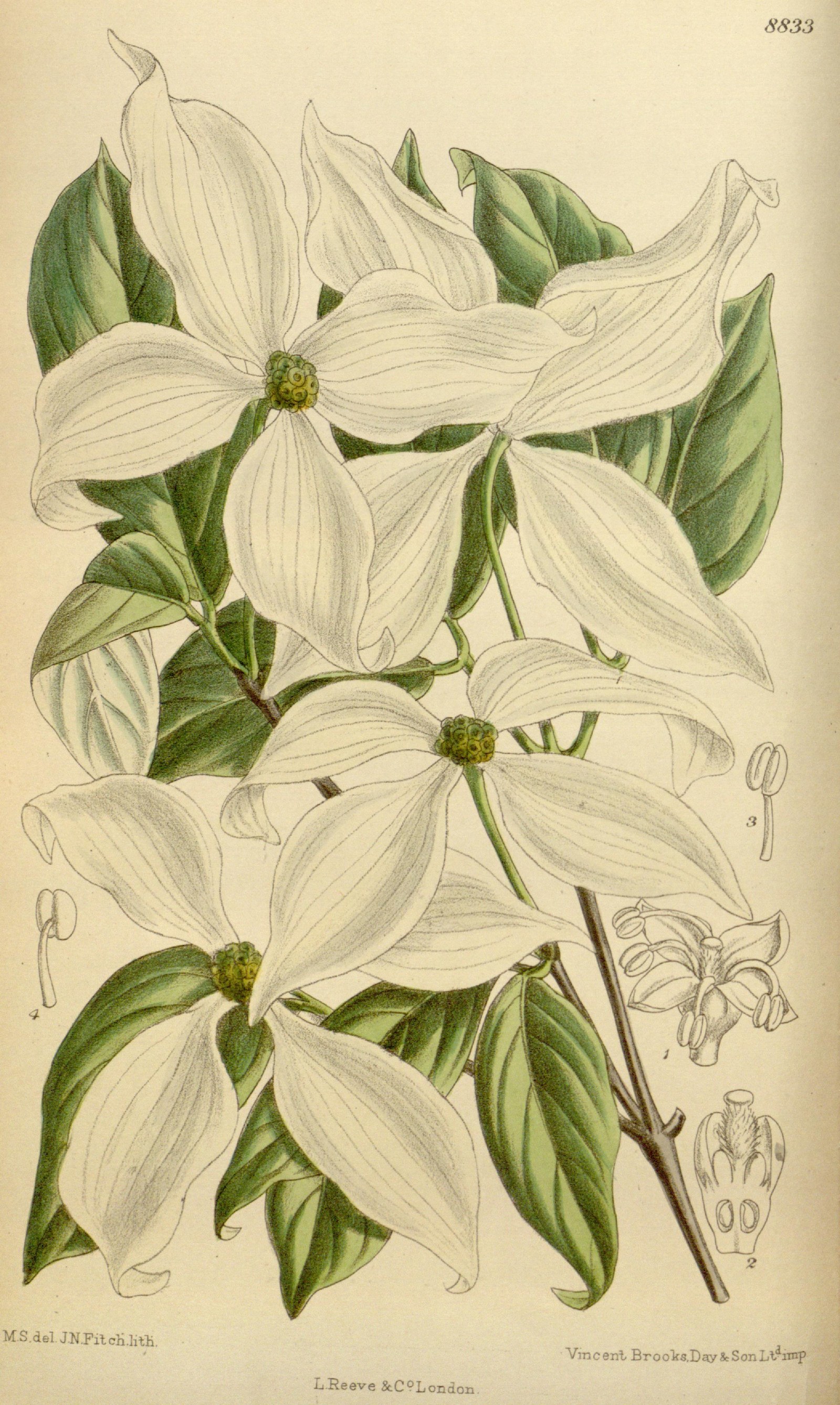
Matilda Smith del. · John Nugent Fitch lith. · Vincent Brooks, Day & Son Ltd · L. Reeve & Co., London
Week of 27 October 2025
Kousa dogwood
Part 6 of 6 in Trees and conifers
Cornus kousa
A small East Asian tree whose starry white 'flowers' are really four bracts, followed in autumn by strawberry-like red fruits and burgundy leaves.
- Published
- Plate 8833, volume 146, 1920
- From
- Curtis's Botanical Magazine
- Drawn by
- Matilda Smith
- Lithograph
- John Nugent Fitch
- Technique
- Hand-coloured lithograph
- Family
- Cornaceae
- Native to
- Japan, Korea and China
About the plant
The kousa dogwood is one of the most rewarding small trees in a garden because it earns its place three times a year. In early summer, when the leaves are already out, every branch is tiered with starry 'flowers': four creamy bracts, tapering to a point, around a green button that is the real cluster of flowers. In early autumn those buttons swell into knobbly red fruits the size of a strawberry, sweet enough to eat if the birds leave them. Then the leaves turn claret.
It grows wild in the woods of Japan, Korea and central China, and its Japanese name, kousa, has stuck in English. It reached Western gardens in 1875 and has been crossed with the American flowering dogwood, Cornus florida, which it resembles but outlasts: the Asian species shrugs off the fungal anthracnose that has killed so many of its relatives in North America.
Matilda Smith drew this plate for the Magazine in 1920, one of the last she made before retiring after more than forty years as Kew's artist.
Bought together
More in the archive