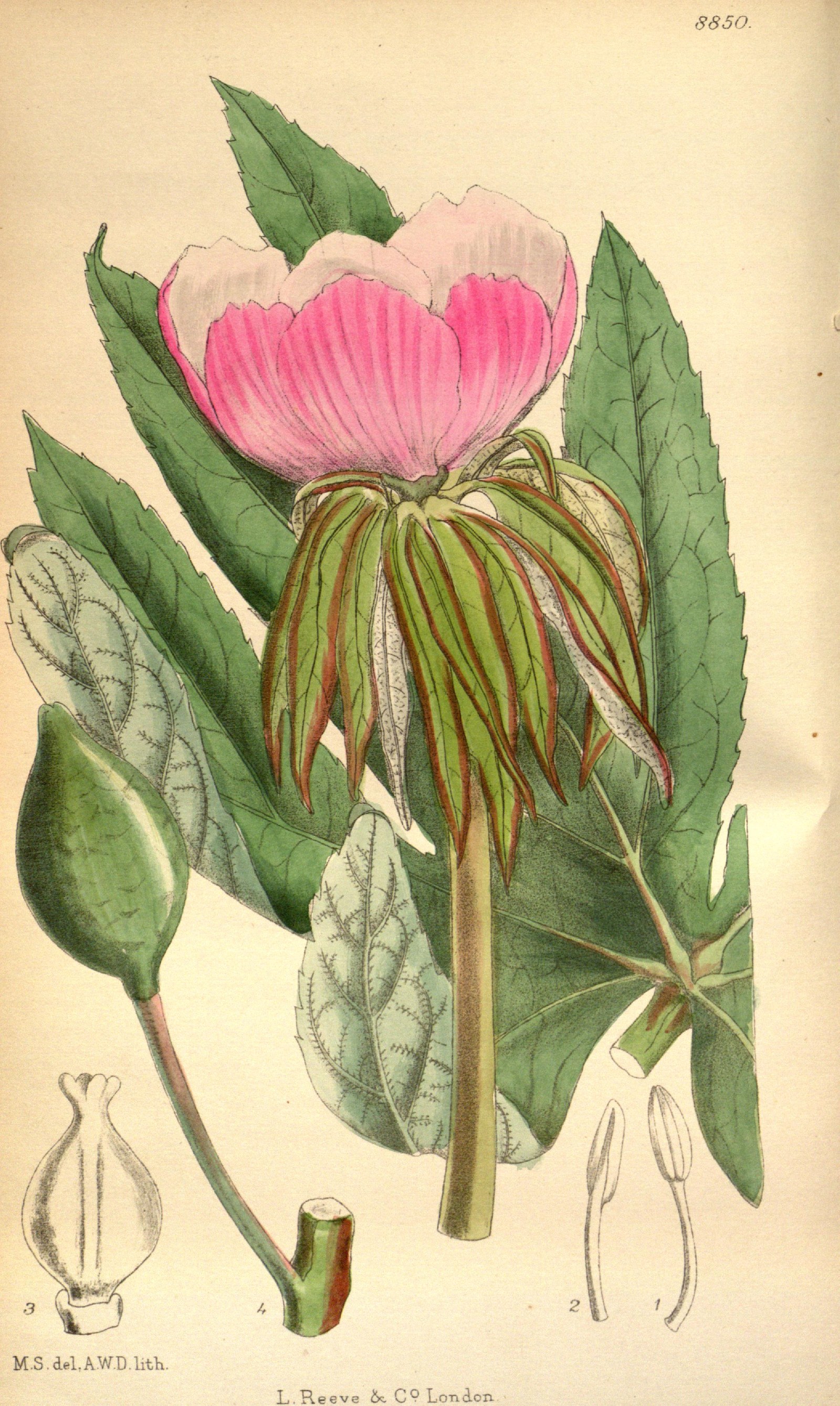
Matilda Smith del. · John Nugent Fitch lith. · Vincent Brooks, Day & Son Ltd · L. Reeve & Co., London
Week of 24 August 2026
Himalayan mayapple
Part 6 of 6 in Climbers and useful plants
Podophyllum hexandrum (published as Podophyllum emodi)
A Himalayan woodlander with umbrella leaves, a single pale flower and a scarlet fruit like a plum, whose roots yield a drug now used against cancer.
- Published
- Plate 8850, volume 146, 1920
- From
- Curtis's Botanical Magazine
- Drawn by
- Matilda Smith
- Lithograph
- John Nugent Fitch
- Technique
- Hand-coloured lithograph
- Family
- Berberidaceae
- Native to
- The Himalaya, from Afghanistan to western China
About the plant
In the clearings of Himalayan forests, from Afghanistan to Yunnan, the mayapple pushes up each spring like a folded umbrella: two lobed leaves, mottled with bronze and chocolate, open on a single stem and shade a lone flower, white or pale pink, the size of a crocus. By late summer the flower has become a fruit like a glossy red plum, sweet and edible once ripe, and the only part of the plant that is not poisonous. Every other part is laced with podophyllotoxin.
That poison is the reason the plant matters. Ground root has been used in Himalayan medicine for centuries, as bankakri, to purge and to burn off warts, and in the twentieth century chemists found that podophyllotoxin stops cells dividing. From it they made etoposide, a drug that has been treating lung cancer, testicular cancer and leukaemias since the 1980s. The demand has been hard on the plant, which is now endangered across much of its range and is grown commercially instead.
The old name Podophyllum emodi, under which this 1920 plate by Matilda Smith was published, comes from Emodus, the Greek and Roman name for the Himalaya.
Bought together
More in the archive