John Curtis del. · Weddell sculp. · Samuel Curtis, London
Week of 10 August 2026
Chinese peony
Part 4 of 6 in Climbers and useful plants
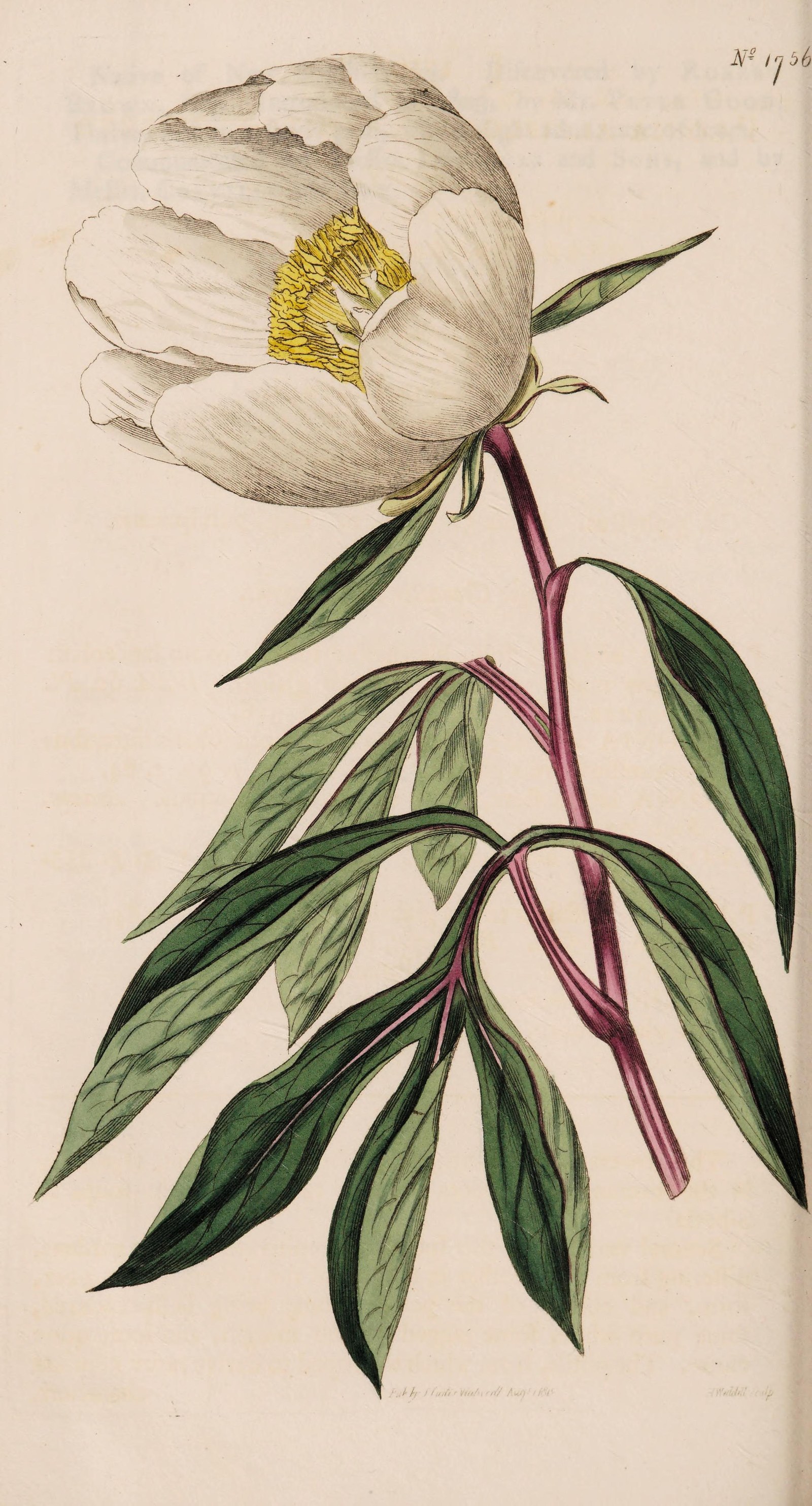
Paeonia lactiflora (published as Paeonia albiflora)
The white-flowered wild peony of northern China, parent of almost every herbaceous peony in our gardens, as it was first drawn for English readers in 1815.
- Published
- Plate 1756, volume 42, 1815
- From
- Curtis's Botanical Magazine
- Drawn by
- John Curtis
- Engraved by
- Weddell
- Technique
- Hand-coloured copper engraving
- Family
- Paeoniaceae
- Native to
- Northern China, Mongolia, Siberia and Korea
About the plant
Every double pink peony that opens in an English June in the second week of the month, drops its petals in a shower, and is gone, descends from this plant. Paeonia lactiflora grows wild on the grassy steppes of northern China, Mongolia and Siberia, a herbaceous perennial with glossy divided leaves and, on the wild plant, single white flowers scented of roses. The Chinese have grown it for well over a thousand years as shaoyao, bred it into hundreds of doubles, and used its root as bai shao, one of the great herbs of their medicine.
It reached Europe late, at the end of the eighteenth century, and the French and English nurserymen of the next hundred years turned it into the garden peony: 'Festiva Maxima' in 1851, 'Sarah Bernhardt' in 1906. The plate from 1815 shows the plant as it first appeared to English readers, under the name Paeonia albiflora, white-flowered, in a hand-coloured copper engraving.
Peonies are famously long-lived and famously resentful of being moved. A clump planted with the buds just below the soil will outlast the gardener.
Bought together
More in the archive