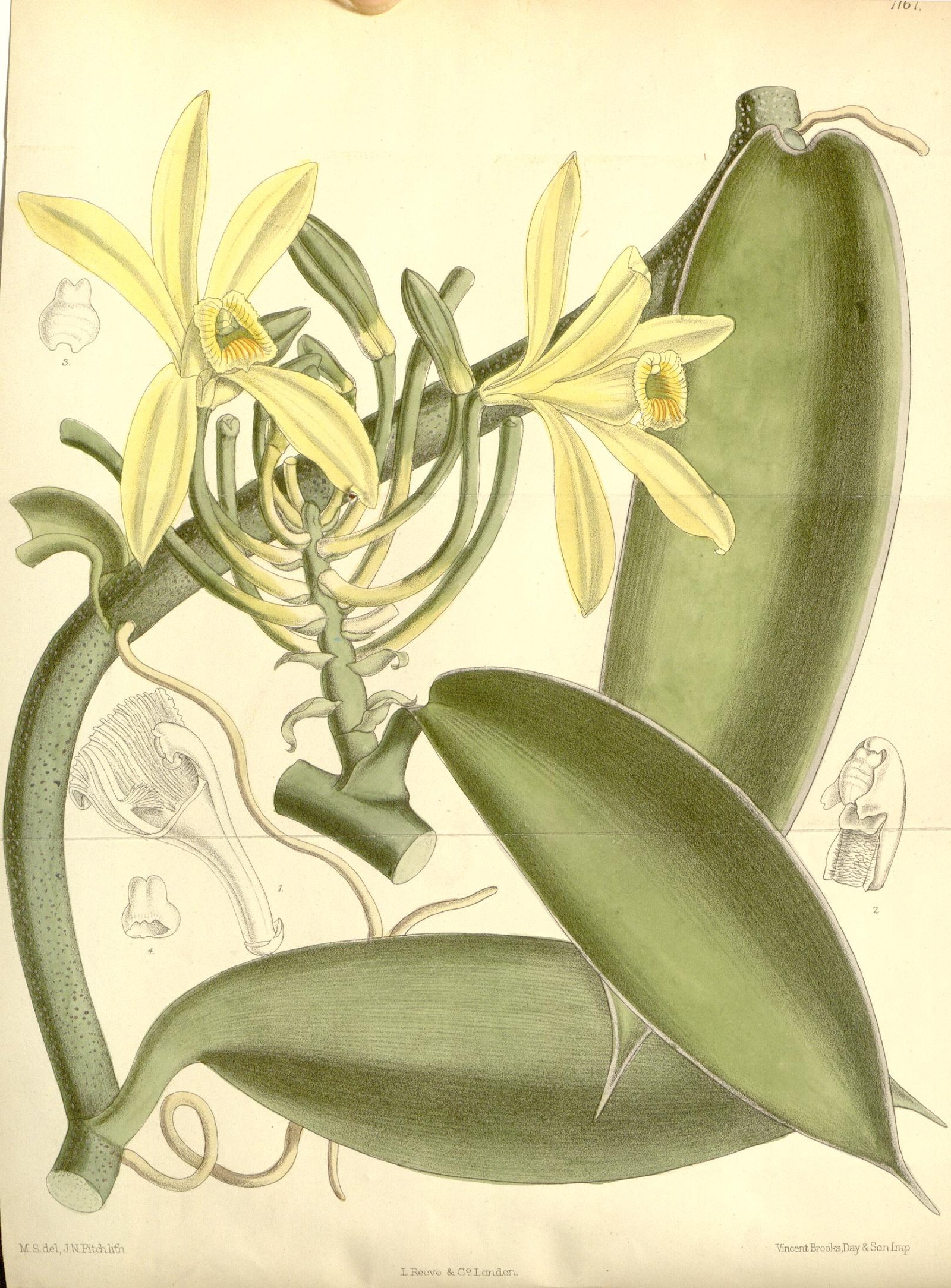
Matilda Smith del. · John Nugent Fitch lith. · Vincent Brooks, Day & Son Ltd · L. Reeve & Co., London
Week of 20 July 2026
Vanilla
Part 1 of 6 in Climbers and useful plants
Vanilla planifolia
The only orchid grown as food: a climbing vine of the Mexican forests whose cured seed pods are the vanilla of every kitchen in the world.
- Published
- Plate 7167, volume 117, 1891
- From
- Curtis's Botanical Magazine
- Drawn by
- Matilda Smith
- Lithograph
- John Nugent Fitch
- Technique
- Hand-coloured lithograph
- Family
- Orchidaceae
- Native to
- Mexico and Central America
About the plant
Vanilla is a climbing orchid of the Mexican forests, a thick green vine that scrambles up trees on aerial roots and opens pale yellow-green flowers for a single morning each. Pollinated, the flower becomes a slender pod, and the pod is the point. Picked green, it has no scent at all; months of scalding, sweating in blankets and slow drying turn it into the dark, oily, glossy bean that smells of vanillin. The Totonac people of Veracruz cured it long before the Aztecs took it as tribute to flavour their chocolate, and the Spanish carried it to Europe in the sixteenth century.
For three hundred years it refused to fruit anywhere but Mexico, because only its native bees would pollinate it. The answer came in 1841 on the French island of Réunion, where Edmond Albius, an enslaved boy of twelve, worked out how to lift the flap inside the flower with a sliver of bamboo and press the pollen home with his thumb. His method is still used on every vanilla farm on Earth, most of them now in Madagascar.
Matilda Smith drew this plate at Kew in 1891, showing the flower and the ripening pods on a vine grown in the Palm House.
Bought together
More in the archive