Matilda Smith del. · John Nugent Fitch lith. · Vincent Brooks, Day & Son Ltd · L. Reeve & Co., London
Week of 17 August 2026
Surinam cherry
Part 5 of 6 in Climbers and useful plants
Eugenia uniflora
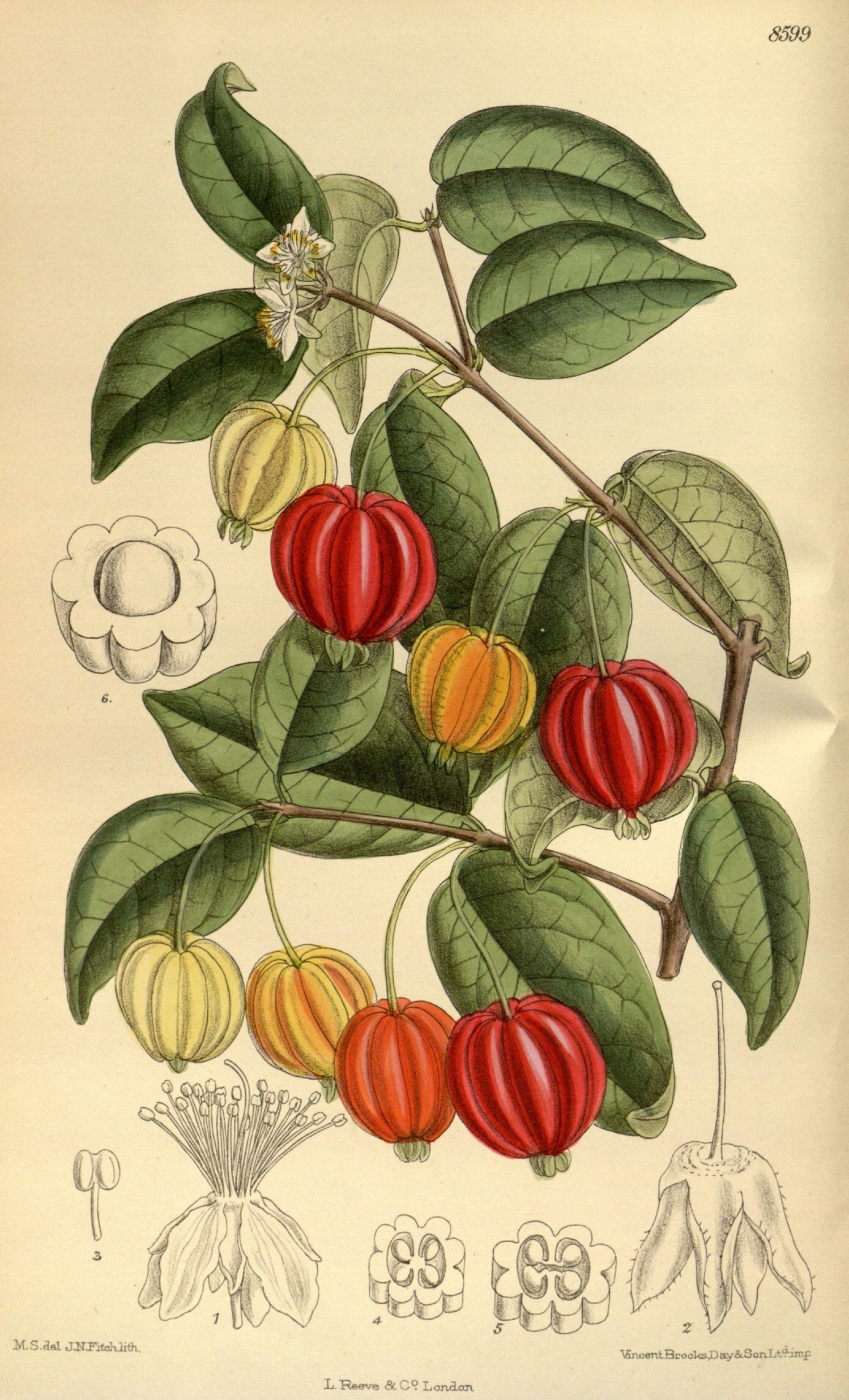
A fruiting branch of the Surinam cherry, its ribbed berries ripening from yellow through orange to scarlet, drawn at Kew by Matilda Smith.
- Published
- Plate 8599, volume 141, 1915
- From
- Curtis's Botanical Magazine
- Drawn by
- Matilda Smith
- Lithograph
- John Nugent Fitch
- Technique
- Hand-coloured lithograph
- Family
- Myrtaceae
- Native to
- Tropical South America
About the plant
Eugenia uniflora is a small evergreen tree of the myrtle family from the warm east of South America: Suriname and the Guianas, southern Brazil, Paraguay, Uruguay and northern Argentina. Linnaeus named it in 1753; the epithet uniflora, 'one-flowered', refers to the blossoms being borne singly in the leaf axils rather than in clusters.
The fruit is the point. It is an eight-ribbed berry the size of a cherry that passes from green to yellow, orange and finally glossy scarlet or near-black. It is juicy and sweet-sharp with a resinous, slightly spicy edge, eaten fresh or made into jams, juices and sorbets wherever the tree is grown. The glossy leaves flush copper-red when young and are aromatic when crushed, which is why the plant is so often clipped into hedges in Florida, the Caribbean, Hawaii and southern Asia, where it has frequently escaped into the wild.
The plate shows a flowering and fruiting branch together, as the Magazine liked to do, with the four-petalled white flowers and their brush of stamens drawn below for identification. Plate 8599 appeared in the fourth series of Curtis's Botanical Magazine in 1915, drawn by Matilda Smith and lithographed by John Nugent Fitch.
Bought together
More in the archive