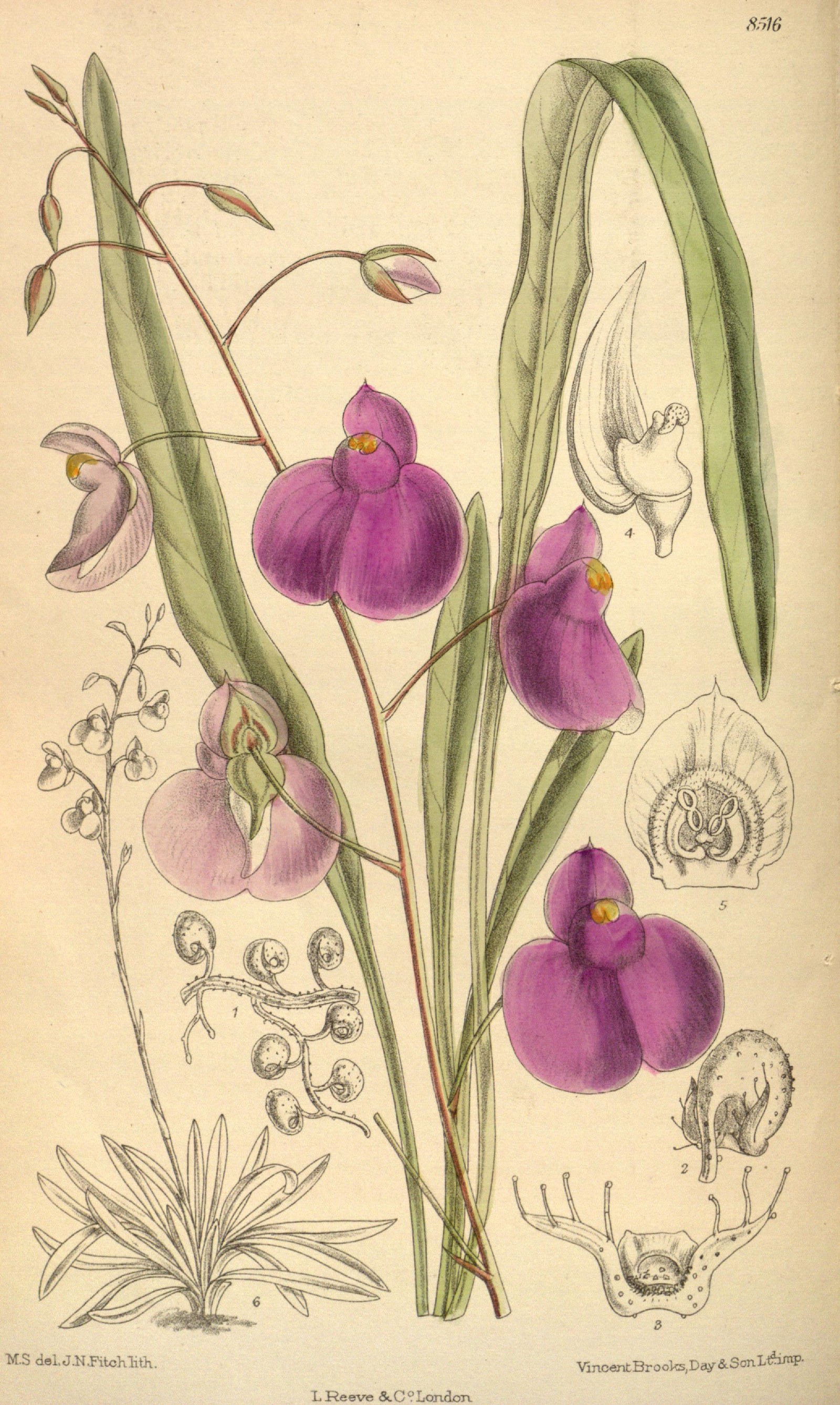
Matilda Smith del. · John Nugent Fitch lith. · Vincent Brooks, Day & Son Ltd · L. Reeve & Co., London
Week of 19 January 2026
Long-leaved bladderwort
Part 6 of 6 in Giants of the stove house
Utricularia longifolia
A carnivorous plant from Brazil with orchid-like purple flowers, which hunts underground with bladder traps that snap shut faster than the eye can follow.
- Published
- Plate 8516, volume 139, 1913
- From
- Curtis's Botanical Magazine
- Drawn by
- Matilda Smith
- Lithograph
- John Nugent Fitch
- Technique
- Hand-coloured lithograph
- Family
- Lentibulariaceae
- Native to
- Brazil
About the plant
Bladderworts are the most sophisticated hunters among plants and the least conspicuous. Utricularia longifolia has no roots; it lives as a tangle of threadlike stems in wet moss and sand in the mountains of south-eastern Brazil, and along those stems hang thousands of bladders no bigger than a pinhead. Each bladder pumps water out of itself until its walls are sucked in under negative pressure. When a springtail or a mosquito larva brushes the trigger hairs at its mouth, a trapdoor flies open, water and prey rush in, and the door shuts, all in less than a thousandth of a second. Enzymes do the rest.
Above ground the plant is all innocence: a few long, strap-shaped leaves and, in summer, stems to 60 cm carrying violet flowers with a yellow blotch on the lip, so like a small orchid that visitors to Kew's collections regularly take it for one. Matilda Smith drew it in 1913, when it had just been introduced from Brazil, and it has since become a favourite of growers of carnivorous plants, who keep it in pots of living sphagnum moss standing in rainwater.
Bought together
More in the archive