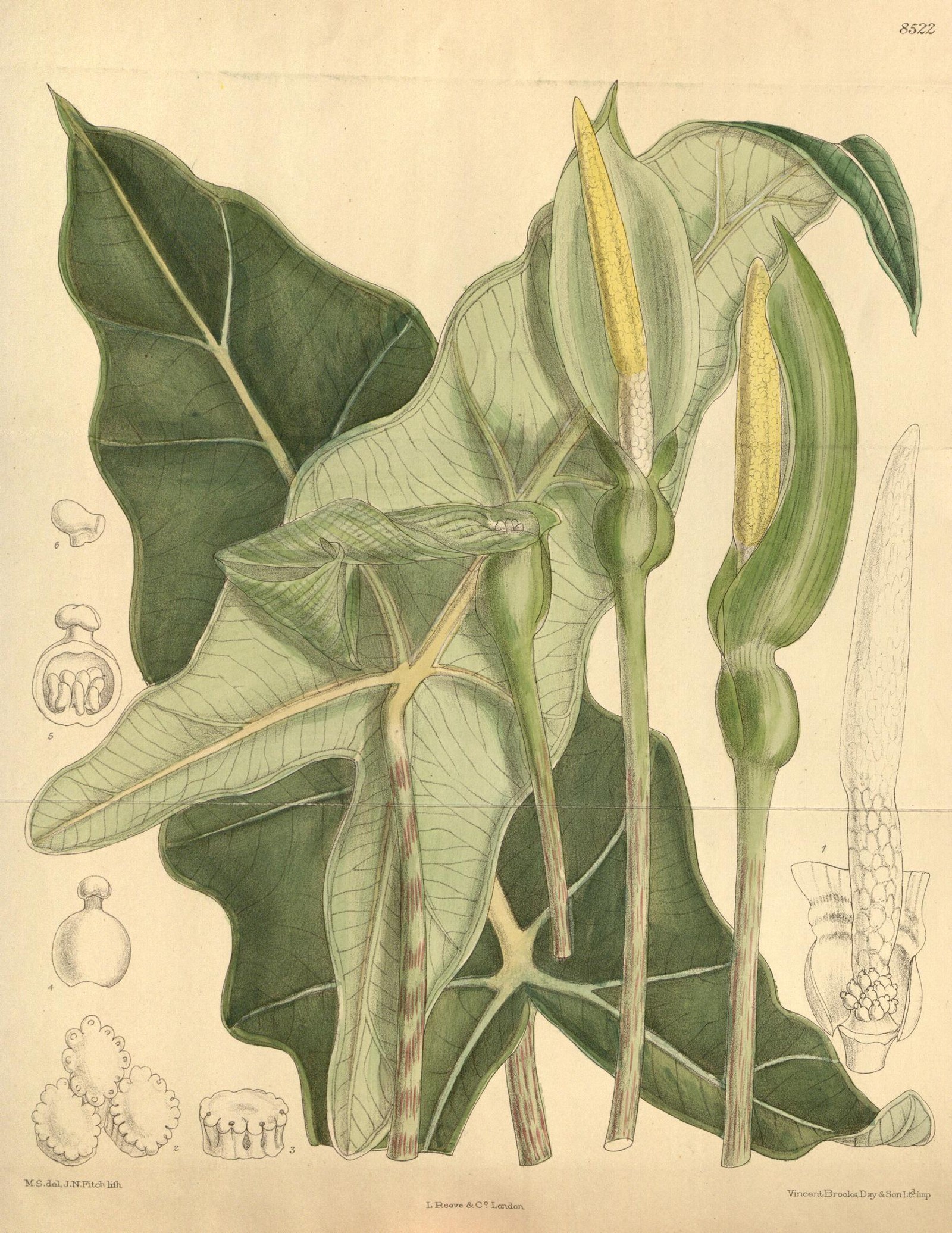
Matilda Smith del. · John Nugent Fitch lith. · Vincent Brooks, Day & Son Ltd · L. Reeve & Co., London
Week of 29 December 2025
Velvet alocasia
Part 3 of 6 in Giants of the stove house
Alocasia micholitziana
A Philippine aroid with velvet-green arrow leaves veined in silver, the wild parent of the houseplant sold today as Alocasia 'Frydek'.
- Published
- Plate 8522, volume 139, 1913
- From
- Curtis's Botanical Magazine
- Drawn by
- Matilda Smith
- Lithograph
- John Nugent Fitch
- Technique
- Hand-coloured lithograph
- Family
- Araceae
- Native to
- Luzon, the Philippines
About the plant
In the dim light of the Philippine forest floor, the velvet alocasia holds its leaves up like arrowheads of dark green velvet, each main vein traced in a pale silver that makes the leaf glow in shade. It is a small plant, a metre at most, growing from a short rhizome, and like its relatives, the taros and elephant's ears, it flowers in a greenish spathe that nobody grows it for. The leaves are the point, and a century after this plate they are everywhere: the houseplant sold as Alocasia 'Frydek', the 'green velvet alocasia' of a million window ledges, is a selection of this species.
Wilhelm Micholitz, a German plant hunter who scoured Asia and the Pacific for the orchid nursery of Frederick Sander at St Albans, sent it to England around 1910, and Matilda Smith drew it at Kew in 1913 as a stove plant for the hothouse. The sap, like that of every alocasia, carries needle-like crystals of calcium oxalate that make the mouth burn, which is why cats and children should leave it alone.
Micholitz, who collected for Sander for thirty years, is remembered in a dozen orchids as well as in this aroid.
Bought together
More in the archive