Matilda Smith del. · John Nugent Fitch lith. · Vincent Brooks, Day & Son Ltd · L. Reeve & Co., London
Week of 15 December 2025
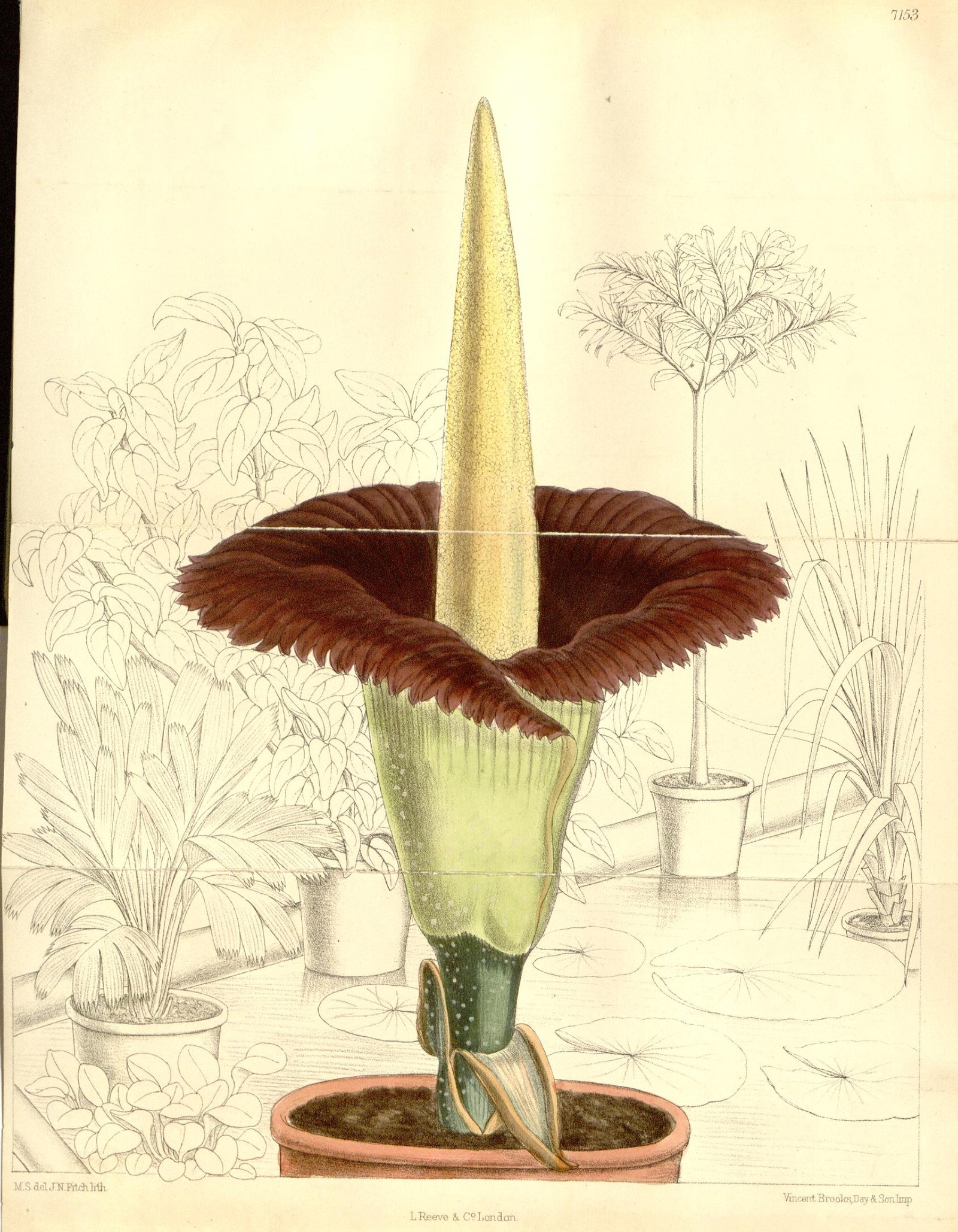
Titan arum
Part 1 of 6 in Giants of the stove house
Amorphophallus titanum
The corpse flower: the largest unbranched flower spike in the world, which first bloomed outside Sumatra at Kew in 1889, and which Matilda Smith drew for this plate.
- Published
- Plate 7153, volume 117, 1891
- From
- Curtis's Botanical Magazine
- Drawn by
- Matilda Smith
- Lithograph
- John Nugent Fitch
- Technique
- Hand-coloured lithograph
- Family
- Araceae
- Native to
- Rainforests of Sumatra
About the plant
In 1878 Odoardo Beccari, botanising in the forests of western Sumatra, found a plant with a leaf like a small tree on a single mottled stalk and, later, a flower he could barely believe: a fluted, purple-lined spathe wrapped around a yellow spike taller than a man. He sent seeds to Florence, and seedlings from them went to Kew. Eleven years later, in June 1889, one of them flowered for the first time outside Sumatra. The crowds were so large that police were called, and the smell, by every account, was appalling.
The titan arum's flowering is a short, violent event. The spike heats itself to around body temperature and pumps out a stench of rotting flesh that carries for hundreds of metres, luring the carrion beetles and flesh flies that pollinate it in the wild. After two days it collapses. Then the corm, which can weigh more than 100 kg, spends years growing one enormous leaf at a time before it can afford to flower again.
Matilda Smith drew the 1889 plant for this plate, published in 1891 across three sheets to fit it in. It has been the Magazine's most famous flower ever since.
Bought together
More in the archive