William Jackson Hooker del. · Joseph Swan sculp. · Samuel Curtis, London
Week of 22 December 2025
Elephant foot yam
Part 2 of 6 in Giants of the stove house
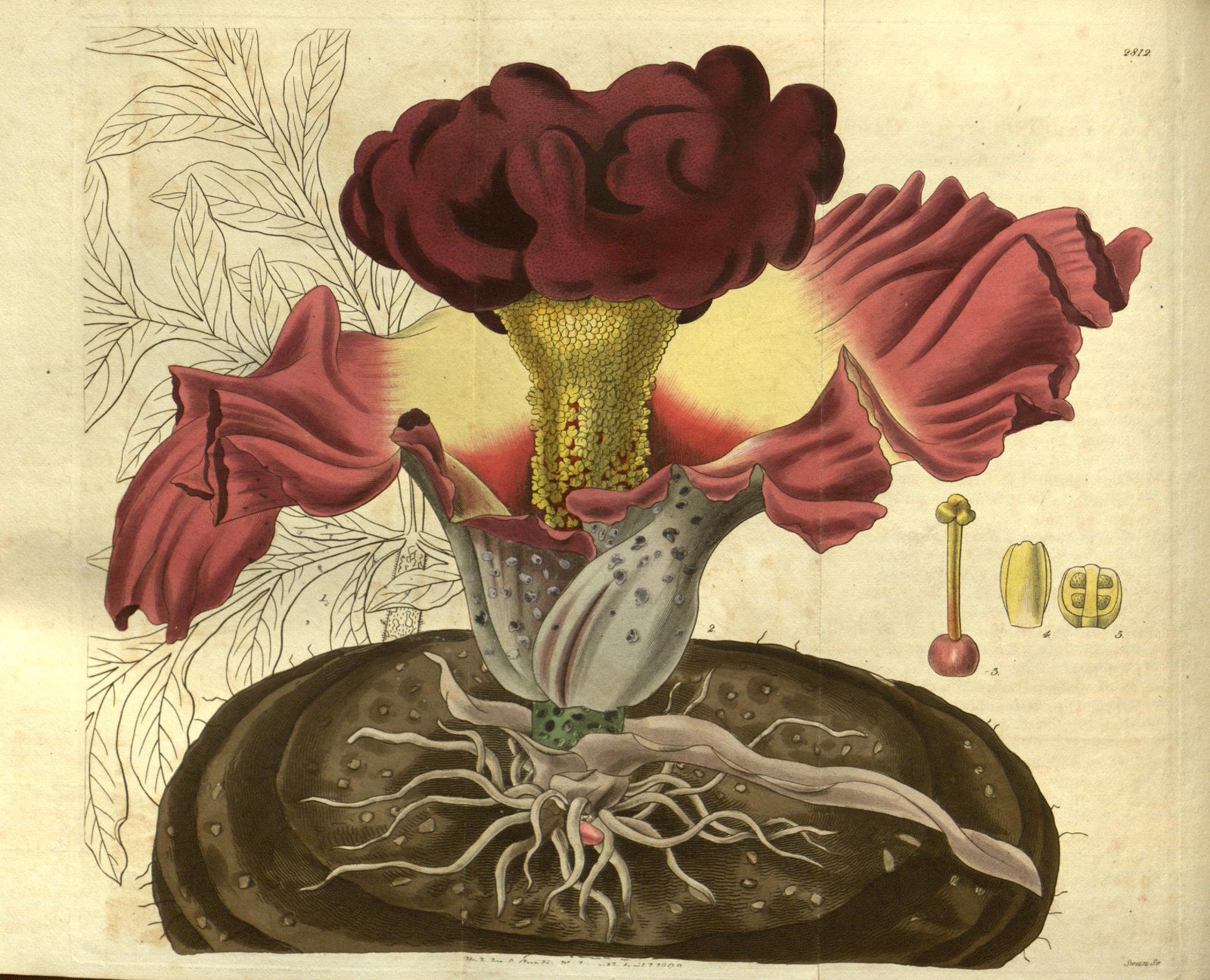
Amorphophallus paeoniifolius (published as Arum campanulatum)
A staple root crop of tropical Asia with a flower like a frilled maroon bell that stinks of carrion, drawn by W. J. Hooker in 1828 as Arum campanulatum.
- Published
- Plate 2812, volume 55, 1828
- From
- Curtis's Botanical Magazine
- Drawn by
- William Jackson Hooker
- Engraved by
- Joseph Swan
- Technique
- Hand-coloured copper engraving
- Family
- Araceae
- Native to
- Tropical Asia, from India to New Guinea and northern Australia
About the plant
Across India, Bangladesh and South-east Asia the elephant foot yam is an everyday vegetable, a corm the size of a football, or bigger, that is dug, cooked into curries and chips, and sold in every market under names like suran and jimikand. Few of the people who eat it see it flower. Early in the wet season, before the leaf, the corm sends up a bell-shaped spathe of liver-purple, frilled at the edge like a peony (the 'paeoniifolius' of the name refers to the leaf, which is cut like a peony's), around a bulbous spadix. For a day it heats itself and gives off the stink of rotting meat, and flies and beetles tumble in.
The leaf that follows is a single green umbrella two metres across on a stalk mottled like a snake, and it feeds the corm for the next year. Raw, the corm is full of needle-like crystals of calcium oxalate that make the mouth burn; boiling or roasting destroys them. The plant is a close relative of the titan arum of Sumatra and shares its habits in miniature.
William Jackson Hooker drew it in 1828, in the first year of his editorship of the Magazine, from a plant flowered in a hothouse in England under the name Arum campanulatum, the bell-shaped arum.
Bought together
More in the archive