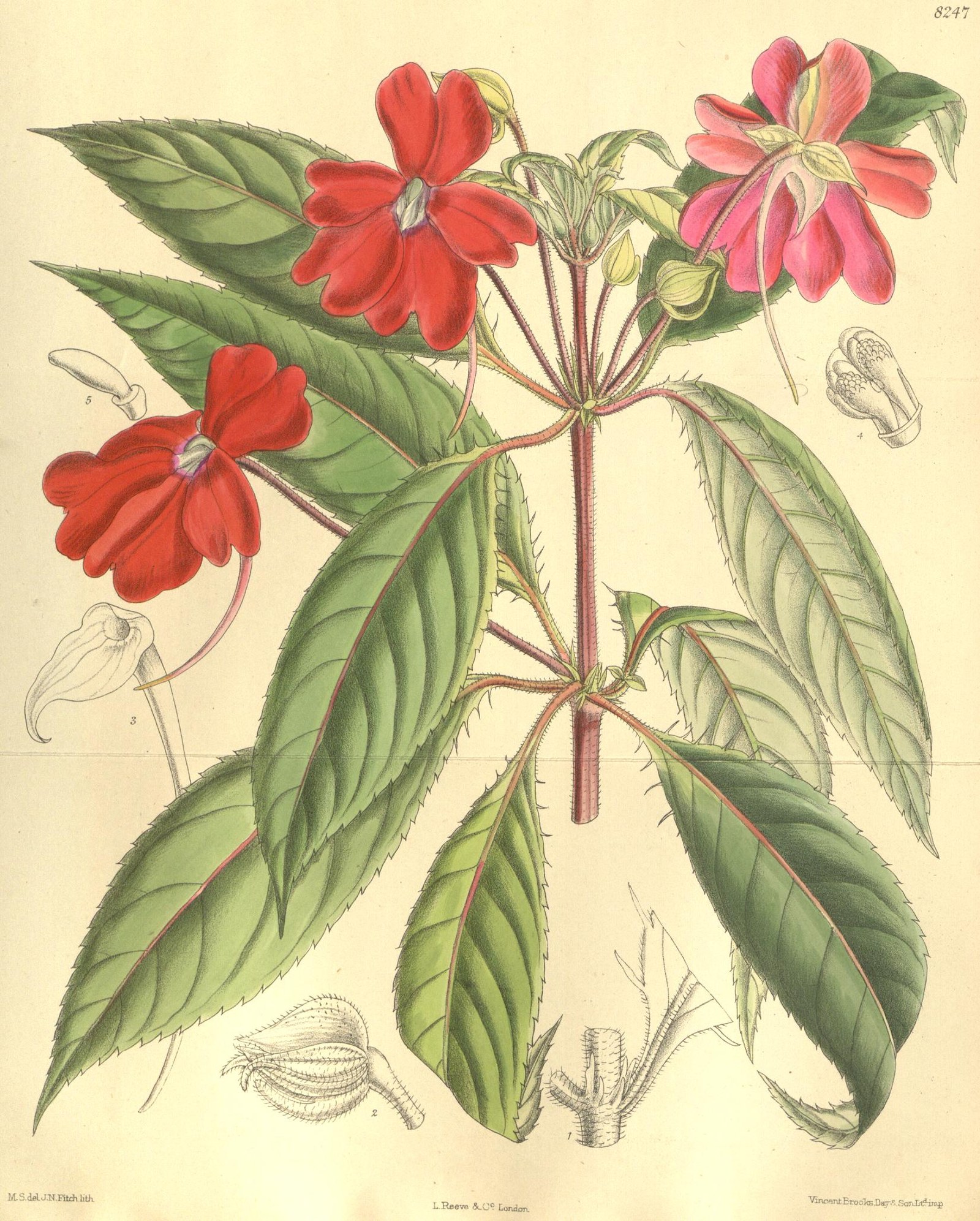
Matilda Smith del. · John Nugent Fitch lith. · Vincent Brooks, Day & Son Ltd · L. Reeve & Co., London
Week of 21 September 2026
New Guinea impatiens
Part 4 of 6 in Daisies, primulas and the odd ones out
Impatiens hawkeri
The wild ancestor of the New Guinea impatiens sold by the million as summer bedding, a forest plant with big flat flowers and glossy, often bronzed leaves.
- Published
- Plate 8247, volume 135, 1909
- From
- Curtis's Botanical Magazine
- Drawn by
- Matilda Smith
- Lithograph
- John Nugent Fitch
- Technique
- Hand-coloured lithograph
- Family
- Balsaminaceae
- Native to
- New Guinea and the Solomon Islands
About the plant
The New Guinea impatiens that fill hanging baskets and shady borders every summer, with their big flat flowers and bronze or variegated leaves, descend from this forest plant of New Guinea and the Solomon Islands. In the wild it grows in deep shade beside streams, a fleshy-stemmed herb a metre high with glossy leaves and flowers in red, pink or white, each with a slender spur behind holding nectar for butterflies. Like all balsams it scatters its seed by exploding: the ripe pod bursts at a touch and flings the seeds a metre or more.
Lieutenant Hawker of the Royal Navy collected the first plants in the 1880s and they flowered in Britain soon after, but the species stayed a greenhouse curiosity until 1970, when an American expedition to New Guinea brought back dozens of wild forms. From those the breeders built the modern race, bigger in flower and tougher in sun. When downy mildew swept through the common busy lizzie in the 2010s, the New Guinea kinds, which resist it, took over the garden centres.
Matilda Smith drew the wild species at Kew in 1909, in the plain red of the forest plant.
Bought together
More in the archive