Matilda Smith del. · John Nugent Fitch lith. · Vincent Brooks, Day & Son Ltd · L. Reeve & Co., London
Week of 14 September 2026
Pink sorrel
Part 3 of 6 in Daisies, primulas and the odd ones out
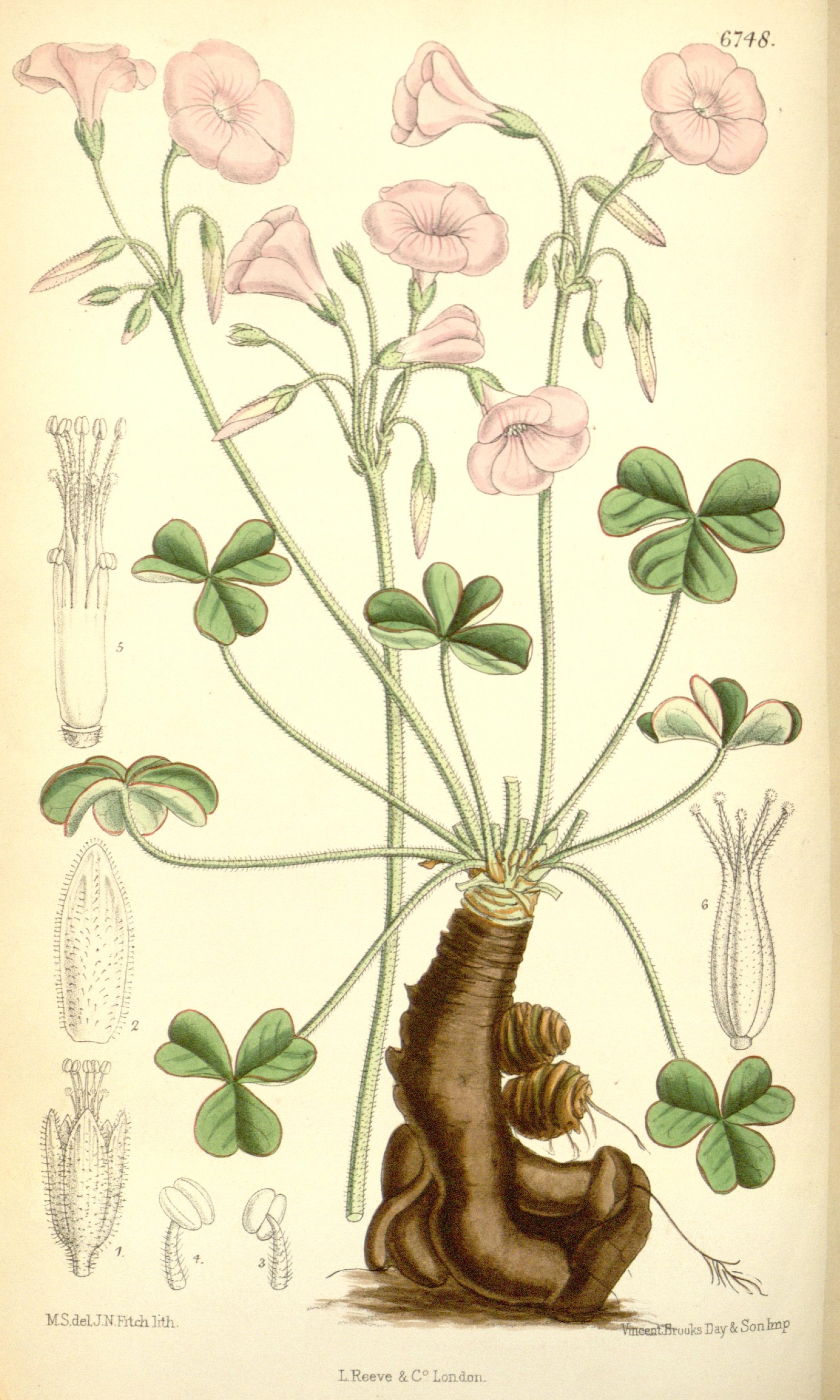
Oxalis articulata
A South American sorrel with clover leaves that fold at dusk and a long summer of rose-pink flowers, now naturalised along the Cornish lanes.
- Published
- Plate 6748, volume 110, 1884
- From
- Curtis's Botanical Magazine
- Drawn by
- Matilda Smith
- Lithograph
- John Nugent Fitch
- Technique
- Hand-coloured lithograph
- Family
- Oxalidaceae
- Native to
- Southern Brazil, Uruguay, Paraguay and Argentina
About the plant
Pink sorrel is a plant that has quietly made itself at home in Britain. It came from the pampas of South America, where it grows in grassland from Brazil to Argentina, and it was planted in Victorian gardens for its clover leaves and its months of rose-pink flowers. From there it escaped, and in Cornwall and Devon it now colours hedge banks, churchyards and the gaps between cottage paving stones from May until the frosts.
Unlike the Bermuda buttercup and the other oxalises that are a gardener's nightmare, it spreads from a thick, knobbly, jointed rootstock rather than a scattering of bulbils, so it stays where it is put. The leaflets fold flat at nightfall and in rain, a trick of the whole family, and if you chew one it tastes sharply of lemon from the oxalic acid that gives the genus its name. In the Andes a relative, oca, is grown for its tubers alongside the potato.
This 1884 plate was drawn by Matilda Smith in her early years at Kew, where the plant was grown as a border perennial.
Bought together
More in the archive