Matilda Smith del. · John Nugent Fitch lith. · Vincent Brooks, Day & Son Ltd · L. Reeve & Co., London
Week of 12 January 2026
Rocky Mountain pond lily
Part 5 of 6 in Giants of the stove house
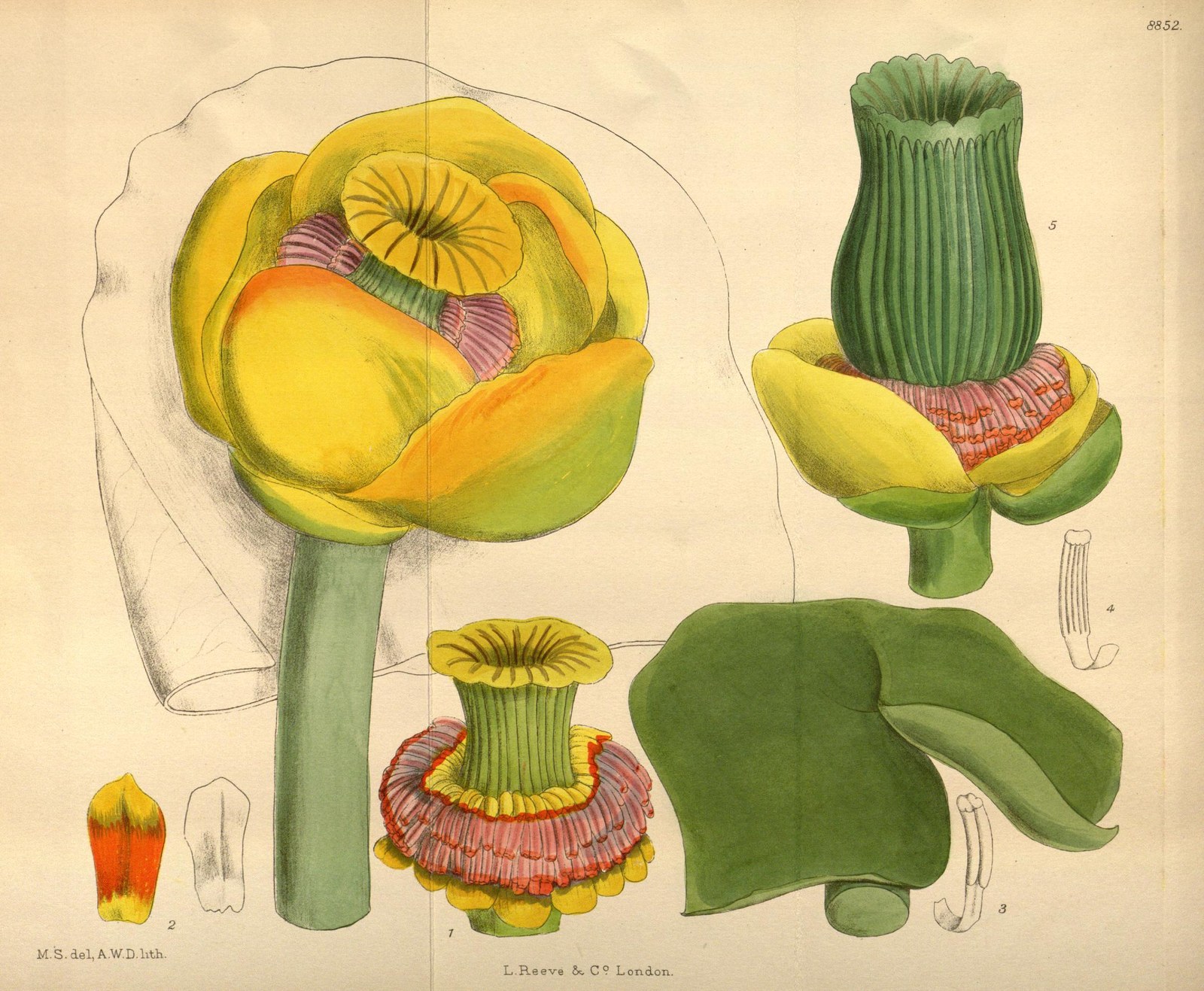
Nuphar polysepala (published as Nuphar polysepalum)
The yellow pond lily of the American West, whose waxy globe flowers have a dozen sepals and whose seeds, the wokas, were a staple of the Klamath people.
- Published
- Plate 8852, volume 146, 1920
- From
- Curtis's Botanical Magazine
- Drawn by
- Matilda Smith
- Lithograph
- John Nugent Fitch
- Technique
- Hand-coloured lithograph
- Family
- Nymphaeaceae
- Native to
- Western North America, from Alaska to California
About the plant
Where the European brandy-bottle has five or six sepals around its small yellow flower, its western American cousin has up to a dozen, and the flower is a waxy globe the size of a fist, yellow washed with red, standing above leaves nearly half a metre long. Nuphar polysepala fills the lakes and sloughs of the American West from Alaska to the Sierra Nevada, growing from rhizomes as thick as a forearm in mud that may freeze solid in winter.
To the Klamath and Modoc people of the Oregon lakes it was a staple. The women harvested the swollen seed pods from canoes in late summer, let them ferment, then dried and roasted the seeds, which popped like popcorn and were ground into meal; a family might put up sacks of wokas against the winter. The beetles and flies that pollinate the flowers are drawn by a scent of alcohol and ripe fruit.
Matilda Smith drew this plate in 1920 from a plant in the pond outside Kew's Waterlily House, where it had been grown since seeds arrived from the Rockies.
Bought together
More in the archive