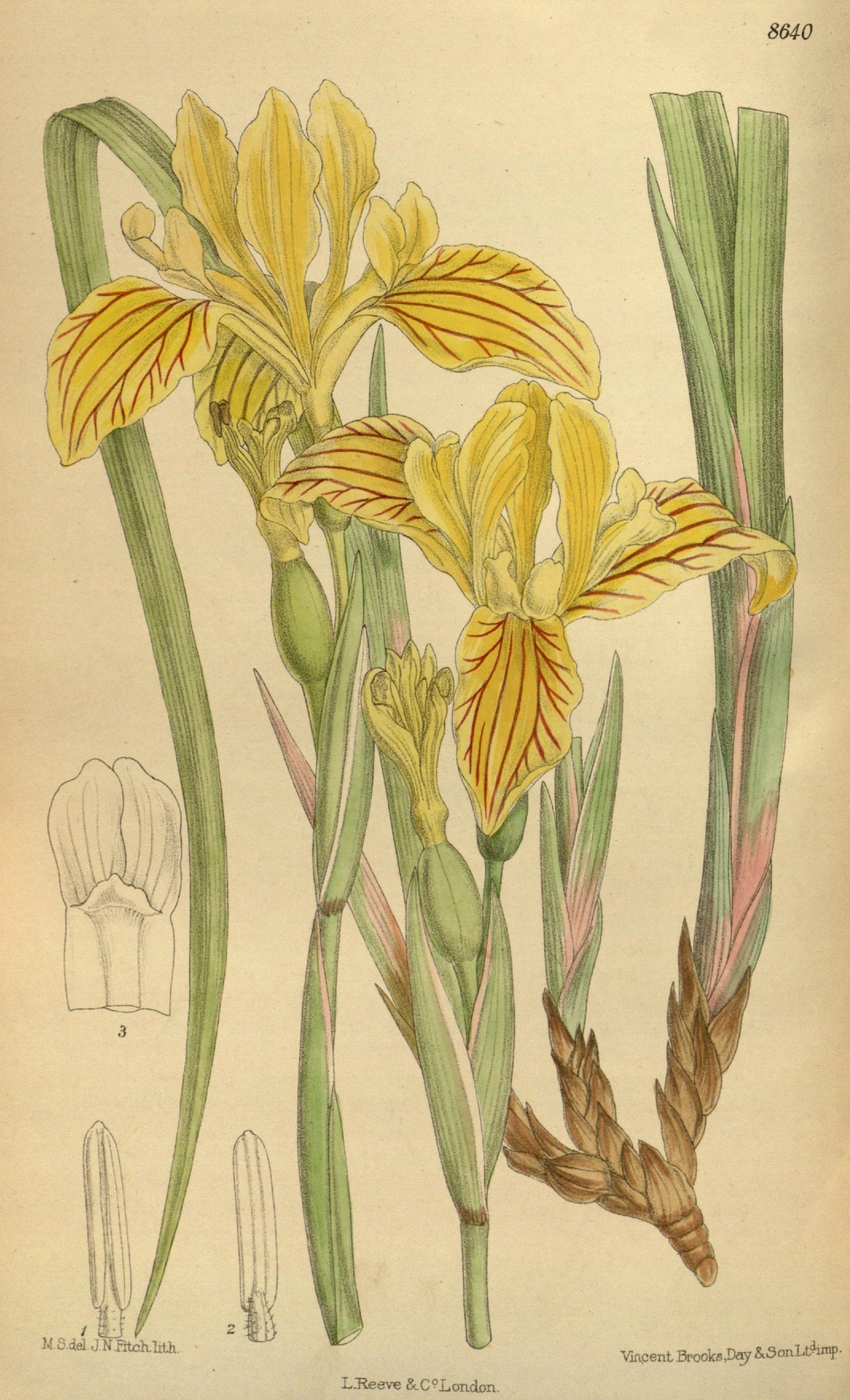
Matilda Smith del. · John Nugent Fitch lith. · Vincent Brooks, Day & Son Ltd · L. Reeve & Co., London
Week of 1 September 2025
Siskiyou iris
Part 4 of 6 in Bulbs and irises
Iris bracteata
The Siskiyou iris of Oregon and California: pale yellow petals pencilled with maroon, held above stiff, glossy evergreen leaves.
- Published
- Plate 8640, volume 141, 1915
- From
- Curtis's Botanical Magazine
- Drawn by
- Matilda Smith
- Lithograph
- John Nugent Fitch
- Technique
- Hand-coloured lithograph
- Family
- Iridaceae
- Native to
- Siskiyou Mountains, Oregon and California
About the plant
Iris bracteata is one of the Pacific Coast irises, a small group of wild irises confined to the far west of North America. This species has one of the narrowest ranges of all: the Siskiyou Mountains of south-western Oregon and the adjoining corner of northern California, where it grows in open pine and oak woodland, often on dry, stony ground.
It was described by the Harvard botanist Sereno Watson in 1885. The name bracteata refers to the large, leaf-like bracts that sheath the short flower stem, a feature that, together with the stiff, glossy, dark green leaves, makes the plant easy to tell from its neighbours. The flowers are cream to clear yellow, finely veined with brown or maroon on the falls, and appear in late spring, usually one or two to a stem.
Like all its group it resents being moved and is best raised from seed, but in a sunny, well-drained spot it is a long-lived and quietly beautiful garden plant. Plate 8640 was published in 1915 from a plant grown at Kew.
Bought together
More in the archive