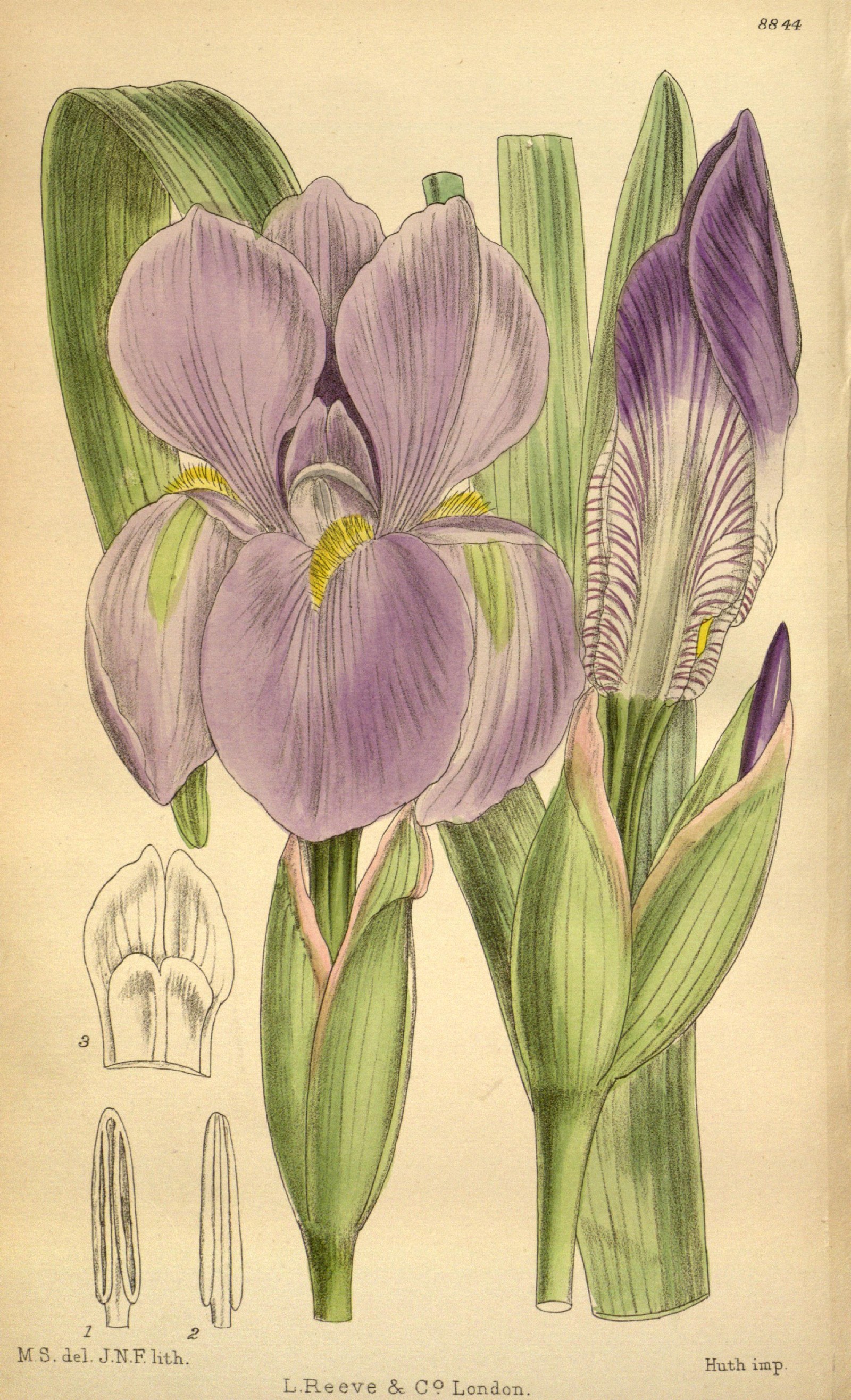
Matilda Smith del. · John Nugent Fitch lith. · Vincent Brooks, Day & Son Ltd · L. Reeve & Co., London
Week of 8 September 2025
Hoog's iris
Part 5 of 6 in Bulbs and irises
Iris hoogiana
A smooth lavender-blue iris with a golden beard from the mountains of Central Asia, found by the Dutch bulb firm Van Tubergen's collectors in 1913.
- Published
- Plate 8844, volume 146, 1920
- From
- Curtis's Botanical Magazine
- Drawn by
- Matilda Smith
- Lithograph
- John Nugent Fitch
- Technique
- Hand-coloured lithograph
- Family
- Iridaceae
- Native to
- Pamir-Alai mountains, Tajikistan
About the plant
Among the thousands of garden irises, few have the clean, unmarked colour of Iris hoogiana: a lavender-blue so even that the flower seems cut from silk, set off by a beard of pure gold on each fall. It belongs to the Regelia irises of Central Asia, cousins of the strange Oncocyclus irises of the Middle East, and it grows on dry stony slopes in the Pamir-Alai mountains of Tajikistan, where winters are hard and summers bake the ground.
The Dutch bulb house of Van Tubergen, in Haarlem, sent collectors across Central Asia before the First World War, and in 1913 they found this iris and sent it home; it was named for John Hoog, the firm's director. In an English garden it asks for the summer it was born to: sharp drainage, full sun and no rain while it rests, which is why dedicated growers lift the rhizomes after flowering or grow it under a frame.
Matilda Smith drew the plate at Kew in 1920 from plants that had flowered in the alpine house.
Bought together
More in the archive