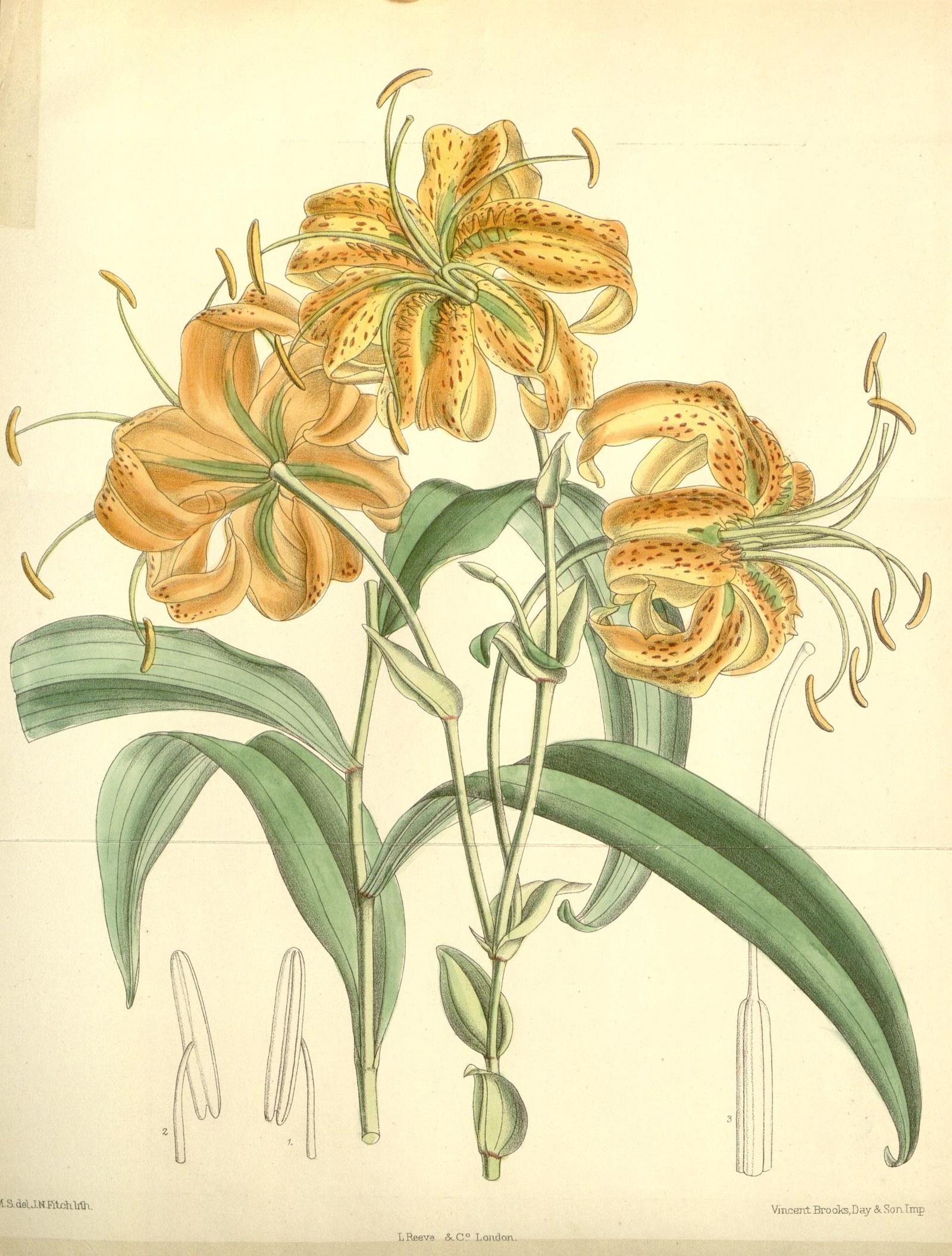
Matilda Smith del. · John Nugent Fitch lith. · Vincent Brooks, Day & Son Ltd · L. Reeve & Co., London
Week of 25 August 2025
Henry's lily
Part 3 of 6 in Bulbs and irises
Lilium henryi
An apricot-orange Turk's-cap lily from the Yangtze gorges, found by Augustine Henry in 1888 and one of the easiest lilies ever to reach a garden.
- Published
- Plate 7177, volume 117, 1891
- From
- Curtis's Botanical Magazine
- Drawn by
- Matilda Smith
- Lithograph
- John Nugent Fitch
- Technique
- Hand-coloured lithograph
- Family
- Liliaceae
- Native to
- Limestone gorges of Hubei and Guizhou, China
About the plant
Lilies have a reputation for dying out after a few years, but Henry's lily is the exception that gardeners plant and forget. It grows wild on limestone cliffs in the gorges of the Yangtze near Yichang, where Augustine Henry, the Irish customs officer and botanist, found it in 1888 and sent bulbs to Kew. By August the stems arch to two metres or more under the weight of up to twenty flowers, Turk's-caps of soft apricot-orange with their petals rolled right back and their faces studded with small raised bumps, and the plant comes back stronger each year.
Its tolerance of lime, rare among lilies, and its vigour made it the obvious partner for the white trumpet lilies from China, and the crosses, the Aurelian hybrids, gave the twentieth century some of its grandest garden lilies. The stems lean rather than stand, and growers plant the bulb deep, because it roots from the stem as well as from the base.
Matilda Smith drew the plate at Kew in 1891, three years after the bulbs arrived, in the same volume that recorded the first flowering of the titan arum.
Bought together
More in the archive
Week of 18 August 2025 · Plate 6778
Katherine-wheel lily
Scadoxus multiflorus subsp. katherinae
From £10
Buy