Matilda Smith del. · John Nugent Fitch lith. · Vincent Brooks, Day & Son Ltd · L. Reeve & Co., London
Week of 18 August 2025
Katherine-wheel lily
Part 2 of 6 in Bulbs and irises
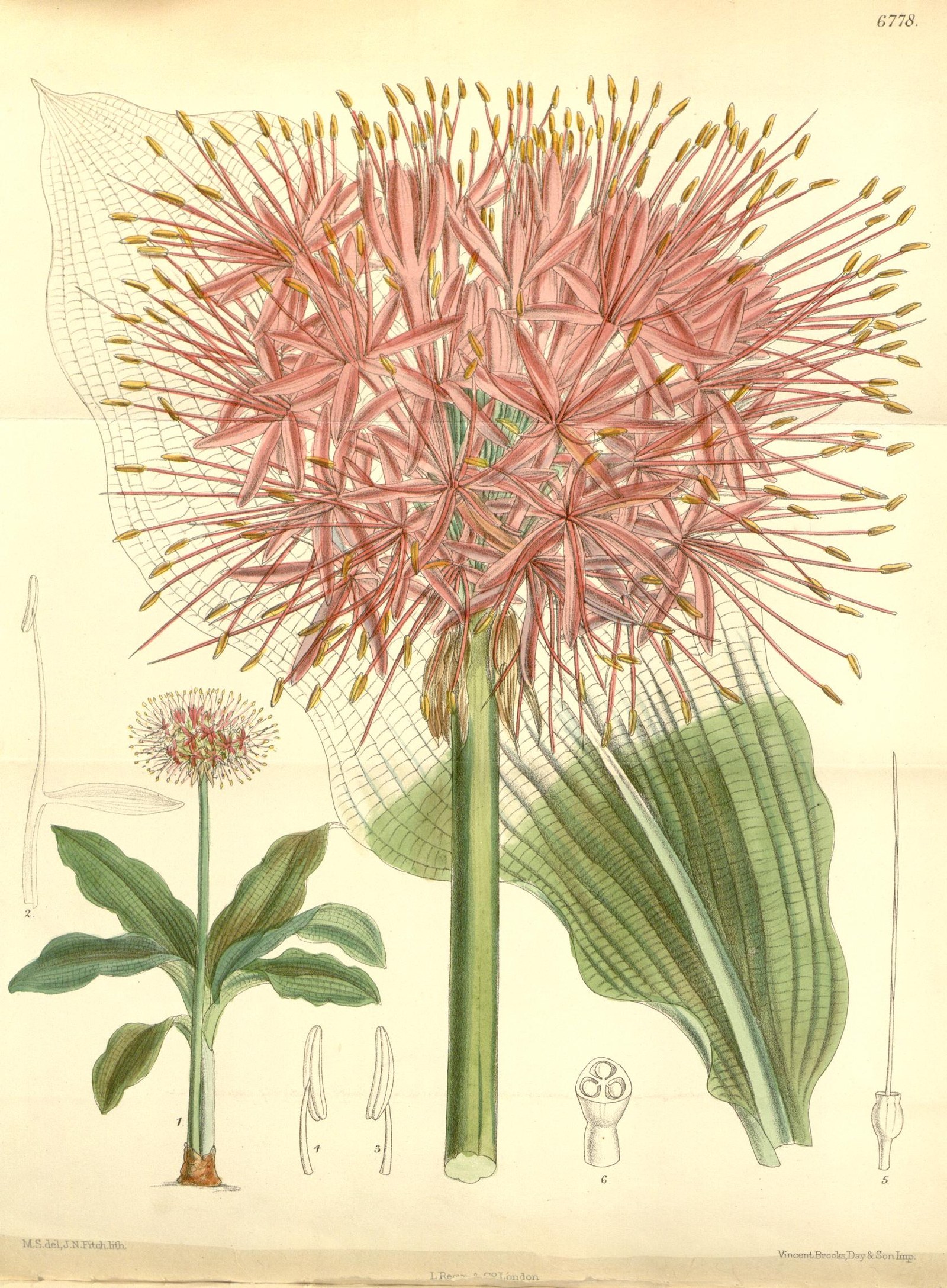
Scadoxus multiflorus subsp. katherinae (published as Haemanthus katherinae)
A South African blood lily that explodes into a scarlet sphere of two hundred flowers in summer, named for the Natal artist Katherine Saunders who sent it to Kew.
- Published
- Plate 6778, volume 110, 1884
- From
- Curtis's Botanical Magazine
- Drawn by
- Matilda Smith
- Lithograph
- John Nugent Fitch
- Technique
- Hand-coloured lithograph
- Family
- Amaryllidaceae
- Native to
- Forests of KwaZulu-Natal and the Eastern Cape, South Africa
About the plant
In the forests of Natal the Katherine-wheel lily spends the winter as a bulb under the leaf litter. In spring it throws up broad glossy leaves on a false stem speckled with purple, and in midsummer a bare stalk rises above them and bursts into a perfect sphere of scarlet, two hundred small flowers with long red stamens radiating like a firework, which is exactly what the English name means. Sunbirds and butterflies work it for weeks, and the flowers are followed by orange-red berries.
Katherine Saunders, who farmed near Pietermaritzburg and painted the plants of Natal for forty years, sent bulbs to Kew in the 1870s, and John Gilbert Baker named the plant for her in 1877. It was grown in Victorian conservatories as a pot plant, flowered in a cool house in July, and dried off for the winter; Matilda Smith drew it there in 1884. Botanists have since moved it from Haemanthus into Scadoxus and made it a subspecies of the widespread blood lily of tropical Africa.
Like its relatives it is poisonous in every part, with the same alkaloids as a daffodil bulb, and in southern Africa it is used in traditional medicine only by specialists.
Bought together
More in the archive