Matilda Smith del. · John Nugent Fitch lith. · Vincent Brooks, Day & Son Ltd · L. Reeve & Co., London
Week of 20 October 2025
Lacebark
Part 5 of 6 in Trees and conifers
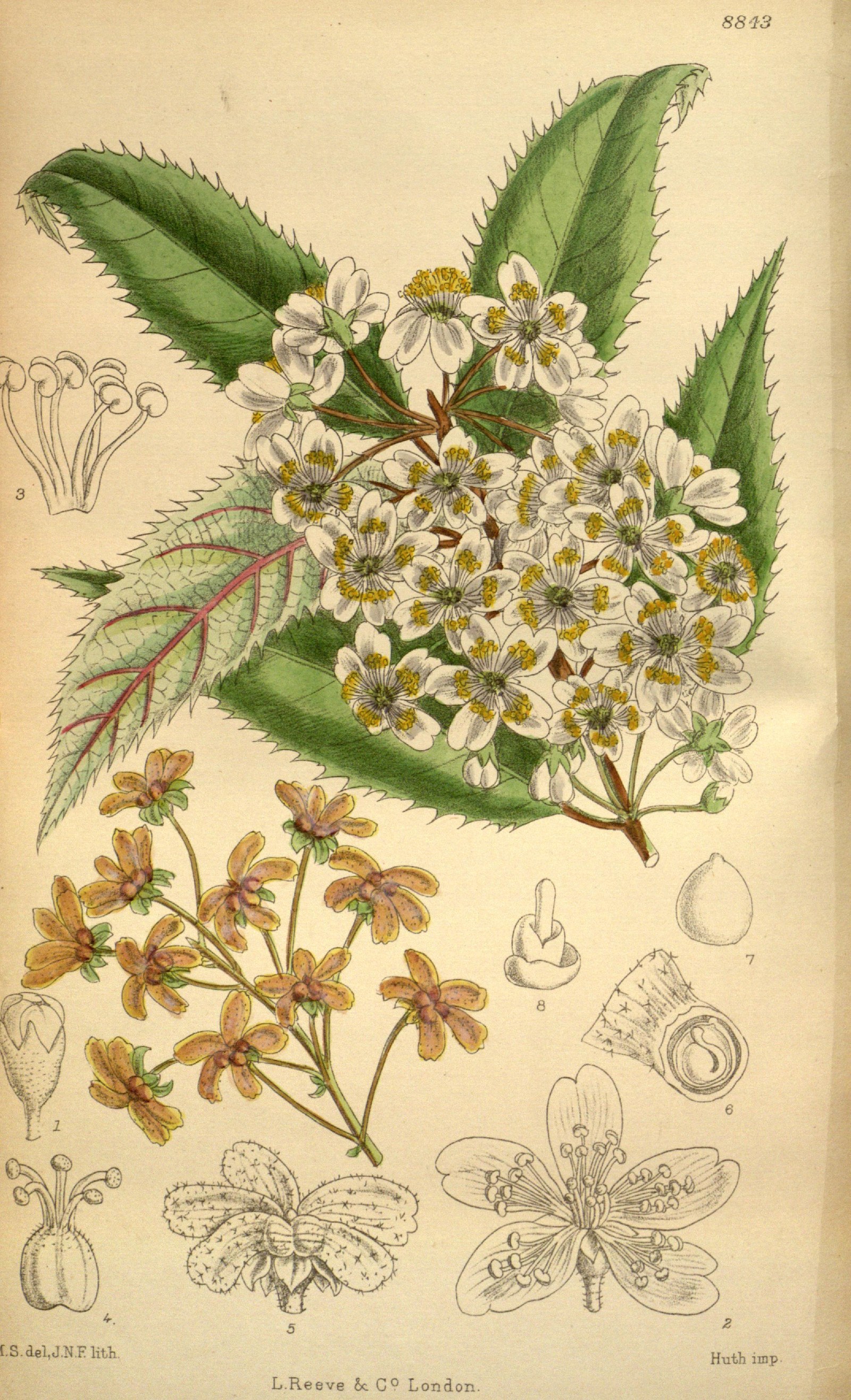
Hoheria sexstylosa (published as Hoheria populnea var. lanceolata)
The New Zealand lacebark, or houhere: an evergreen of the mallow family with white starry flowers and an inner bark of lace that Māori wove into cloth.
- Published
- Plate 8843, volume 146, 1920
- From
- Curtis's Botanical Magazine
- Drawn by
- Matilda Smith
- Lithograph
- John Nugent Fitch
- Technique
- Hand-coloured lithograph
- Family
- Malvaceae
- Native to
- New Zealand
About the plant
Peel a strip of bark from a lacebark and under the smooth outer skin you find a sheet of fine interlaced fibres, as open as a doily, that can be lifted away intact. Māori called the tree houhere and used the lace for cords, baskets and the decoration of cloaks, and the first European settlers used it to trim hats. It is one of the few New Zealand trees from the mallow family, and in late summer it shows the connection: every branch is crowded with white starry flowers like tiny hibiscus, scented with honey and loud with bees.
The genus name is the Māori name respelled, and the species are confusing: the plant in this plate was drawn in 1920 as a narrow-leaved variety of Hoheria populnea, and botanists now treat that form as a species of its own, Hoheria sexstylosa, the 'six-styled' lacebark. It grows fast, keeps its leaves all year, and in the milder parts of Britain makes a small tree within a decade. Matilda Smith drew it from a tree flowering at Kew.
Bought together
More in the archive