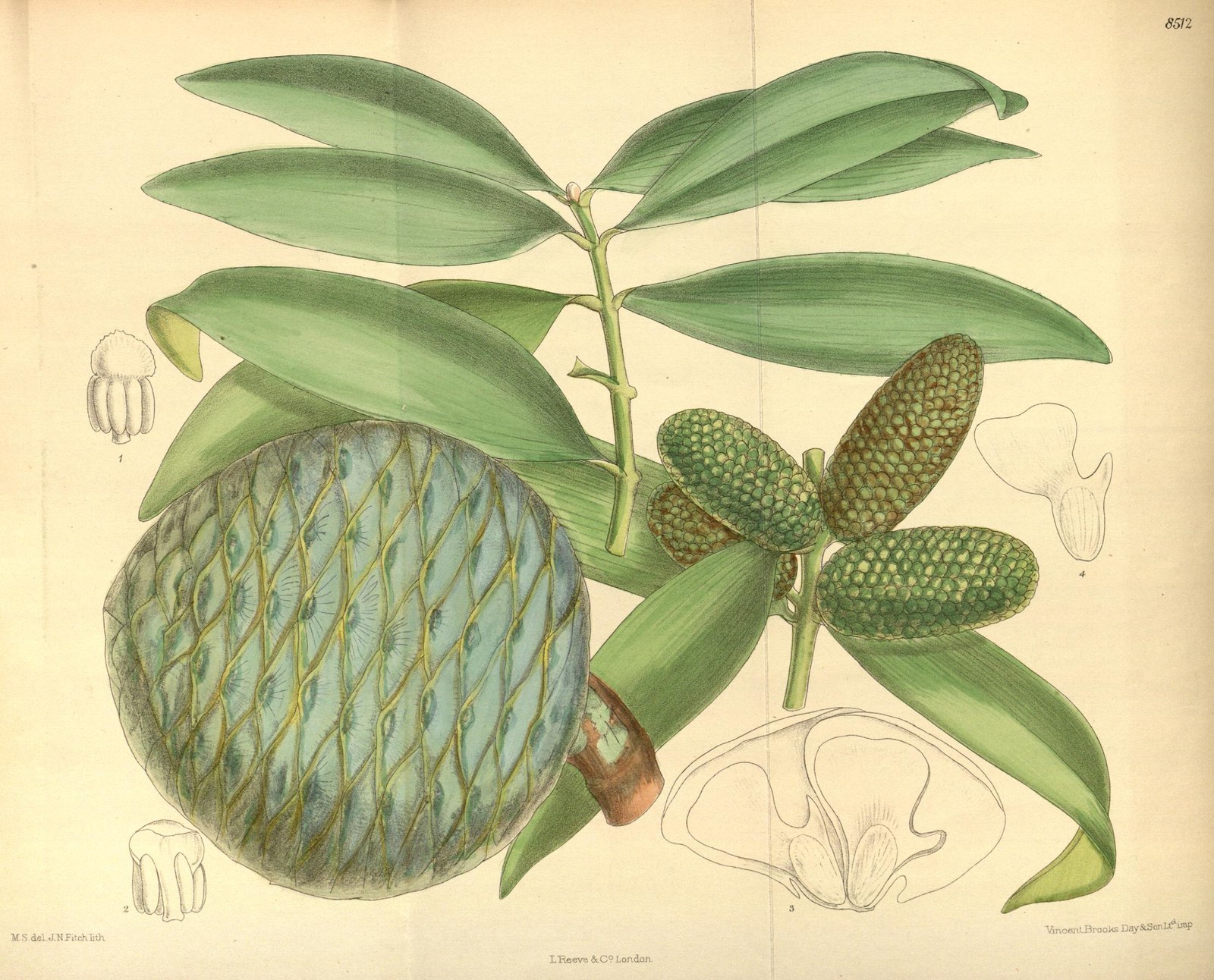
Matilda Smith del. · John Nugent Fitch lith. · Vincent Brooks, Day & Son Ltd · L. Reeve & Co., London
Week of 13 October 2025
Fijian kauri
Part 4 of 6 in Trees and conifers
Agathis vitiensis
A rainforest conifer from Fiji with broad leathery leaves that look nothing like a pine's, from a family that was old when the dinosaurs were young.
- Published
- Plate 8512, volume 139, 1913
- From
- Curtis's Botanical Magazine
- Drawn by
- Matilda Smith
- Lithograph
- John Nugent Fitch
- Technique
- Hand-coloured lithograph
- Family
- Araucariaceae
- Native to
- Fiji
About the plant
Kauris are conifers that have forgotten how conifers are supposed to look. Instead of needles they carry broad, flat, leathery leaves with many fine parallel veins, and instead of a spire they build a vast dome of a crown on a column of smooth grey trunk. Agathis vitiensis is the kauri of Fiji, a rainforest tree reaching 30 m, and its family, the Araucariaceae, was already widespread in the Jurassic when the first birds were learning to fly.
Fijians know the tree as dakua. Its resin was burned as a light and as the soot for tattooing, and under the name copal it was exported for varnish; the pale, even timber built canoes and the masts of trading schooners, and was logged so hard in the twentieth century that the tree is now protected. Seedlings grow slowly in deep shade for decades before a gap in the canopy lets them race for the light.
This plate of 1913 was made from a young plant grown at Kew; the Magazine noted that the seeds were sent from Fiji by the colonial botanist.
Bought together
More in the archive