Joseph Dalton Hooker del. · Walter Hood Fitch lith. · Vincent Brooks, Day & Son · L. Reeve & Co., London
Week of 17 November 2025
Living stones
Part 3 of 6 in Desert plants and living fossils
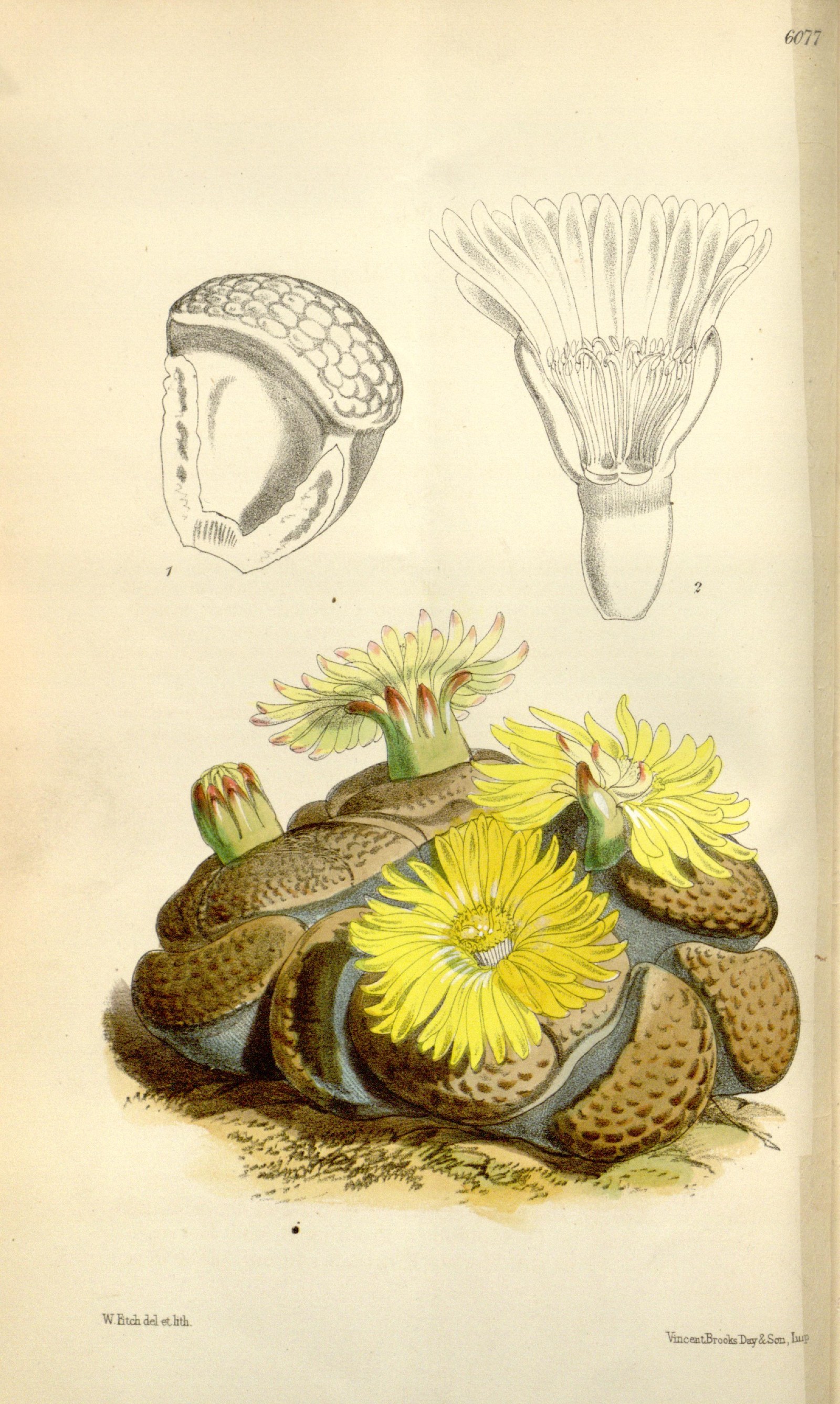
Lithops hookeri (published as Mesembryanthemum truncatellum)
A plant that disguises itself as a pebble: two fused leaves with a window on top, flowering yellow from the slit between them, drawn by Joseph Hooker himself.
- Published
- Plate 6077, volume 100, 1874
- From
- Curtis's Botanical Magazine
- Drawn by
- Joseph Dalton Hooker
- Lithograph
- Walter Hood Fitch
- Technique
- Hand-coloured lithograph
- Family
- Aizoaceae
- Native to
- Northern Cape, South Africa
About the plant
In September 1811 the explorer William Burchell, crossing the dry country near Prieska in the Northern Cape, stooped to pick up what he took for an oddly shaped pebble and found that it was a plant. Living stones are the most committed mimics in the plant kingdom: a pair of fat, fused leaves, flat-topped and coloured to match the quartz, ironstone or shale they grow among, with only the top surface showing above the ground. That surface carries a translucent window through which light passes down to the chlorophyll inside, so the plant can photosynthesise while buried to the neck.
Each year a new pair of leaves grows inside the old, drawing on their water until the old pair is a dry husk. In autumn a single daisy-like flower pushes up through the slit between the leaves. The plant drawn here flowered at Kew in 1874, and Joseph Dalton Hooker, the garden's director, drew it himself for the Magazine under the name Mesembryanthemum truncatellum. When Lithops was separated as a genus the species was named for him.
Hooker's painting carries pencilled notes by N. E. Brown, the Kew botanist who made sense of the genus decades later.
Bought together
More in the archive