James Sowerby del. · William Curtis, London
Week of 7 April 2025
Sweet violet
Part 1 of 6 in Georgian and Regency gardens
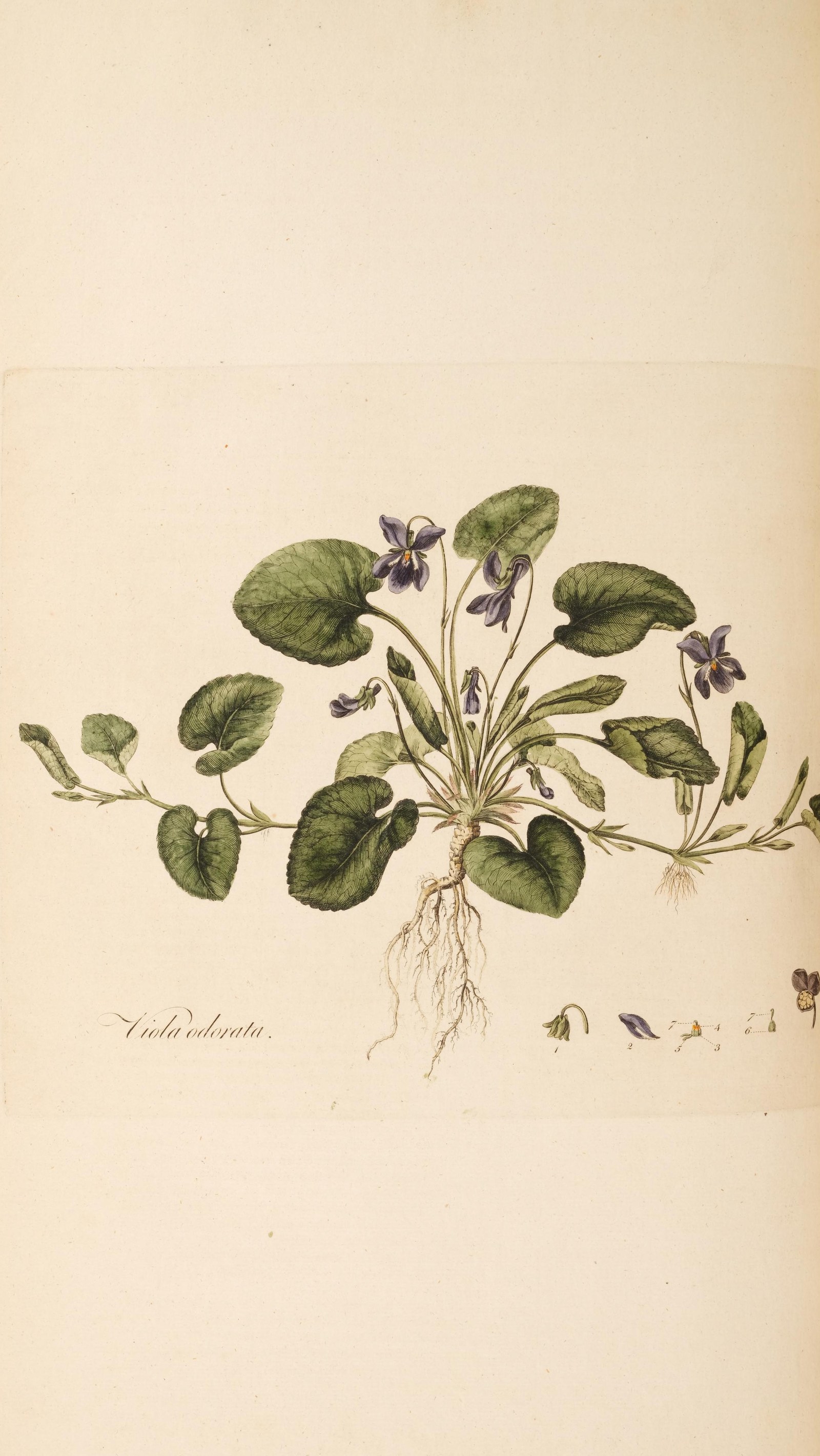
Viola odorata
The sweet violet of the hedge bank and the perfumer, drawn with its runners and roots for Flora Londinensis, the first great book of British wild flowers.
- Published
- 1777
- From
- Flora Londinensis
- Drawn by
- James Sowerby
- Technique
- Hand-coloured copper engraving
- Family
- Violaceae
- Native to
- Europe, North Africa and western Asia
About the plant
The sweet violet opens in March on hedge banks and at the edges of woods, a small purple flower on a leafless stalk among heart-shaped leaves, and for a few moments it has the scent that everybody knows and nobody can smell for long: the ionone in its perfume numbs the nose, so that the violet seems to come and go. It is the only scented violet in Britain and probably not a native at all, but an escape from gardens so old that nobody can tell. Later in the year it makes a second kind of flower that never opens and sets seed shut, and ants carry the seed off for the oily lump attached to each.
Few flowers have carried so much meaning. It was the flower of Athens, the sign of Napoleon's supporters when he was on Elba, the posy that Victorian gentlemen bought from flower girls, and the scent of the Edwardian drawing room, when violet farms at Stratford in east London and at Hyères on the Riviera sent flowers by the million. Curtis described its uses as a physician would, the syrup of violets for children's coughs and the leaves for sleeplessness, and had it drawn at life size with its creeping runners and the capsule splitting to shed seed, in the first part of Flora Londinensis in 1777.