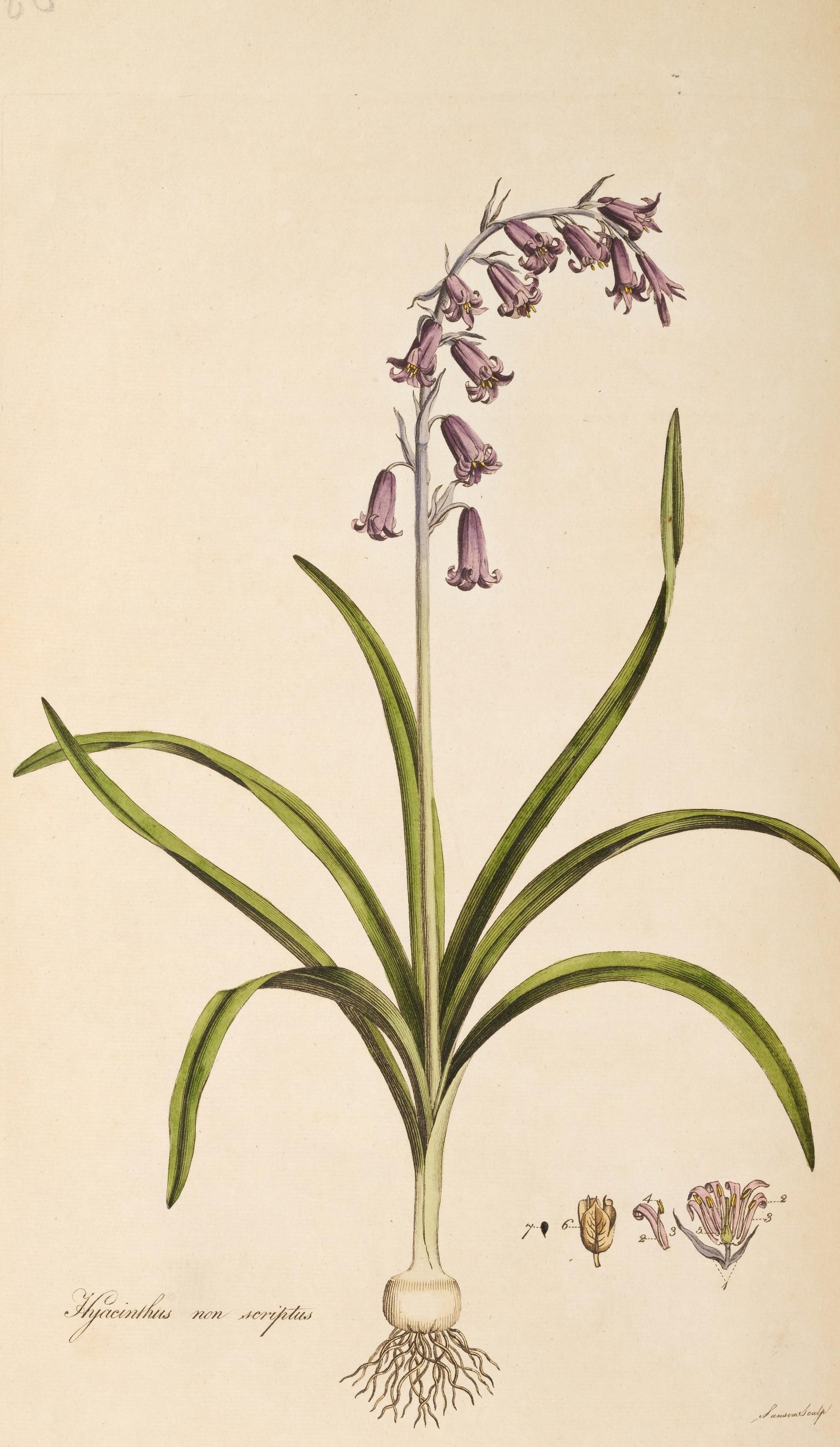
James Sowerby del. · Francis Sansom sculp. · William Curtis, London
Week of 14 April 2025
Bluebell
Part 2 of 6 in Georgian and Regency gardens
Hyacinthoides non-scripta (published as Hyacinthus non-scriptus)
The English bluebell drawn life-size for Flora Londinensis, William Curtis's record of the wild plants within ten miles of London, with the bulb, the flower and its dissected parts.
- Published
- 1779
- From
- Flora Londinensis
- Drawn by
- James Sowerby
- Engraved by
- Francis Sansom
- Technique
- Hand-coloured copper engraving
- Family
- Asparagaceae
- Native to
- Britain, Ireland and Atlantic Europe from Spain to the Netherlands
About the plant
William Curtis was an apothecary's apprentice from Alton who gave up the shop for botany, became demonstrator at the Chelsea Physic Garden and in 1777 began Flora Londinensis, a work of plain ambition: every wild plant that grew within ten miles of London, drawn from life at natural size, engraved, coloured by hand and sold in parts with a full account of its uses. He had James Sowerby and William Kilburn to draw for him. The plates are among the finest ever made of British wild flowers and the public did not want them; Curtis lost money on every part, gave up after six fascicles in 1798, and made his fortune instead with the Botanical Magazine, which showed garden flowers and sold by the thousand.
The bluebell is a plant of the Atlantic edge of Europe, from the north of Spain to the Low Countries, and nowhere is it as common as in Britain, where ancient oakwoods turn blue with it in May before the leaves close over. The bulb was once dug for its starch, which stiffened Elizabethan ruffs and glued the feathers to arrows. Sowerby drew it with the bulb and roots, the nodding one-sided raceme with its reflexed tips, and the flower taken apart, as Curtis required for every plate. The scent of a bluebell wood in the evening is one of the things England does better than anywhere.
Bought together
More in the archive