Walther Müller, C. F. Schmidt and K. Gunther del. · Franz Eugen Köhler, Gera-Untermhaus
Week of 11 November 2024
Foxglove
Part 2 of 7 in The medicine chest
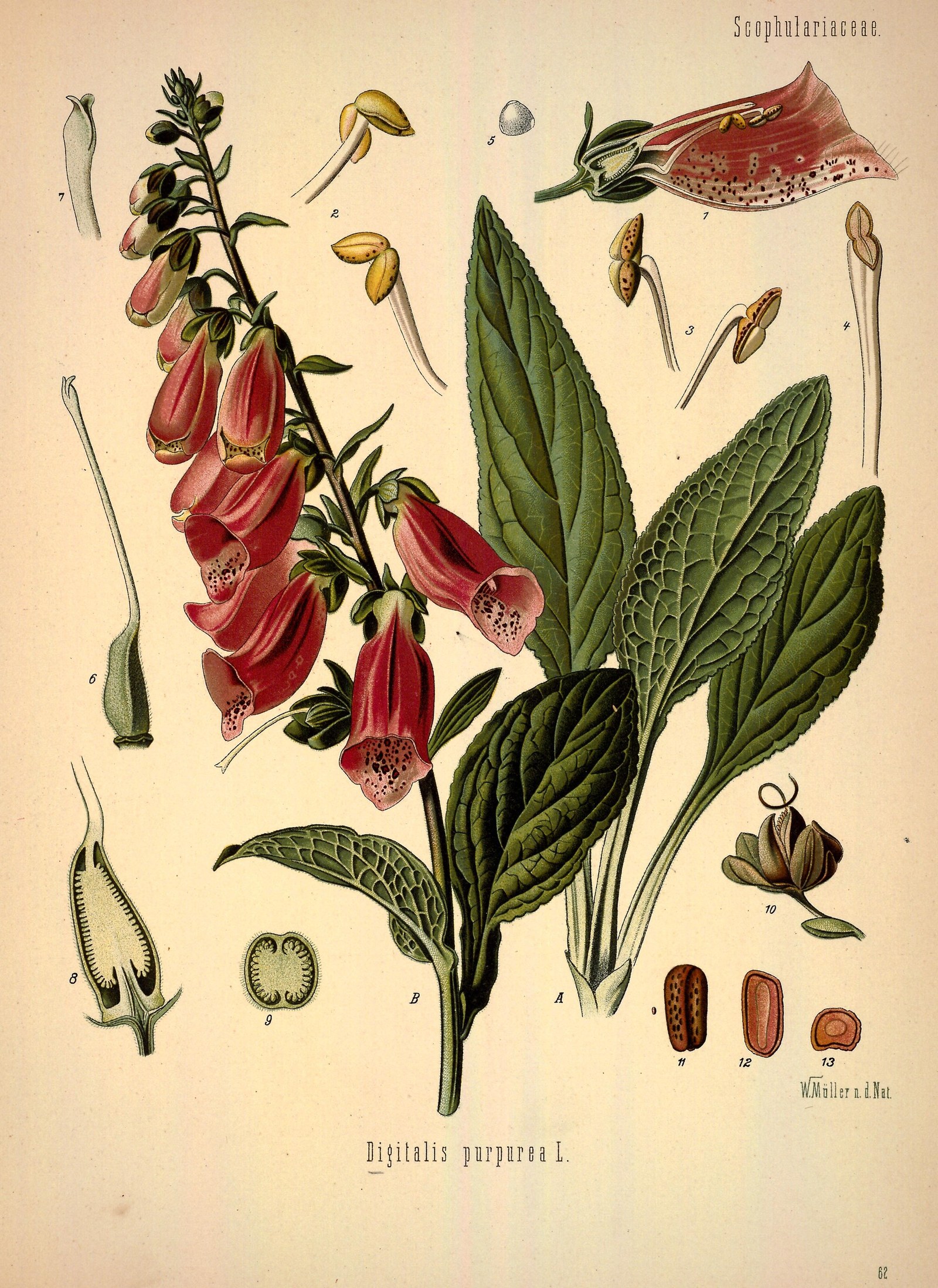
Digitalis purpurea
The foxglove of British woods and the drug that came from it: a century after William Withering taught doctors to use it for the heart, Köhler's atlas drew it for the pharmacy.
- Published
- volume 1, 1887
- From
- Köhler's Medizinal-Pflanzen
- Drawn by
- Walther Müller, C. F. Schmidt and K. Gunther
- Technique
- Chromolithograph
- Family
- Plantaginaceae
- Native to
- Western Europe, including Britain and Ireland
About the plant
Everyone knows the foxglove: a rosette of soft grey-green leaves in its first year, and in its second a spire of purple bells, each speckled inside, that bumblebees crawl into one after another from the bottom up. It is a plant of clearings and burnt ground across western Europe, and in Britain it appears by the thousand wherever a wood is felled. It is also deadly, and that is its importance. In 1775 William Withering, a physician in Birmingham, was asked about a family recipe used in Shropshire to cure dropsy, the swelling of heart failure; he found that foxglove was its active ingredient, spent ten years working out the dose, and in 1785 published An Account of the Foxglove, the first careful clinical study of a drug plant.
The glycosides he was using without a name, digitoxin and digoxin, strengthen the beat of a weak heart and slow it, and two centuries on they are still on the shelf. Köhler's atlas, drawn for pharmacists who had to recognise the leaf they were buying, shows the plant with its flower dissected and its seeds enlarged, in the exact chromolithography the work was famous for.
Bought together
More in the archive