Walther Müller, C. F. Schmidt and K. Gunther del. · Franz Eugen Köhler, Gera-Untermhaus
Week of 4 November 2024
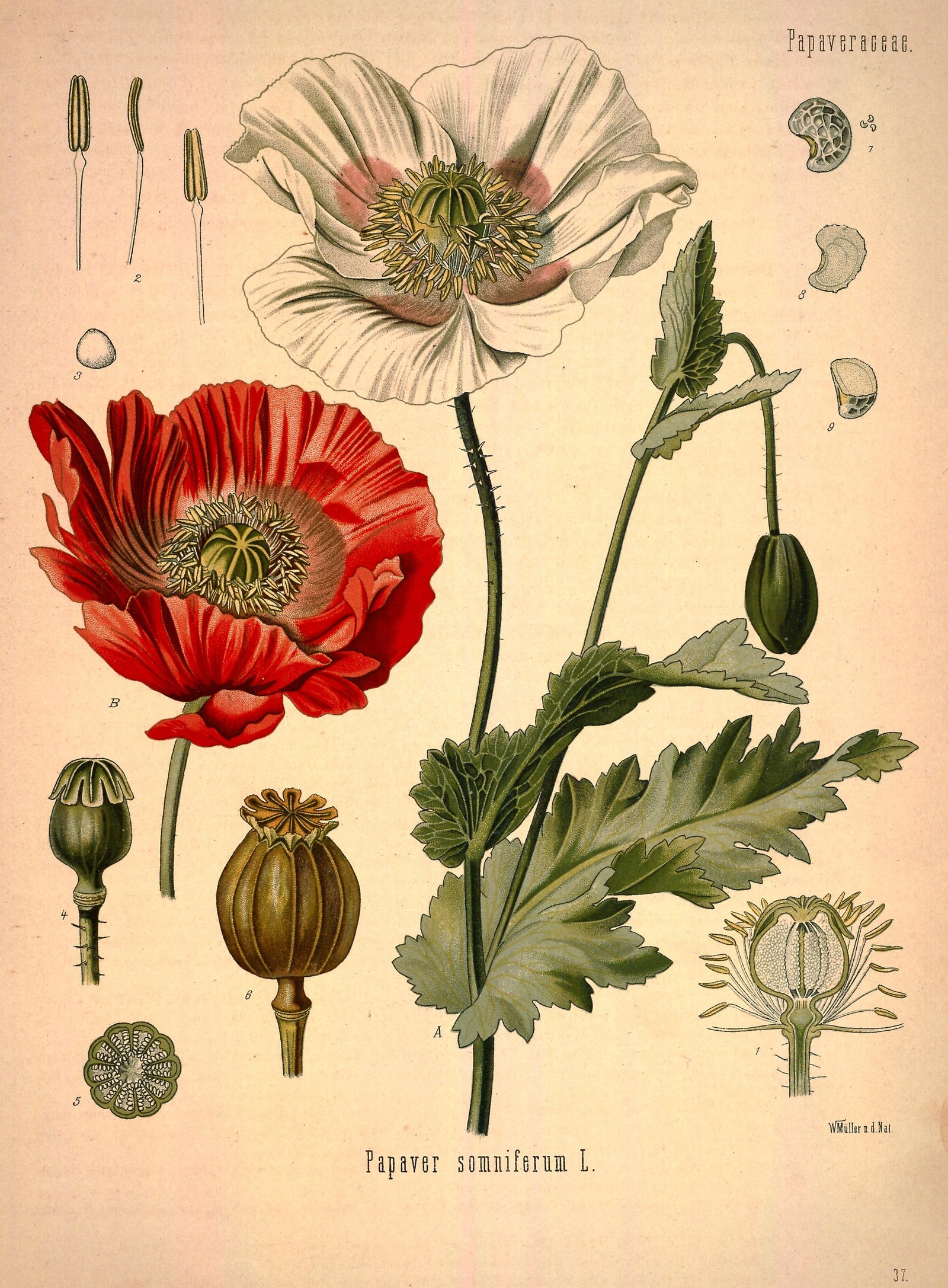
Opium poppy
Part 1 of 7 in The medicine chest
Papaver somniferum
The opium poppy as the German pharmacopoeia saw it in 1887: flower, capsule and seed in a chromolithograph from the most exacting atlas of medicinal plants ever made.
- Published
- volume 1, 1887
- From
- Köhler's Medizinal-Pflanzen
- Drawn by
- Walther Müller, C. F. Schmidt and K. Gunther
- Technique
- Chromolithograph
- Family
- Papaveraceae
- Native to
- Eastern Mediterranean and Asia Minor; cultivated since the Neolithic
About the plant
Few plants have shaped history as the opium poppy has. A tall annual with waxy blue-grey leaves and silken flowers of white, pink or purple, it has been grown since the Stone Age for its seeds and for the latex that oozes from the scored, unripe capsule and dries to opium. Sumerian tablets call it the joy plant; Greek physicians prescribed it; and in 1804 the German apprentice pharmacist Friedrich Sertürner isolated from it a crystalline substance he named morphium, after the god of dreams, the first time an active principle had ever been purified from a plant. Modern medicine still runs on its descendants.
The plate comes from Köhler's Medizinal-Pflanzen, published in parts from Gera in Thuringia between 1887 and 1898 as an atlas to the German, Austrian and other pharmacopoeias. Its 283 plates, drawn by Walther Müller, C. F. Schmidt and K. Gunther and printed in up to a dozen colours, show each drug plant whole and in dissection with a precision no herbal had managed before, and they have never been bettered.
Bought together
More in the archive