Walther Müller, C. F. Schmidt and K. Gunther del. · Franz Eugen Köhler, Gera-Untermhaus
Week of 18 November 2024
Hop
Part 3 of 7 in The medicine chest
Humulus lupulus
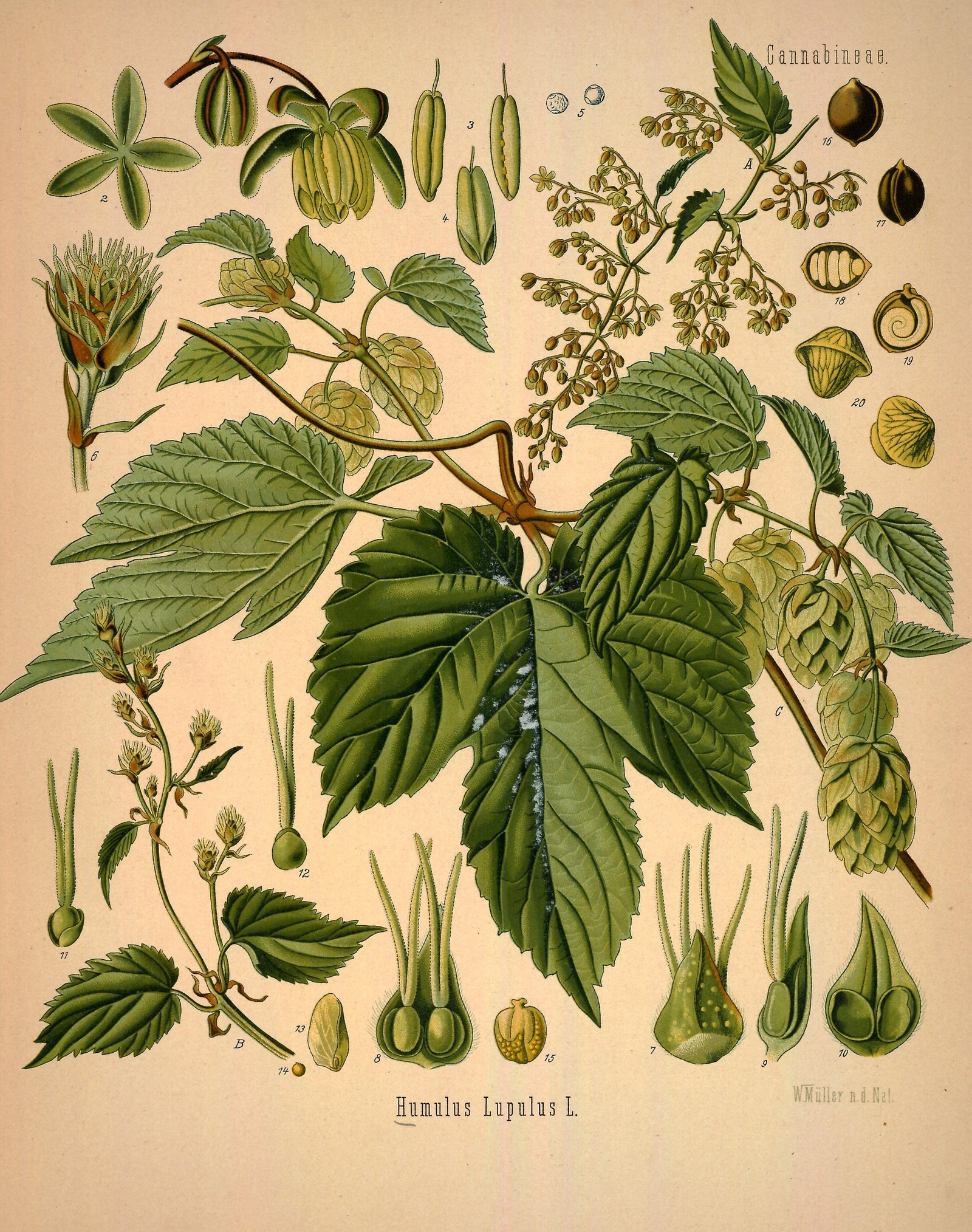
The hop vine whose cones bitter and preserve beer, drawn with its papery female cones and the golden lupulin dust that is the point of it.
- Published
- volume 1, 1887
- From
- Köhler's Medizinal-Pflanzen
- Drawn by
- Walther Müller, C. F. Schmidt and K. Gunther
- Technique
- Chromolithograph
- Family
- Cannabaceae
- Native to
- Europe, western Asia and North America
About the plant
The hop is one of the few plants grown for a single sex. The female flowers ripen into papery green cones, and at the base of each scale sit yellow glands full of lupulin, a sticky resin whose acids give beer its bitterness and, more usefully to a medieval brewer, keep it from going sour. Monks in ninth-century Germany were the first to put hops in ale; the Dutch brought hopped beer to England in the fifteenth century, to the disgust of ale drinkers, and by Tudor times the hop gardens of Kent were a landscape of poles and bines, picked each September by families from London.
It is a vigorous perennial climber that dies to a crown each winter and in spring sends up shoots that can grow a hand's breadth in a day, twining clockwise, always clockwise, up strings and wires. In Belgium the young shoots are eaten like asparagus. Köhler's atlas included it as a medicine: hop pillows for sleeplessness and a bitter tonic for the digestion, and the plate shows the cones, the lupulin glands and the male flowers in dissection.
Bought together
More in the archive