Walther Müller, C. F. Schmidt and K. Gunther del. · Franz Eugen Köhler, Gera-Untermhaus
Week of 25 November 2024
Saffron crocus
Part 4 of 7 in The medicine chest
Crocus sativus
The autumn crocus whose three red stigmas are saffron, the most expensive spice on Earth, a plant that cannot set seed and has been passed from hand to hand since the Bronze Age.
- Published
- volume 2, 1890
- From
- Köhler's Medizinal-Pflanzen
- Drawn by
- Walther Müller, C. F. Schmidt and K. Gunther
- Technique
- Chromolithograph
- Family
- Iridaceae
- Native to
- Unknown in the wild; grown for 3,500 years from the Aegean to Kashmir
About the plant
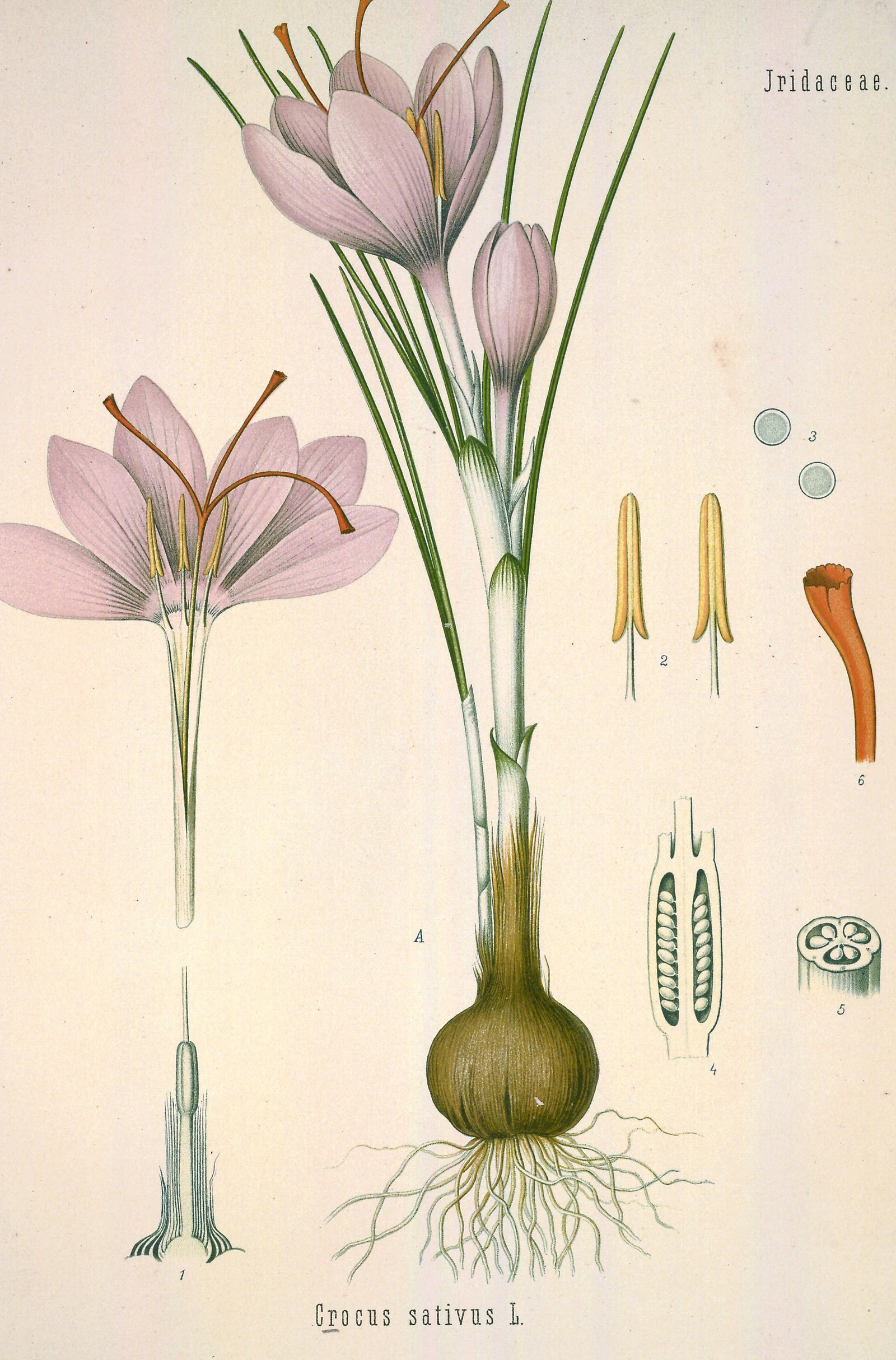
Saffron is the stigma of a crocus, three slender threads of scarlet that hang from each lilac flower, and nothing else. They must be picked by hand on the morning the flower opens, in October, and dried the same day, and it takes something like a hundred and fifty thousand flowers to make a kilogram, which is why saffron has always cost more than its weight in silver. The plant that produces it is a human invention: a sterile triploid that sets no seed and has been propagated by dividing its corms for at least three and a half thousand years, since the Minoan women painted on the walls of Akrotiri gathered it on the slopes of Santorini.
It was grown in Persia, Kashmir, Spain and Italy, and in the fourteenth century in Essex, where the town of Chipping Walden became Saffron Walden and put the flower on its coat of arms. Köhler's atlas drew it for the pharmacy, where saffron was prescribed as a sedative and a dye for medicines; the plate shows the corm, the flower, and the stigmas that are the drug.
Bought together
More in the archive