Walther Müller, C. F. Schmidt and K. Gunther del. · Franz Eugen Köhler, Gera-Untermhaus
Week of 2 December 2024
Nutmeg and mace
Part 5 of 7 in The medicine chest
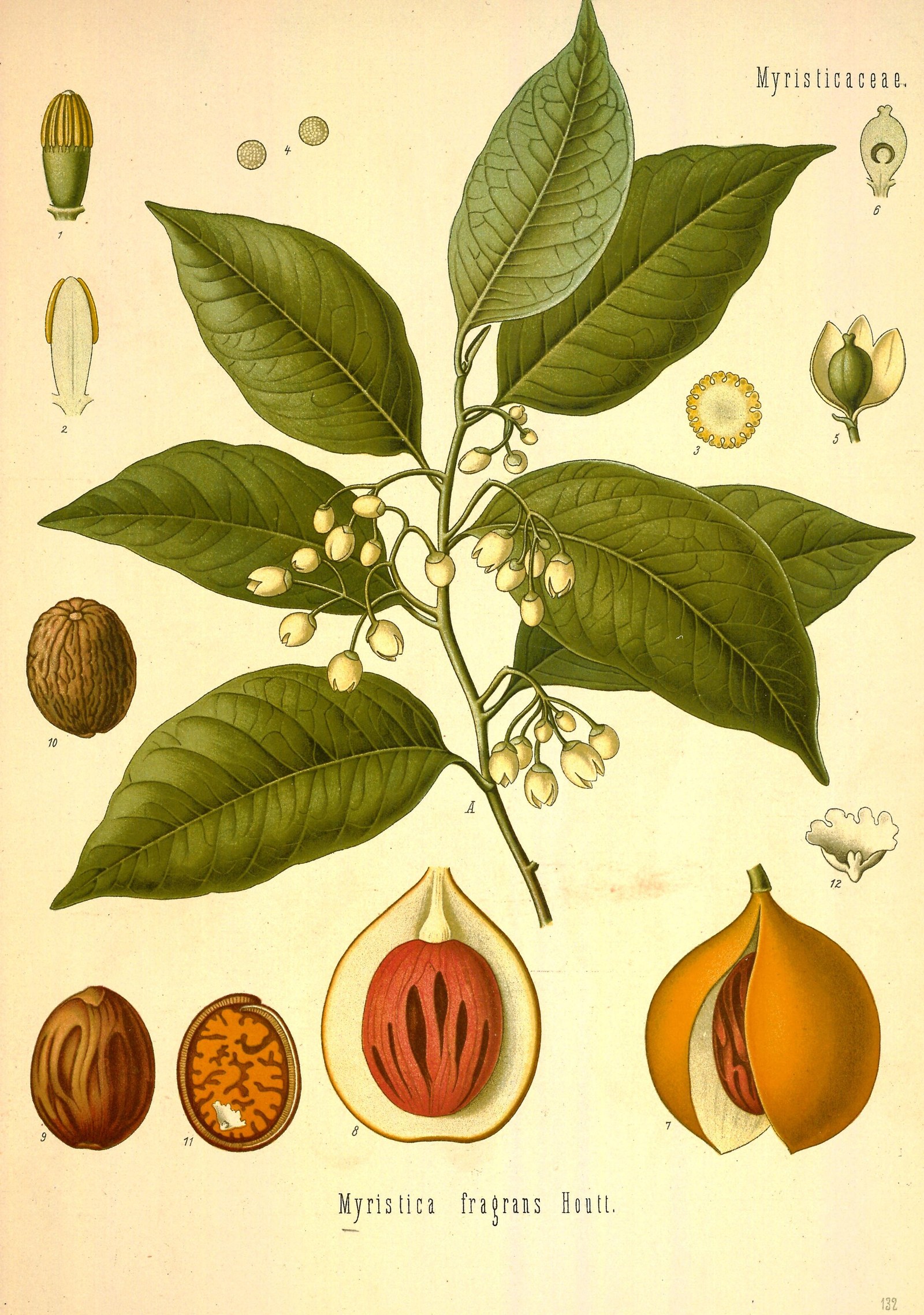
Myristica fragrans
Two spices from one fruit: the nutmeg seed in its scarlet lace of mace, from the tiny Banda Islands whose trees were once worth more than Manhattan.
- Published
- volume 2, 1890
- From
- Köhler's Medizinal-Pflanzen
- Drawn by
- Walther Müller, C. F. Schmidt and K. Gunther
- Technique
- Chromolithograph
- Family
- Myristicaceae
- Native to
- The Banda Islands, Indonesia
About the plant
The nutmeg tree grows only, in nature, on a handful of small volcanic islands in the Banda Sea, and for most of history nobody in Europe knew where that was. The spice arrived through Arab and Venetian hands at prices that made it a luxury of kings, and when the Portuguese and then the Dutch found the islands in the sixteenth century they fought for them. In 1621 the Dutch East India Company massacred and enslaved the Bandanese and planted the islands as a nutmeg factory, and in 1667, to keep the last English foothold, the island of Run, they handed the English New Amsterdam in exchange: Manhattan for nutmeg.
The tree is a glossy evergreen with yellow fruits like apricots that split when ripe to show the seed inside, wrapped in a lacy scarlet net. The net is mace and the seed is nutmeg, two spices from one fruit, and the Dutch limed the seeds before export so they could not be grown elsewhere, until the French botanist Pierre Poivre smuggled seedlings to Mauritius in 1770. Köhler's atlas, which drew it for the pharmacopoeia, shows the fruit, the mace and the seed; it adds the warning that a few whole nutmegs will poison.
Bought together
More in the archive