Walther Müller, C. F. Schmidt and K. Gunther del. · Franz Eugen Köhler, Gera-Untermhaus
Week of 9 December 2024
Tea
Part 6 of 7 in The medicine chest
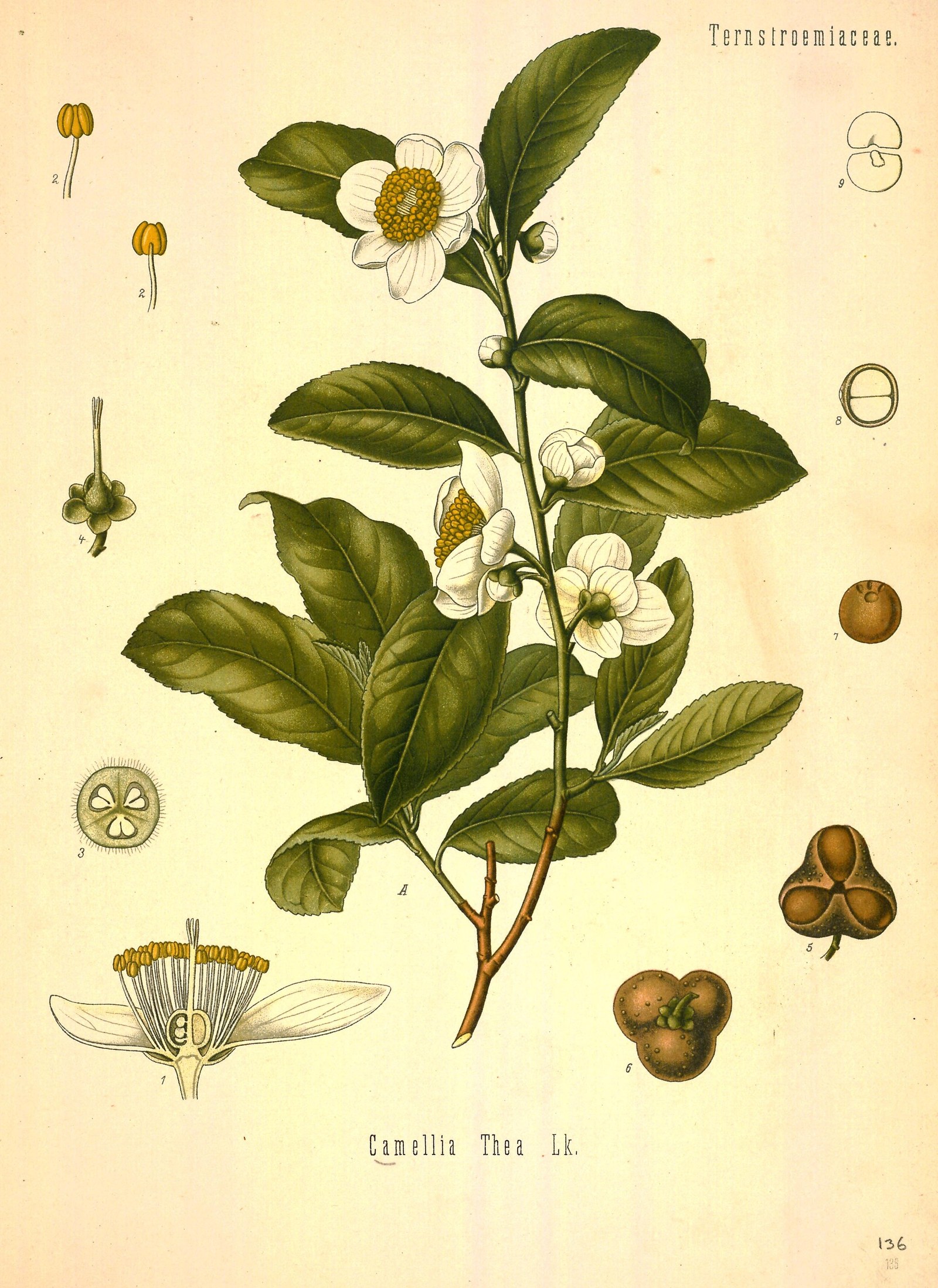
Camellia sinensis (published as Thea chinensis)
The tea plant, a camellia with a small white flower, which China kept to itself for two thousand years and Britain carried to India in 1848.
- Published
- volume 2, 1890
- From
- Köhler's Medizinal-Pflanzen
- Drawn by
- Walther Müller, C. F. Schmidt and K. Gunther
- Technique
- Chromolithograph
- Family
- Theaceae
- Native to
- Borderlands of south-west China, Myanmar and Assam
About the plant
Tea is a camellia. Left to itself it makes a small evergreen tree with glossy, toothed leaves and white, yellow-stamened flowers like a modest cousin of the garden camellia; plucked every week or two it is held at waist height in the dense green hedges of a tea garden, and the pluckers take only the bud and the two youngest leaves. What happens next decides everything: steamed or pan-fired at once the leaf stays green; bruised and left to oxidise for a few hours it turns to black tea; stopped halfway it is oolong. The Chinese had worked all this out a thousand years before Europe tasted it.
The plant grows wild in the hills where Yunnan, Burma and Assam meet, and China guarded its cultivation so well that in 1848 the East India Company sent the plant hunter Robert Fortune into the interior disguised as a Chinese merchant to steal plants, seed and the knowledge of the men who processed them. The tea gardens of Darjeeling and Assam are the result. Köhler drew it under the old name Thea chinensis as a stimulant drug, with the flower and the capsule in dissection.
Bought together
More in the archive