Elizabeth Blackwell del. · Samuel Harding, London
Week of 30 December 2024
Clove
Part 2 of 6 in Blackwell's Curious Herbal
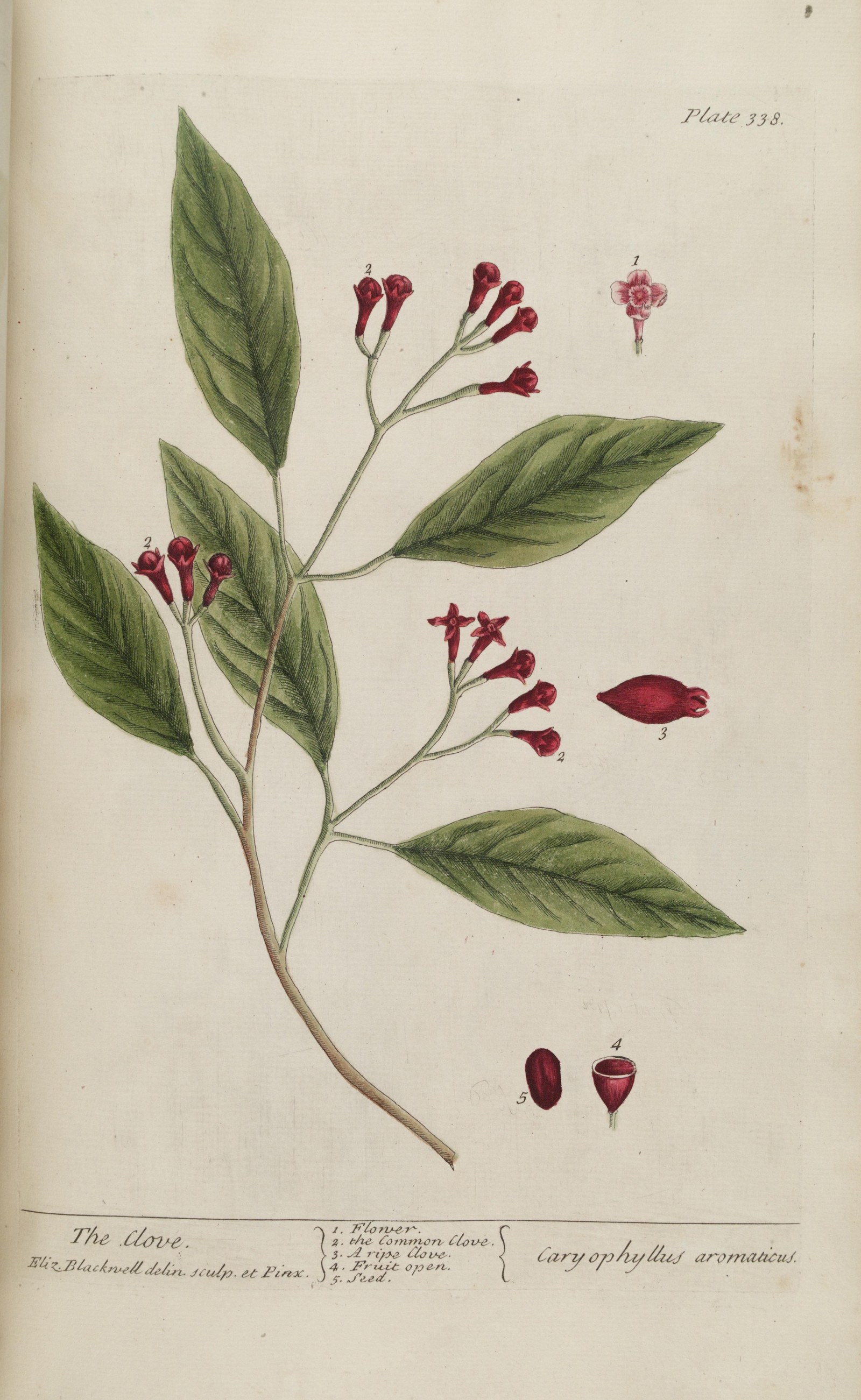
Syzygium aromaticum (published as Caryophyllus aromaticus)
The clove tree of the Moluccas, whose dried flower buds were worth more than gold in Blackwell's London, drawn, engraved and coloured by Elizabeth Blackwell for A Curious Herbal.
- Published
- Plate 338, volume 2, 1739
- From
- A Curious Herbal
- Drawn by
- Elizabeth Blackwell
- Technique
- Hand-coloured copper engraving
- Family
- Myrtaceae
- Native to
- The Moluccas, the spice islands of eastern Indonesia
About the plant
Cloves are the flower buds of a tall evergreen tree of the myrtle family, picked by hand just before they open and dried in the sun until they turn the colour of rust and become as hard as nails, which is what the name means: the French clou, a nail. For most of history the tree grew on five small volcanic islands in the Moluccas and nowhere else, and the spice that reached Rome, China and medieval Europe had passed through a dozen hands and multiplied its price at each. When the Dutch took the islands in the seventeenth century they kept the monopoly by felling every tree they did not control, until in 1770 a French administrator, Pierre Poivre, smuggled seedlings out to Mauritius and the trade was broken.
Elizabeth Blackwell drew the clove in 1739 for the second volume of A Curious Herbal, next to the coffee, from a dried branch and an earlier drawing, since no living clove tree had been seen in England; she showed the leafy branch, the flower and the bud, and gave the plant's uses in the few lines beneath. The plate was drawn, engraved and coloured by her own hand, as were all five hundred of the book she made to get her husband out of debtors' prison.