Elizabeth Blackwell del. · Samuel Harding, London
Week of 20 January 2025
Mandrake
Part 5 of 6 in Blackwell's Curious Herbal
Mandragora officinarum
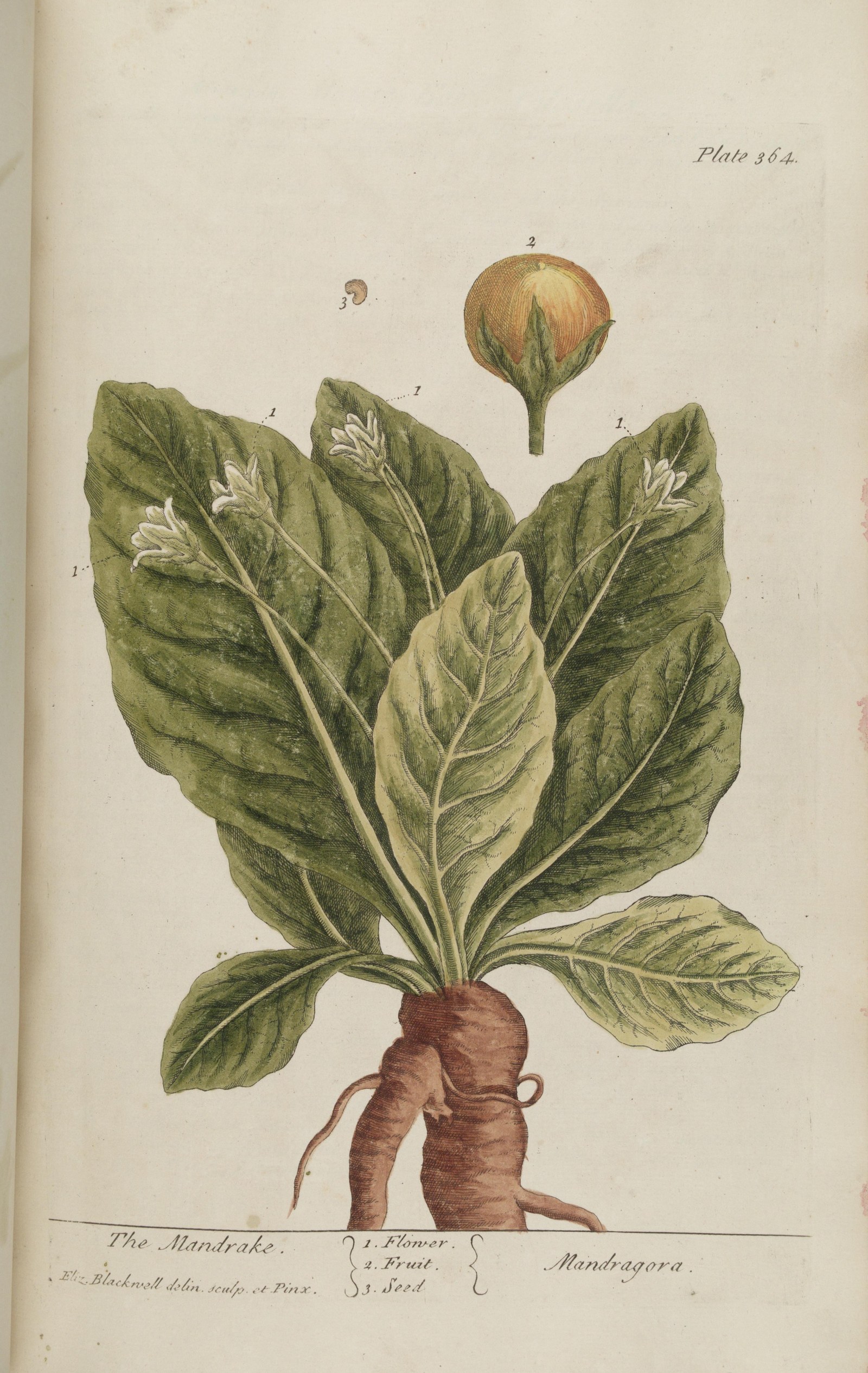
The mandrake, the most storied plant in the herbal, with its forked root and its legendary shriek, drawn by Elizabeth Blackwell from the plant itself rather than the legend.
- Published
- Plate 364, volume 2, 1739
- From
- A Curious Herbal
- Drawn by
- Elizabeth Blackwell
- Technique
- Hand-coloured copper engraving
- Family
- Solanaceae
- Native to
- The Mediterranean, from Portugal to the Levant
About the plant
No plant has carried more legend than the mandrake. The forked root, split like a pair of legs, was a man in miniature; it screamed when pulled from the earth and the scream killed, so the gatherer stopped his ears, tied a hungry dog to the plant, and let the dog do the pulling and the dying. Rachel buys mandrakes from Leah in Genesis for the sake of children; Juliet dreads the shrieks like mandrakes torn out of the earth; and the dealers of the seventeenth century carved bryony roots into little men and sold them as mandrakes to the credulous, to the fury of John Gerard, who exposed the trade in his herbal of 1597.
Behind the legend is a real and useful plant, a Mediterranean nightshade with a rosette of leaves, purple bell flowers in the cool months and yellow fruits that smell of apples, whose root is full of the same alkaloids as henbane and deadly nightshade. Dioscorides gave mandrake wine to patients before surgery, and it stayed in the pharmacopoeia as a sedative and painkiller into Blackwell's day. Her plate shows it without the man, a plant drawn from the Chelsea Physic Garden, and her text keeps the folklore at arm's length.
Bought together
More in the archive