Elizabeth Blackwell del. · Samuel Harding, London
Week of 13 January 2025
Pomegranate
Part 4 of 6 in Blackwell's Curious Herbal
Punica granatum
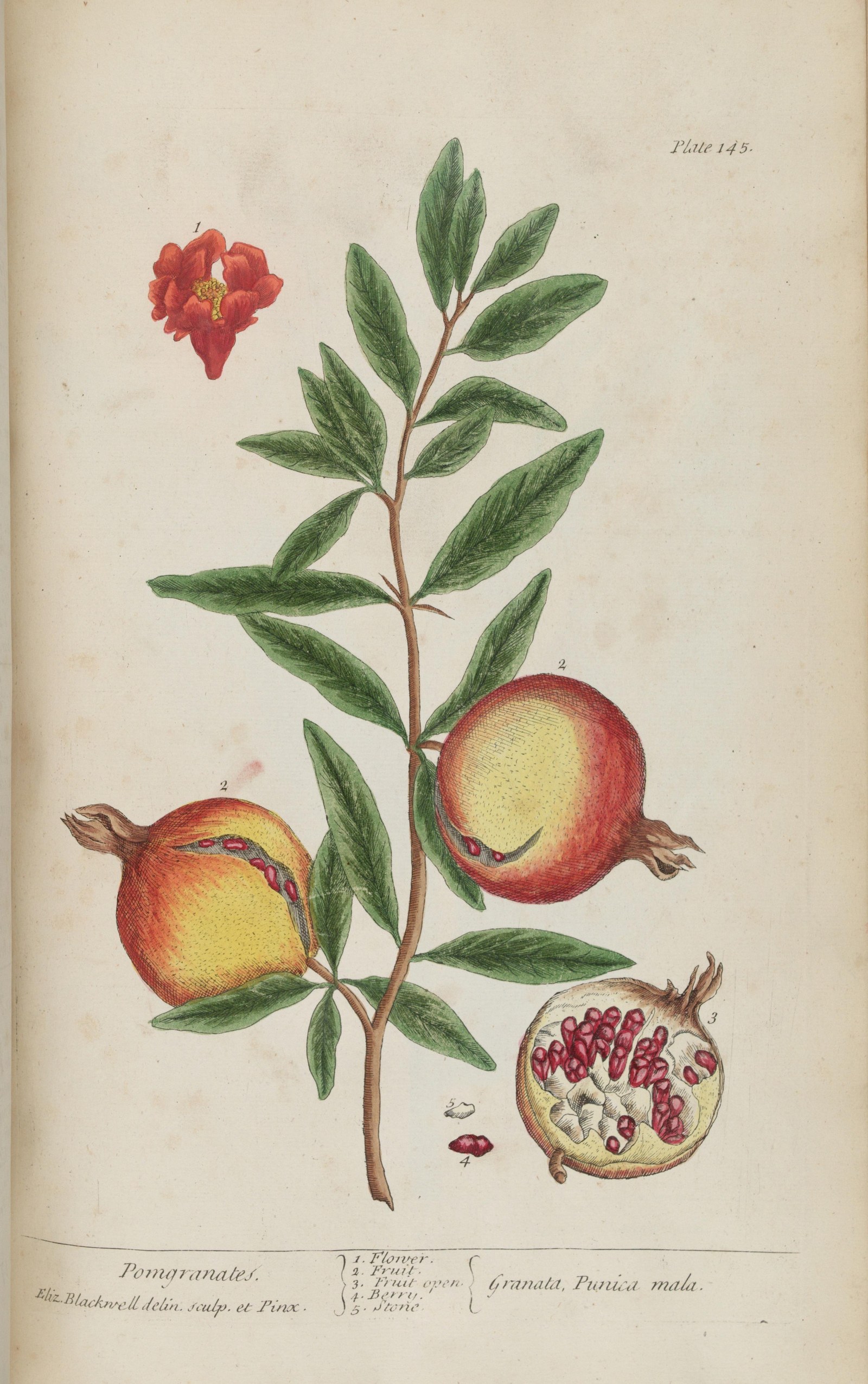
The pomegranate in flower and fruit from A Curious Herbal: the fruit of Persephone and the badge of Catherine of Aragon, in the herbal for the sake of its bitter rind.
- Published
- Plate 145, volume 1, 1737
- From
- A Curious Herbal
- Drawn by
- Elizabeth Blackwell
- Technique
- Hand-coloured copper engraving
- Family
- Lythraceae
- Native to
- Iran to northern India; cultivated across the Mediterranean since antiquity
About the plant
The pomegranate came west from Persia so early that the Greeks thought it native: it is the fruit Persephone ate in the underworld, which bound her to Hades for the winter months and gave the world its seasons, and the Romans called it the Punic or Carthaginian apple because they had it from North Africa. The Moors planted it in Spain and named the city of Granada for it, and Catherine of Aragon carried it to England on her badge, where it was quartered with the Tudor rose until Henry VIII put her aside. The crumpled scarlet flowers come in June; the fruit ripens in autumn to a leathery globe packed with hundreds of glassy red seeds in a honeycomb of pith.
Blackwell drew it at Chelsea because the physicians used it: the astringent rind and the root bark, rich in tannins and alkaloids, were the standard treatment for tapeworm and for dysentery from Dioscorides until the twentieth century, and the flowers, dried, went into gargles. Her plate shows flower, fruit and a split seed-chamber, engraved on copper and coloured by her own hand.