Elizabeth Blackwell del. · Samuel Harding, London
Week of 6 January 2025
Orange
Part 3 of 6 in Blackwell's Curious Herbal
Citrus × sinensis (published as Aurantium)
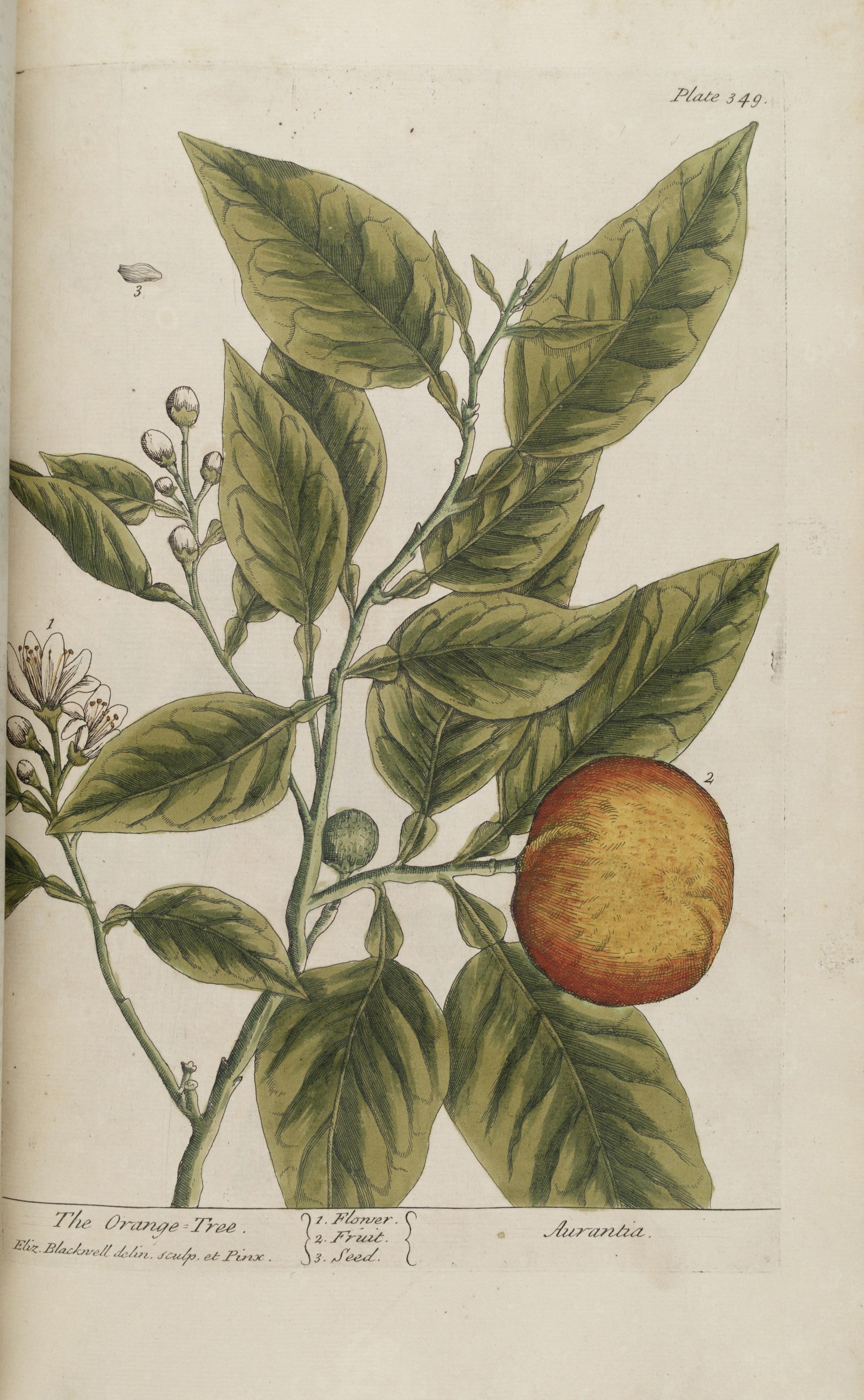
The orange tree in flower and fruit, a Chinese hybrid that reached Europe with the Portuguese and filled the orangeries of Blackwell's England, drawn, engraved and coloured by her for A Curious Herbal.
- Published
- Plate 349, volume 2, 1739
- From
- A Curious Herbal
- Drawn by
- Elizabeth Blackwell
- Technique
- Hand-coloured copper engraving
- Family
- Rutaceae
- Native to
- A hybrid of ancient cultivation from southern China
About the plant
The sweet orange is not a wild plant but a cross between the pomelo and the mandarin made in the gardens of southern China so long ago that its origin is lost, and it came west slowly: the bitter orange with the Arabs to Sicily and Spain in the tenth century, the sweet orange with the Portuguese in the sixteenth, so that in several European languages an orange is still a portugal. In England it could not live outdoors, and the great houses built orangeries, glass-fronted halls with stoves, to winter their trees in tubs and wheel them out onto the terrace in May. Blackwell drew hers in 1739, in flower and fruit at once as the tree always is, with a fruit cut across to show the segments.
She had reason to: the orange was a drug plant as well as a luxury. The peel and its oil, the juice and the flower water were all in the pharmacopoeia, for the stomach, for fevers and for scurvy, and the distilled scent of the flowers, neroli, was the perfume of the age. A Curious Herbal, published in weekly parts between 1737 and 1739, gave the uses of each plant in a few lines under the picture, and this plate stands between the coffee and the lemon in its second volume.