Louis van Houtte's artists del. · Louis van Houtte, Ghent
Week of 8 June 2026
Veitch's rhododendron
Part 1 of 6 in Van Houtte's Flore des serres
Rhododendron veitchianum
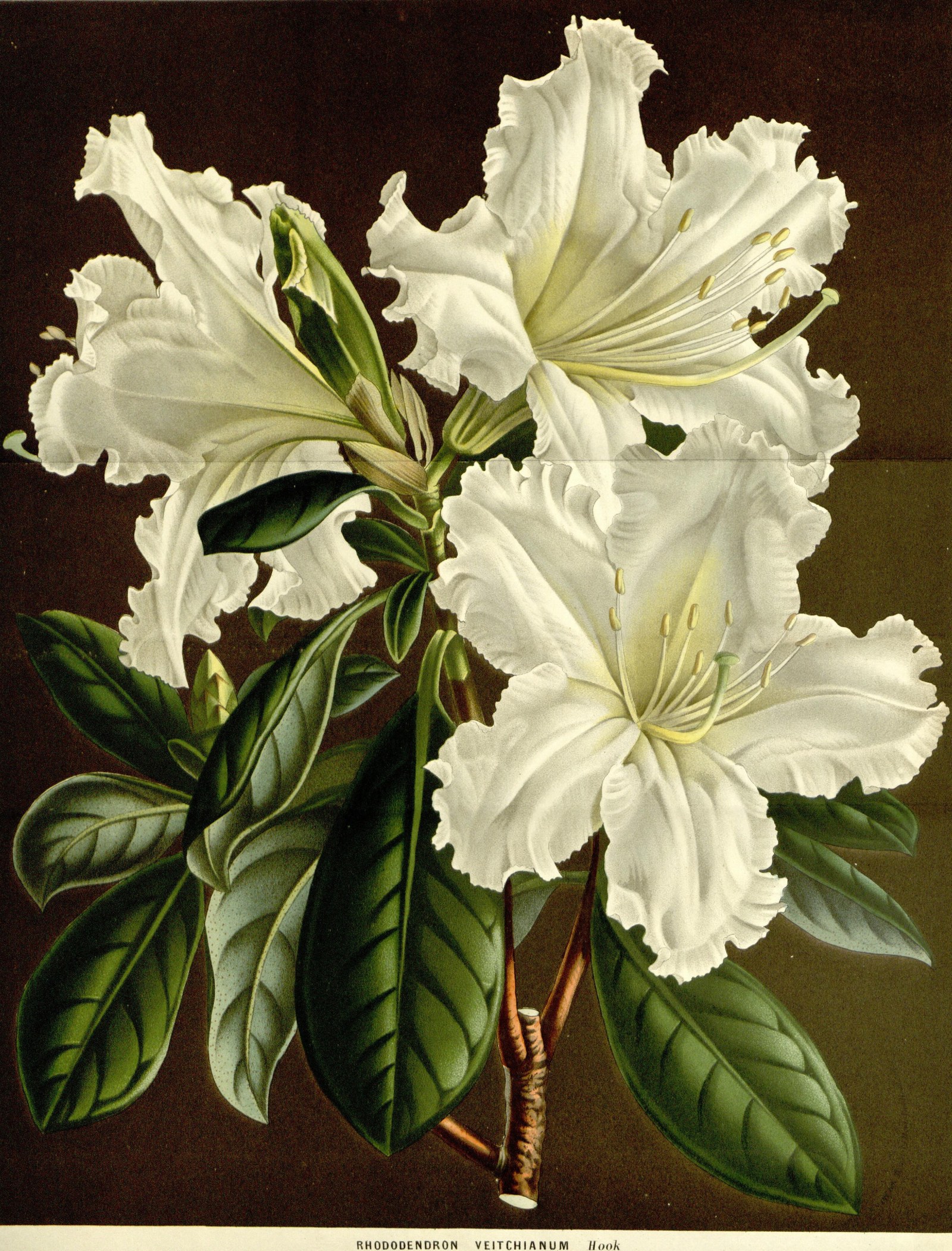
A white, frilled, scented rhododendron from the hills of Burma, grown as an epiphyte in the trees there and in the cool greenhouse here, figured for the Flore des serres in 1863.
- Published
- volume 15, 1863
- From
- Flore des serres et des jardins de l'Europe
- Drawn by
- Louis van Houtte's artists
- Technique
- Hand-coloured lithograph
- Family
- Ericaceae
- Native to
- The hills of Burma, Thailand and Laos
About the plant
Most rhododendrons are shrubs of the ground, but a few in the monsoon hills of Burma and Assam live in the trees, perched on mossy branches with the orchids, and this is the finest of them. Thomas Lobb, who collected for the Veitch nursery in Burma and Java for twenty years, found it in the hills above Moulmein in the 1850s, and when it flowered at Exeter it was named for the firm: flowers larger than any rhododendron then known, white with a frilled crimped edge and a flare of greenish yellow in the throat, and a scent that filled the house.
It needs a cool greenhouse in Britain and a loose, mossy root run, and it has never been common, but Veitch's hybridists used it in the 1880s to breed the scented white greenhouse rhododendrons of the Edwardian conservatory, and it is grown today by the few who can give it what it wants. The Flore des serres figured it in 1863 against a dark ground, a convention the Ghent lithographers kept for white flowers, with Moulmein given as its home and a cool house as its requirement.
Bought together
More in the archive